Inspiration
Every ML engineer knows the loop: look at the data, build a feature, train, evaluate, realize you were wrong, do it again. It is the biggest time sink in recommender work and almost none of it is creative. We wanted to find out how much of that loop an agent could actually own — not "suggest code to a human", but propose the hypothesis, write the code, run it, read its own score, and decide what to try next.
The honest test of that is a benchmark where you cannot fool yourself: a fixed official metric, a strict temporal split, and a hidden test set you are only allowed to touch once.
What it does
RecAgent runs the full MLE loop unattended on KuaiRand-Pure under the organizers' starter-kit protocol — label long_view, within-user ranking, primary score = mean(GAUC, nDCG@5), date split train 04/08–04/21, validation 04/22–04/28, hidden test 04/29–05/08.
It reproduces the official baselines, then iterates: hypothesis → feature or model change → train → score with the untouched official evaluate.py → reflect → next hypothesis. Independent experiments are fanned out in parallel. Every iteration is logged with its hypothesis, the reasoning behind it, the change applied, and the resulting validation score.
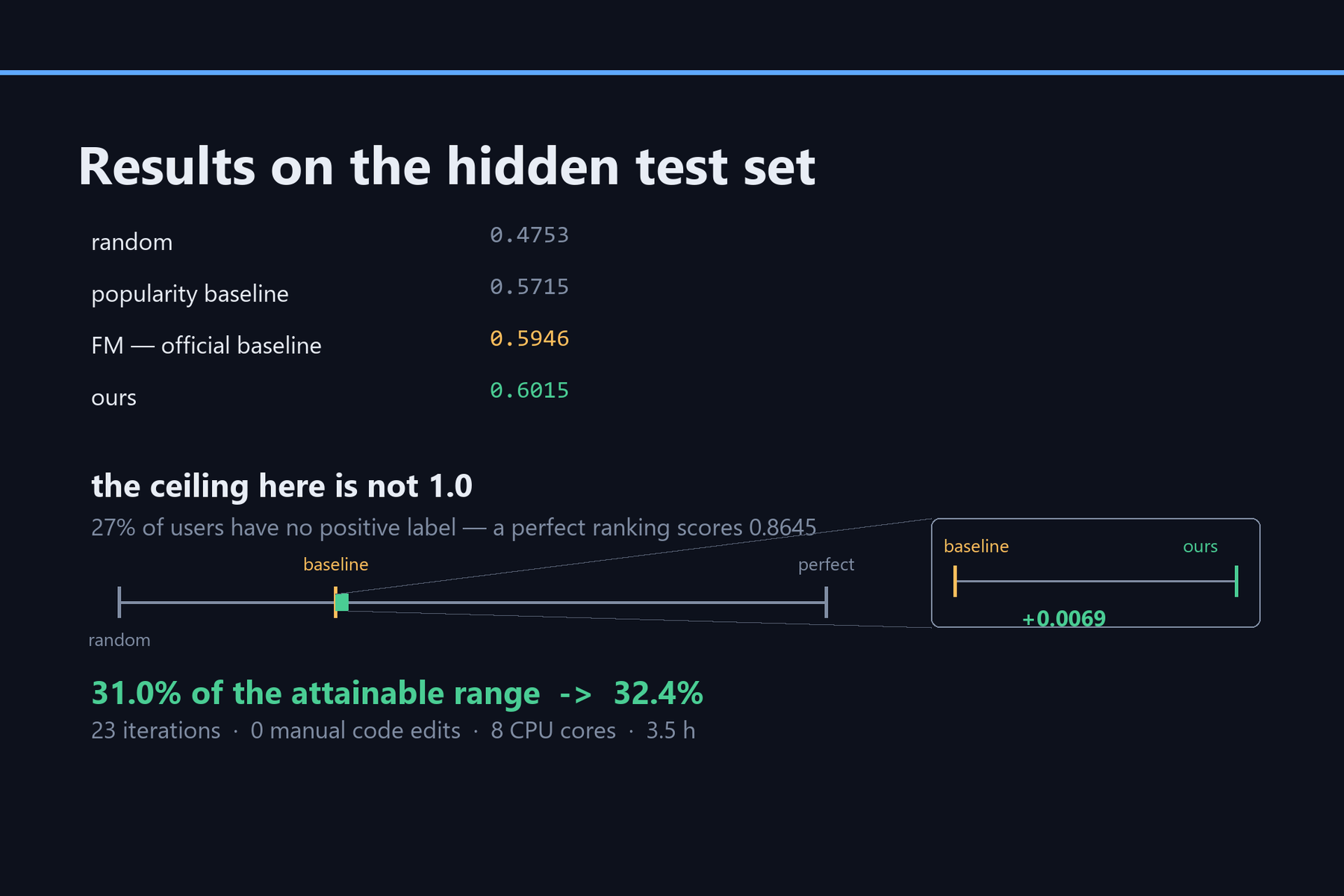
Result on the hidden test set: 0.6015 (GAUC 0.6697, nDCG@5 0.5333) against the official FM baseline of 0.5946 — an improvement of +0.0069.
That number deserves its scale. On this benchmark a perfect ranking scores only 0.8645, because 27% of users have no positive label at all and 9% are all positive; random scoring sits at 0.4753. The official baseline therefore already captures 31.0% of the attainable range, and this submission reaches 32.4%. The ceiling is not 1.0, and progress should be read against 0.8645.
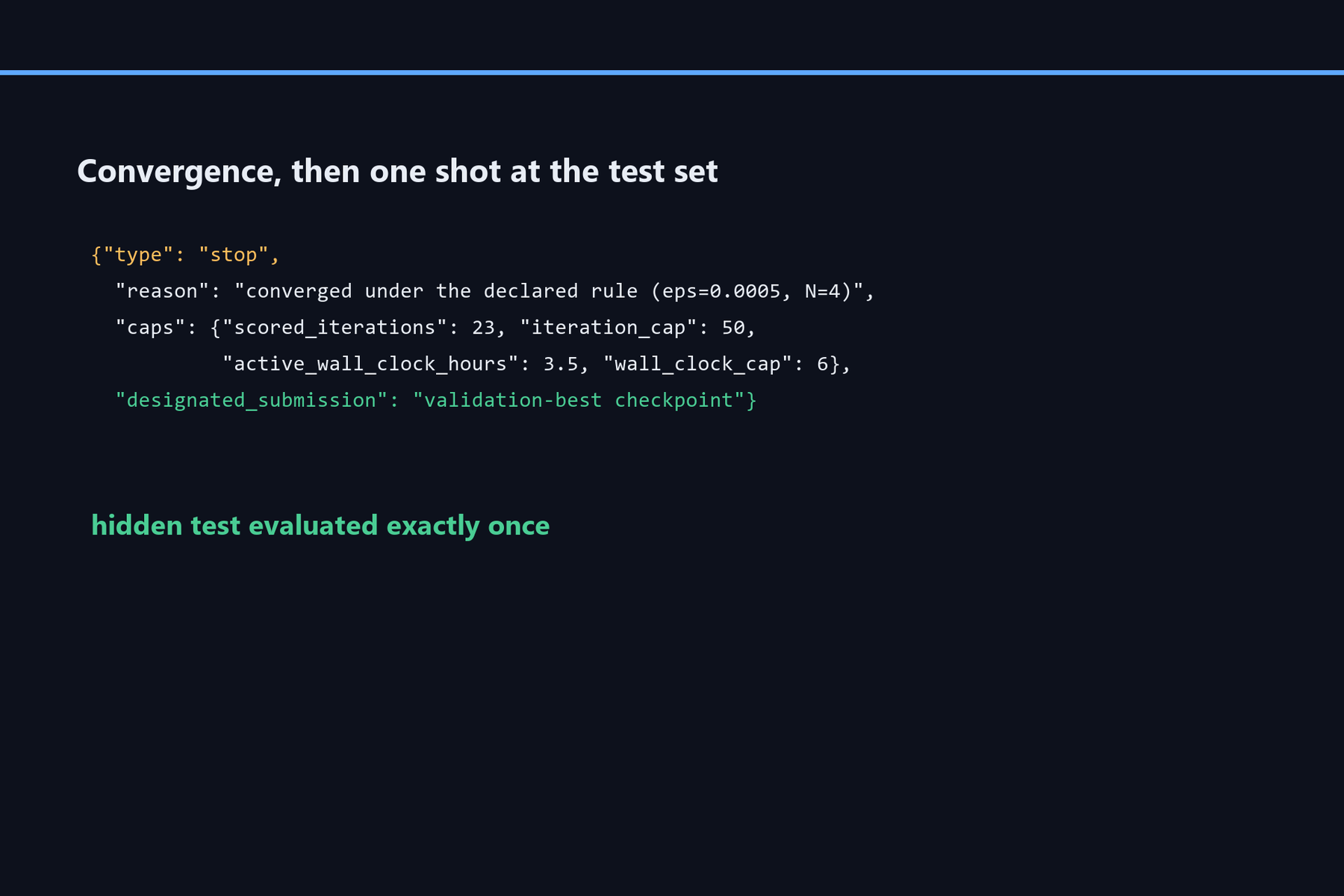
The run finished in 23 scored iterations of the 50 allowed and about 3.5 hours of active wall-clock of the 6 permitted, on 8 CPU cores with no GPU, with zero manual code or hyperparameter edits by a human.
How we built it
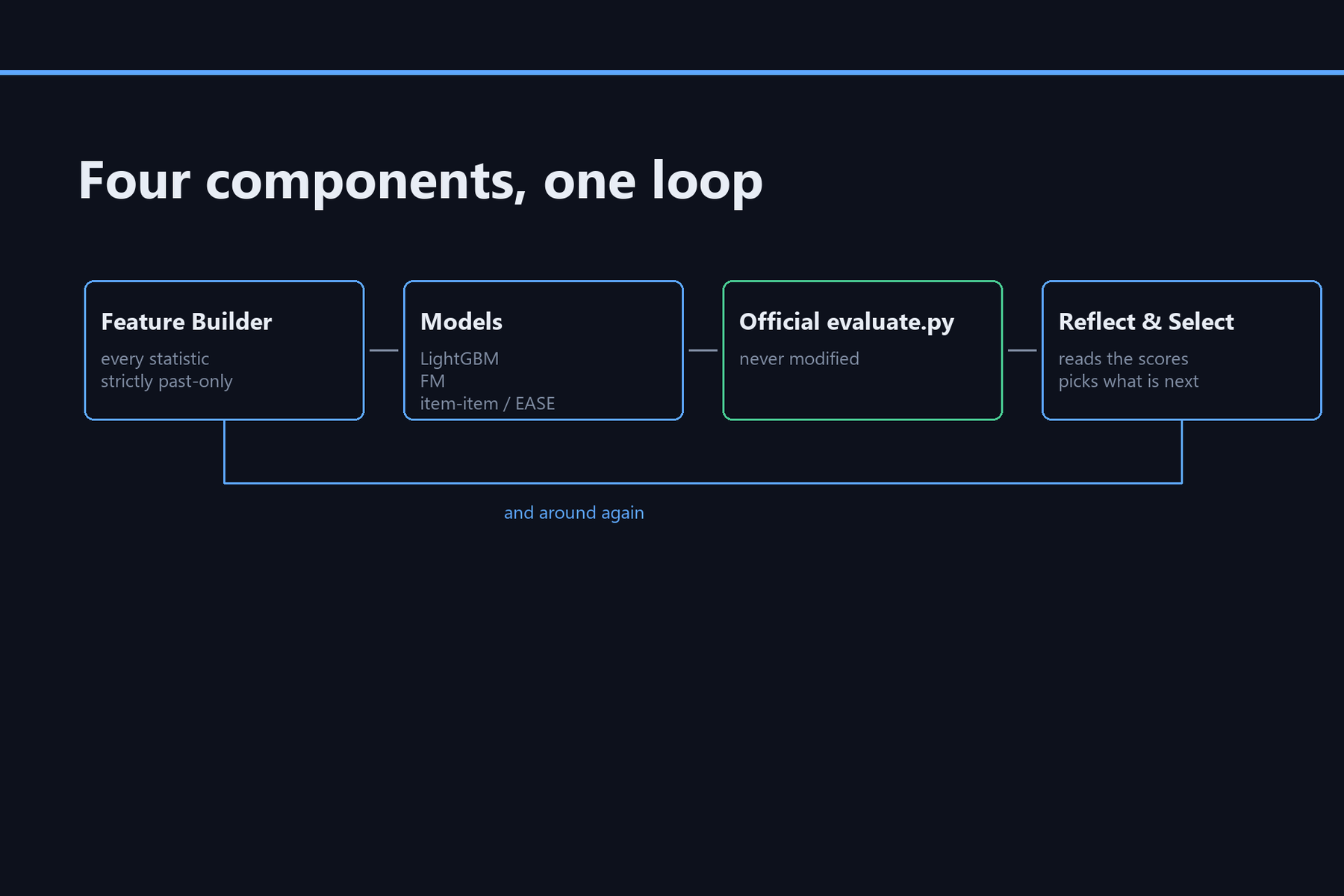
Four components, driven by the agent in a loop:
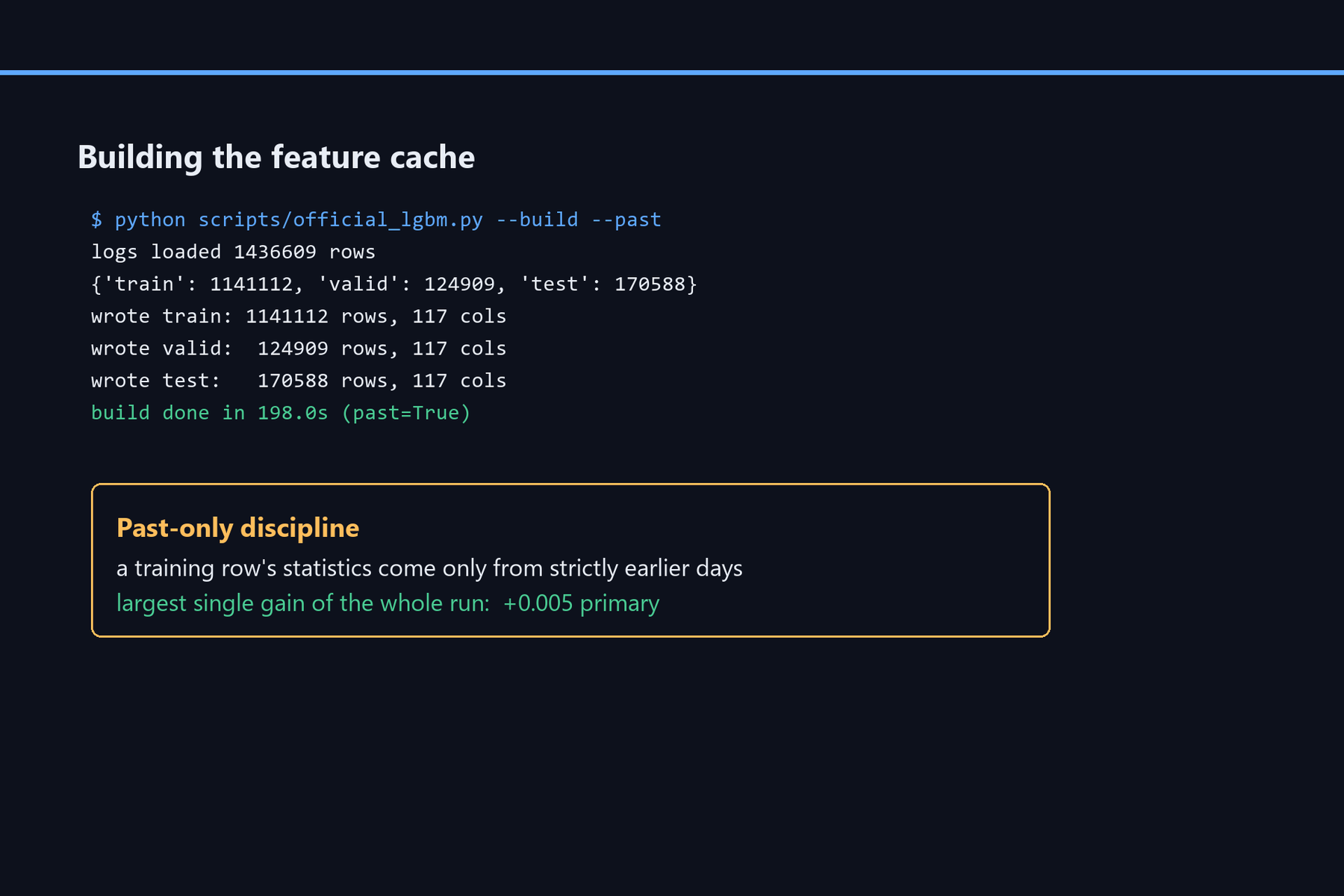
- Feature builder — every aggregate for a training row is computed from strictly earlier days via per-key×date prefix sums.
- Model layer — LightGBM as the ranker, a PyTorch factorization machine whose out-of-fold scores become a feature, and item-item models (cosine CF and a closed-form EASE ridge).
- The official evaluator, vendored and never modified.
- Reflection — reads the scores, picks the next hypothesis, and fans out sweeps in parallel when experiments are independent.
The final submission is a rank-average blend: a five-seed LightGBM backbone at 0.80 and lambdarank members at 0.20, designated as the validation-best checkpoint and scored on the hidden test exactly once.
What actually moved the number, in order:
- Past-only training features (+0.005, the single biggest gain). Originally the training rows used leave-one-out statistics computed over their own week, while validation rows saw only strictly past data. That mismatch capped boosting at roughly 30 rounds and pinned the score near 0.597. Recomputing training statistics as strictly-earlier-day prefix sums aligned the two conditions, and the model trained healthily for 300–700 rounds.
- Personalization that varies inside a list. We measured that user-constant features have essentially zero within-user ranking power —
u_lv_ratealone scores 0.484, worse than a coin flip on this metric. Only signals that vary across a user's own candidates can move it: the FM out-of-fold score, user×duration-bucket, user×tab, user×tag affinity, and item-item scores. - EASE as features (+0.0013). A closed-form ridge on the long_view Gram matrix with a zeroed diagonal, scored two-phase so training rows never see a matrix built from their own week.
Challenges we ran into
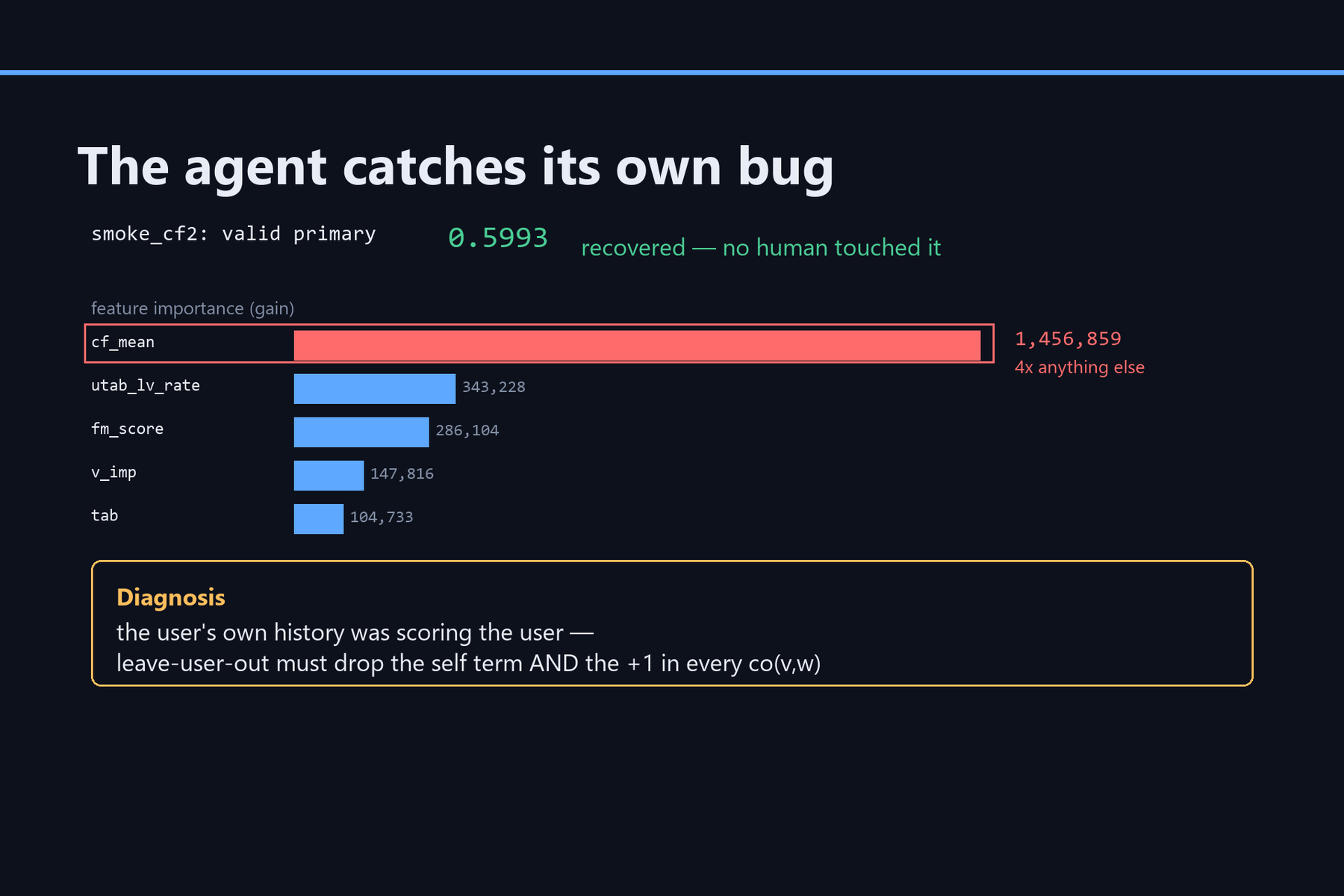
The agent caught its own data leak. After adding collaborative-filtering features the validation score collapsed from 0.5993 to 0.5738. Inspecting feature importances showed cf_mean carrying 1,456,859 gain against 343,228 for the next feature — four times anything else, which is the signature of a leak, not a discovery. The diagnosis: the user's own history was scoring the user. Subtracting self-similarity is not enough; the user's own +1 contribution to every co-occurrence \( \text{co}(v, w) \) for \( w \) in their history has to go too. The correction was derived, applied, and the score recovered — logged as an error→recovery pair.
A silent confound, caught by a reproduction check. Parameterizing the two-phase EASE boundary accidentally moved it from the date-range midpoint (04/15) to the row-count median (04/12), because days hold uneven row counts. The experiment running at the time was invalidated. We caught it by re-running a known configuration: it reproduced the reference score bit-for-bit (0.608008, iteration 714) only after the boundary was restored. Every sweep now carries a reproduction check.
Knowing when to stop, and proving it. After convergence we tested eight more hypotheses — a target-attention sequence model both standalone and as a feature, metric-aware sample weighting, per-user rank blending, multi-λ EASE, feature selection, and CatBoost for library diversity. All eight were negative or neutral, and all eight are in the run log with their numbers. The plateau is measured, not assumed.
We measured a tempting rules-gray idea instead of taking it. Test rows sit 7–17 days after the training window, so their statistics are stale, and extending the statistics pool into the validation week was appealing. Rather than guess, the agent built the measurement and ran it on train+validation only, holding window length constant at seven days: statistics ending immediately before validation scored 0.6066, statistics ending seven days earlier scored 0.6069. Freshness is worth −0.0003 — nothing. What matters is window length (7 days 0.6066 → 14 days 0.6080). The technique was worth at most +0.0005, so it was declined rather than risk the rule that training data is the train split only. The same experiment produced a reassuring side finding: the train→test temporal gap is not a generalization threat.
We also audited log_random_4_22_to_5_08_pure.csv and found it exactly co-extensive with the validation and test windows, with zero randomized rows inside the training window. Any per-item quantity derived from it would be a feature statistic computed over evaluation-window labels. It is used nowhere.
Accomplishments that we're proud of
The leak detection, more than the score. A model that goes up is unremarkable; an agent that watches its own score collapse, reads the feature importances, names the mechanism, derives the correction and recovers — with no human in the loop — is the part that felt like the actual goal of this track.
Second: the negative results are first-class citizens of the log. Eight failed hypotheses with their numbers and reasoning are more useful to the next person than a leaderboard row.
Third: the discipline held. Every decision was made on validation. The hidden test was scored once, for the checkpoint that validation had already chosen.
What we learned
- Train/inference condition mismatch is worth more than model capacity. The largest gain of the entire run came from fixing when a statistic was computed, not from any model change.
- A metric's structure dictates which features can possibly help. For a within-user ranking metric, a feature constant across a user's list carries exactly zero information, no matter how predictive it looks globally.
- An anomalously dominant feature is a leak until proven otherwise. Four-times gain over the runner-up was the tell.
- Measure the tempting shortcut before deciding on it. The freshness question could have been answered with a plausible story in either direction. One controlled experiment settled it in fifteen minutes and turned a compliance gamble into an informed pass.
What's next
Sequence modeling is the honest gap: our target-attention model was trainable on CPU but not competitive, and a GPU budget would let us pool last-N behavior embeddings properly instead of feeding aggregate summaries to a GBDT. The bonus benchmarks (KuaiRand-1k and 27k) are untouched on this hardware. And the convergence rule was formalized mid-run — a production agent would fix it before the first iteration.
The loop itself is not dataset-specific. The past-only discipline, the leak detection heuristic, and the honest logging transfer to any ranking problem.


Log in or sign up for Devpost to join the conversation.