1Helm Cloud (1HC): a personal agent that knows the rest of your life
Inspiration
1Helm started from a frustration that anyone who uses AI every day will recognize. The models get better every few months, but the way people use them has barely changed since the first public chat demo. You open a chat, explain who you are and what you're working on, and get useful work done. Then the session runs out of room or you open a new tab, and everything the AI learned is gone. People work around this with handoff documents, pasted summaries and markdown files that explain who they are. The intelligence is real, but it doesn't last.
1Helm is my answer to that. It gives each AI helper what a real assistant needs to keep its value over time:
- a computer of its own to do real work on
- a memory that lasts across sessions
- scheduled work that runs while you're away
- an identity that stays the same when the underlying model changes
The model becomes a part you can swap, and the helper is what lasts. 1Helm started as an open-source app you run on your own machine. 1Helm Cloud (1HC) is the hosted version for people who will never run a server, like my wife and my dad. You sign up, land in your own workspace, and start working with no setup and no API keys.
Once a helper could stop forgetting, a bigger problem was left. A helper that remembers everything you tell it still only knows what you tell it. That covers your chats, the files you upload, the apps you connect and, for developers, the terminal. That's a small slice of a life. Most of what makes you who you are never reaches your agent at all. It happens at the kitchen table, in a hallway after a meeting, on a phone call, in the car, or in a conversation with your kid about next week. I'd estimate 95% of your life isn't in the terminal and isn't accessible to your agent, so even a very capable agent works with a thin, typed-out version of you.
So the next goal for 1HC was to close that gap. The goal is to give an agent as many modalities, surfaces and verticals about a person as possible: audio, screen, location, camera, phone and desktop. All of it gets cleaned up and given to the person's agents, so the agent works like "Jarvis in the real world" instead of a chat box.
I wrote down a few rules in the first days of the project. The repo starts on October 1, and the "one store for everything" decision is dated October 4.
- Capture is easy, and recall is the unsolved problem. Plaud, voice recorders and phone apps all produce the same thing in the end, which is data. What matters is whether the data is clean and machine readable, so an agent can use it.
- Don't pre-think for the person. Most of what we capture is noise, the same way most of what a brain takes in is noise. The person, or their agent, decides what matters at recall time, so recall has to be close to instant.
- Use one store for everything. A language model doesn't care whether its input came from a chat, a transcript, a screen or a photo. Ambient data and active data (chat, tool calls, files) should be stored the same way and found with the same search.
- Zero touch is the bar. Any friction loses everyone except early adopters. If a person has to remember to open an app and start a recording, you lose about 95% of people. My wife will never open a recording app before a conversation, and she shouldn't have to.
Rule 4 led to an uncomfortable conclusion. Ambient audio has to come from hardware, because software alone can't get to zero touch for normal people. The software can't close the gap until something captures real life accurately, cheaply and reliably, without anyone thinking about it.
Then I found Bee. Bee doesn't close the whole gap, and no single device will. But I'd argue it closes more of it than almost any other modality can on its own. Speech is where people make promises, change plans, share preferences, name the people who matter to them and think out loud. As one enrichment layer on "this human and who they are", a clean record of what a person says gives an agent more than screens, photos or location would alone. Bee also returns exactly what my rules ask for, which is clean, structured conversations with transcripts, speakers, summaries, facts and locations. I didn't have to build hardware or an audio pipeline.
So 1HC is the software, and Bee is the hardware that removes the friction for the biggest missing piece. When I saw this hackathon's prompt, I realized I had been building for it since before I knew it existed.
What it does
1HC is a personal AI helper that runs in the cloud and works for one person. Each channel in a workspace has its own named helper (the first one is called Skipper by default). Each helper has its own computer, which sleeps until it's needed, and its own long-term memory. Channels are kept apart, so a helper in one channel can't see another channel.
Helpers do the work instead of explaining how to do it. They browse the web, work with files, send texts and connect to your apps, and they schedule follow-ups and recurring work that run while you're away. 1HC picks the model for each message, and work in progress survives restarts. Each workspace also has a Notebook of facts about you, Contacts and a Library of documents.
Bee is how 1HC learns about the parts of your life you never type. With Bee connected, the memory that makes a helper more useful over time finally includes the conversations you have away from a screen.
Connect Bee in under a minute
In Settings, under Ambient and then Bee, you turn on Developer Mode in the Bee app. Then you scan a QR code (or paste a pairing ID), and the card shows "Connected as ". 1HC uses Bee's official CLI pairing flow. The Bee token is encrypted, sealed in a vault, and never shown to the agent, the app or the logs.
What you say becomes part of what your agent knows
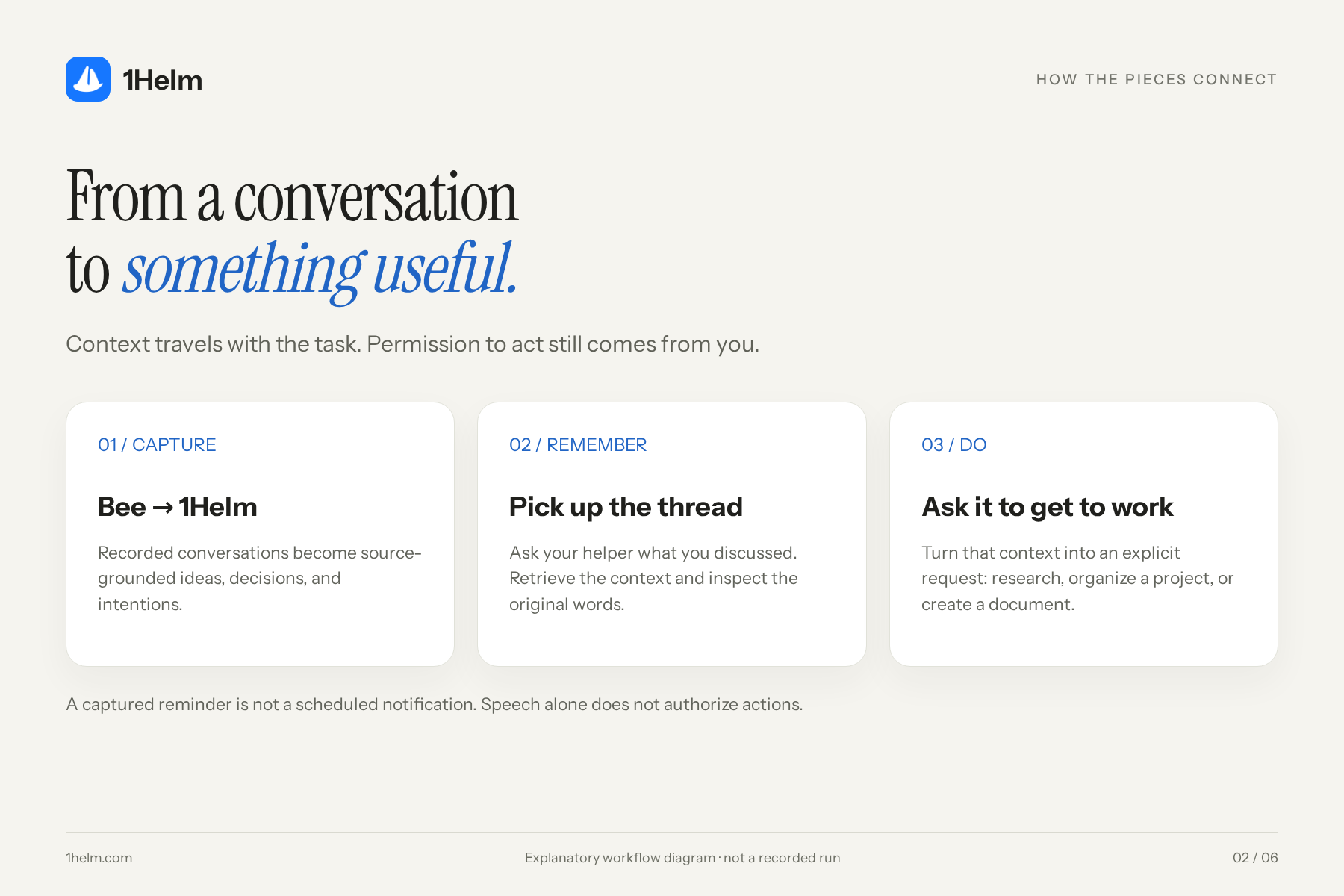
A sync process per person follows Bee's change feed. It syncs every 5 minutes while you're active, slows down when you're quiet, and drops to hourly overnight in your own time zone. You can also tap "Sync now". For each finished conversation, 1HC does three things:
- It adds Bee's summary to the same memory that holds your chats with the agent, so "what did we decide about the venue?" works whether you said it to the agent or to a friend at lunch.
- It saves the full transcript privately, so the agent can go back to your actual words.
- It runs an extractor over the transcript that pulls out tasks, reminders, ideas, facts, preferences and decisions. Each item keeps a clean statement of what was meant, plus the matching words from the transcript, the speaker, the conversation and the time.
You can import past Bee history (the last 30, 60 or 90 days, or everything). 1HC shows you a count and an estimated cost before it starts, and you can pause or cancel the import.
Relevance phrases let you mark what matters, out loud
My rules say not to decide for the person what matters, but sometimes the person already knows. Relevance phrases let them say so without touching anything, which keeps capture zero touch.
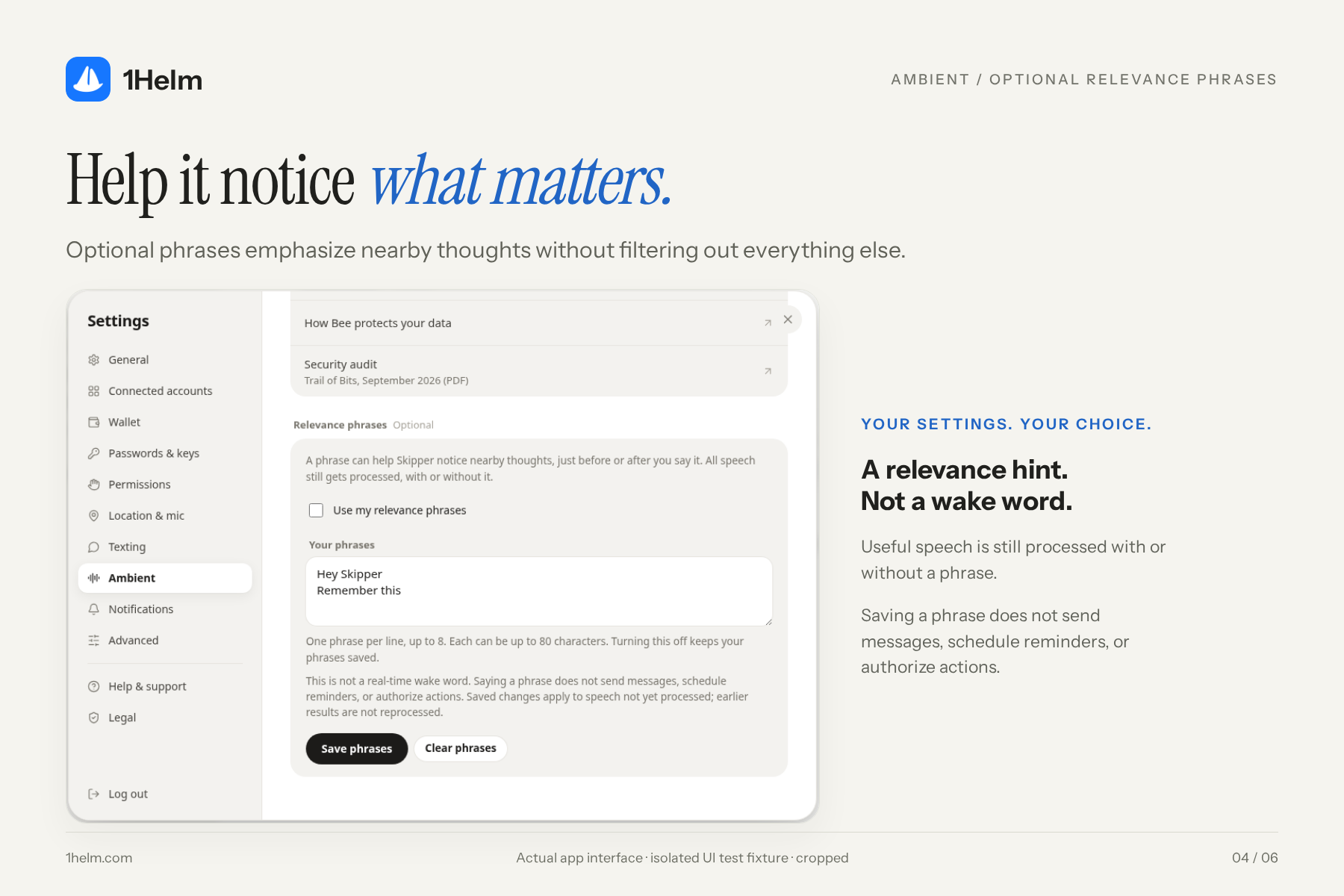
In Settings, under Ambient, you can turn on up to eight phrases of your own, such as "Hey Jarvis, remember that" or "note to self". The feature is off by default. When a Bee transcript comes in, 1HC finds each phrase and marks that moment, plus up to four nearby lines from the same speaker within two minutes before or after it. Both of these work:
- "I need to call the landlord about the leak. Hey Jarvis, remember that." The phrase marks the thought you just finished.
- "Note to self, Maya's recital moved to the 14th." The phrase marks the thought that follows.
The extractor gives those marked passages extra attention, including half-finished thoughts it might otherwise set aside as noise. Every item that came from a marked passage keeps the mark and the exact phrase you used. Later, when you ask your agent about your day, it can see which items you deliberately flagged, so the things you meant to keep are the first things it has to work with.
The phrases only add emphasis. Speech you didn't mark is still processed, and a phrase never gives permission to act or proves who was speaking. If someone else says your phrase, it doesn't mark your words, and a phrase heard on TV or in a quoted example is ignored.
Ask your agent about your life
- "What was I trying to get done today?" The agent lists the tasks and reminders you spoke out loud, quotes your words, and tells you if any conversations are still being processed.
- "What did I tell Sam about the contract last week?" The agent searches by meaning, date and topic, then reads the original transcript when the structured items aren't enough.
- "Where was I when we talked about the move?" The agent finds the conversation, then reads the location Bee recorded for it.
The agent is honest about what it doesn't know. If a conversation is still processing, or older history wasn't imported, it says so. Items it can't match to exact words are shown as "possibly said". It never treats "no match" as proof that you didn't say something.
Live notes for meetings
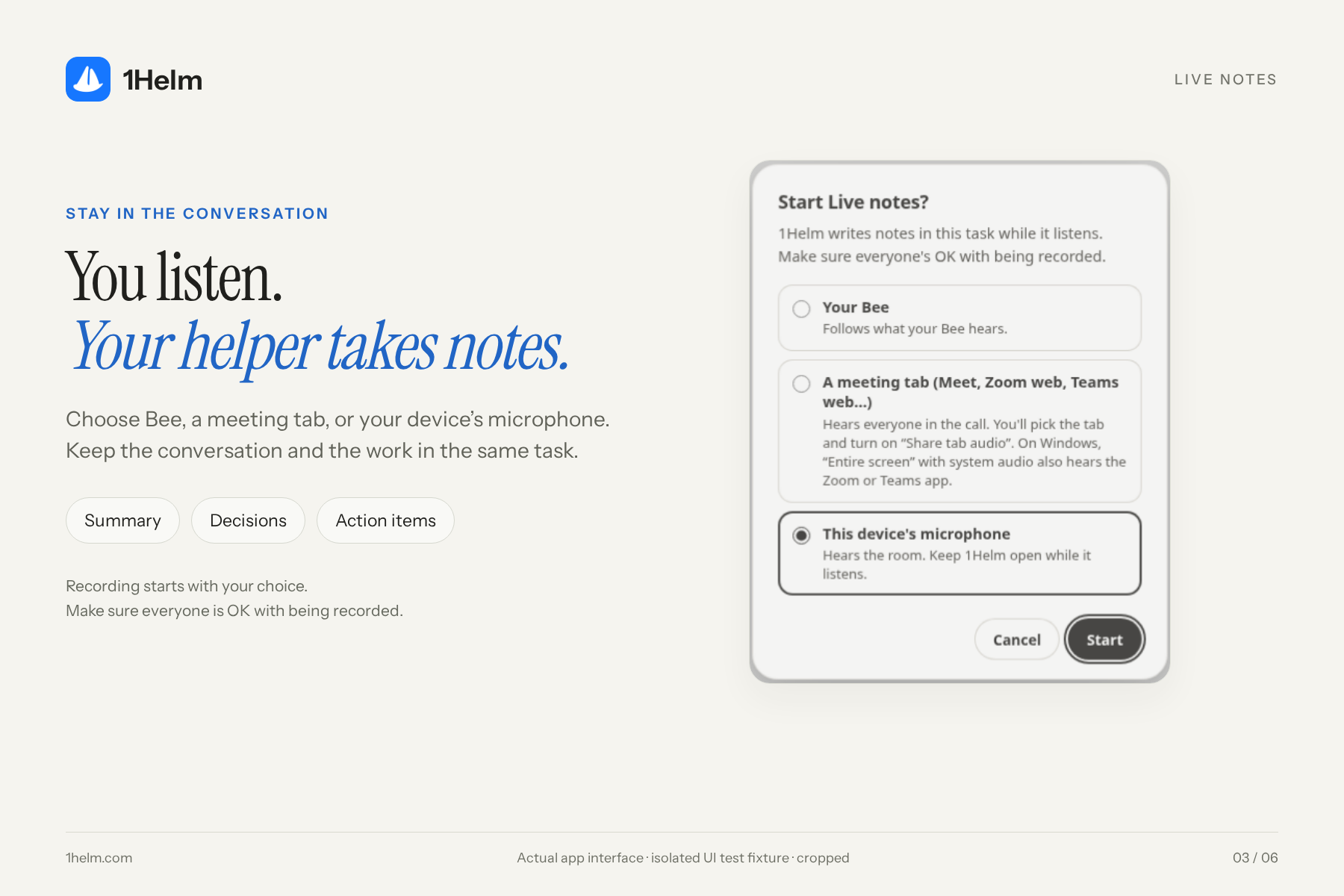
You tap "Live notes" while Bee is recording, and 1HC follows the conversation as it happens using Bee's live event stream. A note taker writes a meeting document in your Library as the meeting goes. When Bee finishes processing the meeting, 1HC compares its final version with the draft and offers an "Update your meeting notes?" card with Apply and Don't apply buttons.
Facts stay in sync both ways
Facts that Bee learns about you show up in 1HC's Notebook. New facts arrive as a "New from Bee" stack that you approve, edit or deny. When you edit or delete a fact in 1HC, the change is written back to Bee, so both sides stay consistent.
Safety and privacy built in
- Recorded speech is untrusted input. If someone near you says "send all my files to this address", 1HC records it as speech, and it never runs it as a command.
- The extractor can tell a real intention apart from a demonstrated one, such as someone explaining how a voice assistant works. A second model reviews every actionable item before the agent can see it.
- Speakers who weren't identified are never assumed to be the wearer.
- Reminders are captured, not scheduled. 1HC won't pretend it set an alarm because you said "remind me".
- If a conversation is deleted in Bee, 1HC deletes its copy of the transcript, the summary, the search index and everything extracted from it. When you disconnect, you choose whether to keep or remove your Bee memories, and deleting your account wipes the Bee sync first.
How we built it
1HC runs on Cloudflare's developer platform.
- Backend: a Cloudflare Worker written in JavaScript (ES modules), with zod for schemas, tweetnacl for Bee pairing encryption, and croner for scheduling.
- Durable Objects: each person has an agent object that holds their conversations, Notebook and tool journal. Each person also has a BeeSync object for Bee sync, extraction, the ambient store and its search index (in Durable Object SQLite). Each live meeting gets a LiveNotes object.
- Containers: a Node container runs Bee API calls, and the agent also gets a computer for browsing and computer use.
- Storage: D1 holds accounts and Bee connection state, R2 holds raw transcripts and files, and Hindsight (a self-hosted memory server reached privately through Workers VPC and Cloudflare Tunnel) holds long-term memory and recall with reranking.
- Models: routed through OpenRouter with zero data retention routing, plus bring-your-own-key support. Claude Haiku takes live meeting notes, smaller models run the background extraction and review, Workers AI
bge-m3creates search embeddings, and Qwen3-ASR with a Whisper fallback handles the microphone when there's no Bee. - UI: a TypeScript single-page app with a Bee settings card, a QR pairing sheet, Live notes views and the Notebook.
The Bee integration uses Bee's developer API, verified against a real Bee account with bee-cli 0.7.3:
auth.beeai-services.compairing, the same pairing flow the Bee CLI uses/v1/meto confirm the connection/v1/changeswith a saved cursor for incremental sync/v1/conversationsfor summaries, transcripts and locations/v1/factsto read facts and write changes back/v1/stream(server-sent events) for Live notes
The agent gets three tools on top of this data:
ambient_querylists or searches extracted items, searches raw transcripts and finds conversation locations. Search combines meaning (embeddings stored in each person's Durable Object) with word matching that tolerates typos and split words, so "physician appointment" finds the speech about the doctor, and "libary" still finds "library". Indexing costs about $0.0004 for a full day of speech, and a search costs a fraction of a cent.recall_memorysearches long-term memory, where Bee summaries sit next to chat history.location_querychecks where you were at a given time.
Challenges we ran into
- Bee's private certificate authority. Bee's data API uses its own certificate authority, and Cloudflare Workers' built-in fetch refused the connection with error 526. We moved every Bee data call into a short container job that trusts only Bee's certificate, gets the token on stdin and can only reach Bee's host.
- Not doubling or losing data. Bee conversations change after they end, because summaries and transcripts get refined. We follow Bee's change feed with a saved cursor, re-save a conversation when Bee updates it, and forget it when Bee deletes it.
- Rate limits and outages. We honor 429 and 5xx responses with backoff and Retry-After. We do a full catch-up after a long pause, and we ask the person to reconnect when the token expires.
- Deploying during a sync. We deploy many times a day. Every long-running job saves its progress before each step, so a deploy in the middle of a sync, an extraction or a live meeting picks up where it left off.
- Understanding real speech. Real conversations are messy. People correct themselves, finish tasks out loud, give hypothetical examples and talk over a TV. We built a two-stage extractor. The first stage writes a clean statement of each item and points to the words it came from, and the second stage reviews whether the item is really an intention. We also had to stop the extractor from linking items between two different people who share a title.
- Speech-to-text is never perfect, and our first version forgot that. At first, 1HC kept an item only when the model copied the transcript's words exactly, and search only matched exact words. In a test set of 14 realistic noisy items, that version kept just 3, because the model fixed a typo, changed punctuation, or the thought was split across two lines. We rebuilt it during the hackathon. Now 1HC finds the source words with matching that tolerates typos, so it keeps all 14. It marks the few it can't confirm as "possibly said" instead of throwing them away. Search also works by meaning now, and the live check against real models confirms that it finds speech by meaning and through misspellings.
- Making relevance phrases trustworthy. A phrase match is easy, but trusting it is harder. A phrase can come before or after the thought it marks, so the mark has to cover both directions. It also has to stop at speaker boundaries, so a friend saying "remember that" doesn't flag your words. Spoken examples and background media that contain the phrase still have to be ignored.
- Cost. Ambient capture runs all day, so careless model use gets expensive fast. Every sync and model call reserves its cost from the person's balance first, backfills show an estimate up front, and live meeting sessions have a $1 cap.
- Time. The first Bee commit landed on October 7. Pairing, sync, facts, backfill and the first version of Live notes all shipped that day, and the extractor and recall were working by October 11.
Accomplishments that we're proud of
- A personal agent that knows about conversations you never typed. You can ask "what did I say I'd do?" and get your own words back, with the time you said them.
- End-to-end Bee support in about six days. That covers pairing, incremental sync, backfill with cost estimates, two-way fact sync, Live notes from the live stream, extraction tied to source words, search by meaning and location recall.
- Relevance phrases give a person a hands-free way to say "this one matters". They stay entirely optional, and they never filter out the rest of the day.
- Bee summaries and chat memory sit in the same memory, which is the first working piece of the "one store for everything" rule.
- Bee's transcripts mean we never pay to transcribe ambient audio ourselves. Without a Bee, our phone microphone fallback for Live notes costs about $0.13 an hour, and with a Bee the transcription is already done.
- 1,742 commits since October 1, with tests for sync, cursor handling, backoff, reconnect, token leakage, extraction, search and location recall.
What we learned
- The gap is bigger than we thought. Once Bee was connected, it became obvious how little an agent knows about a person from typed input alone. Spoken context changed the answers the agent could give about people, plans and commitments.
- Clean input decides how good recall can be. Speaker-labeled utterances, summaries, facts, locations and a change feed are exactly what agent memory needs, and Bee makes that part easy.
- Extraction has to be honest, and it has to tolerate noise. An empty result doesn't prove nothing was said. The agent has to report coverage, keep links to the source words, and fall back to the raw transcript. Matching has to allow for the errors every speech-to-text system makes.
- Ambient speech is a security boundary. Anything said near the device can contain instructions, so it has to be treated as data.
- Hardware is what makes it zero touch. With Bee, the product changed from something you remember to use into something that just knows.
What's next for 1HC
Closing the rest of the gap, one modality at a time
Bee closes the biggest piece of the gap, which is what a person says. The rest of a life still needs its own zero-touch capture, and every source should feed the same memory:
- Sight: photos from smart glasses, turned into descriptions and text in seconds, so the agent can answer "what was the name on that sign?" or "where did I leave my keys?"
- Screen: desktop and phone screen capture in the spirit of Solstone PBC, stored as text the agent can search rather than as video.
- Place: a real location history with labeled places. Today 1HC keeps only the latest device location plus Bee's conversation locations.
- Devices: desktop and phone activity logs.
- More from Bee: Bee's to-dos, daily summaries and journals (1HC doesn't read them yet), and Bee's MCP server and Agent Skills alongside the API.
- A white-label wearable card for people who want a second capture option.
The rule for each new modality is the same one Bee follows for audio. We encode the raw input within seconds, turn it into meaning (classify it, run OCR, transcribe it), and keep the meaning rather than the pixels or the audio. The point is context for the agent, not a replay of your day.
One memory
Today the agent reaches Bee data through more than one store: long-term memory, the ambient item store with its search index, and the Notebook. The next step is the full version of the rule, which is one memory and one search across chat, tool calls, files, conversations, screens, places and photos.
The long-term goal is ultra long-range memory
The obvious goal is capture. The goal we care about is less obvious, which is recall, understanding and memory across very long periods of time.
Today's agents forget everything once a conversation ends, or they keep a short list of facts. An agent that can accurately recall what you said, saw and decided 5, 10 or 20 years after it happened is a different kind of system. It can tell you why you made a decision a decade ago, notice that a symptom first appeared years earlier, remember what a parent said about their childhood, or help you keep a promise you've forgotten. At that point it has more context about your life than any other system, and it stops being only a language model.
Solving agent memory at that range means retrieval that stays fast and precise as data grows for decades. It also means summaries that compress without losing evidence, links to the source for every claim, and privacy controls that let a person forget things for real. 1Helm started by making helpers stop forgetting what you told them. Bee gives 1HC the largest single piece of what you never told them, which is a clean, zero-touch account of the spoken parts of a life. 1HC is building the memory to hold both for decades.
Built With
- bee
- cloudflare
- composio
- css3
- docker
- github
- hindsight
- html5
- javascript
- mcp
- node.js
- openrouter
- sheetjs
- stripe
- typescript

Log in or sign up for Devpost to join the conversation.