Inspiration
In today's fast-paced world, people often find themselves spending a considerable amount of time going through documentation or conducting research to solve various problems. While research is a critical aspect of learning and growth, reading lengthy research papers, blogs and documentations can be strenuous and a time-consuming process that drains people's energy and productivity. To address this challenge, it is essential to create a means for people to save time and streamline their research efforts. This can be achieved by developing tools and platforms that provide quick access to relevant information, automate tedious tasks, and simplify complex concepts. By providing people with efficient means to access information, we can help them achieve their goals faster and improve their overall quality of life.
What it does
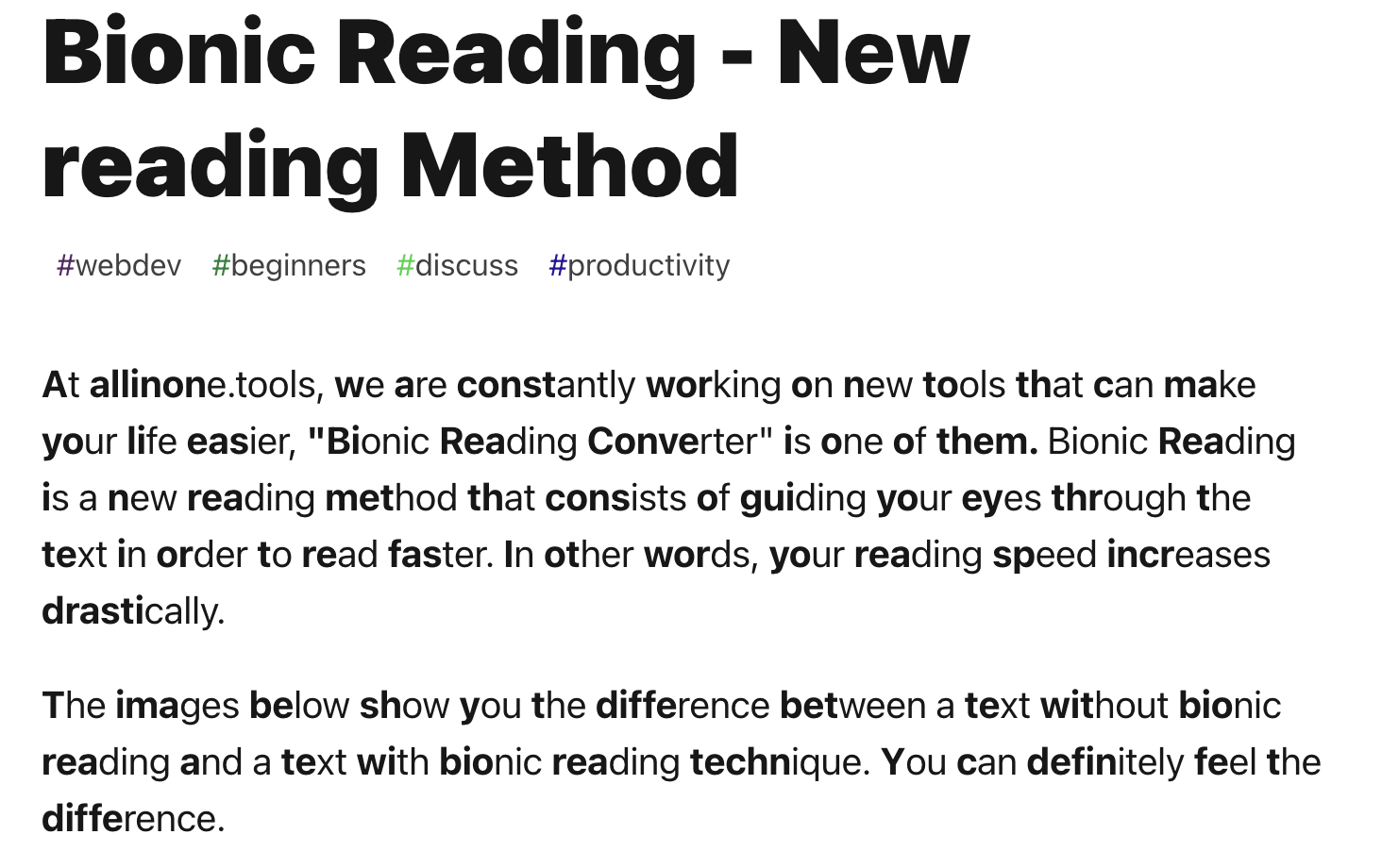
Bionic Reading is an innovative technique that enables individuals to read more efficiently and effectively by allowing their eyes to skip over words and text. It is like a surfboard gliding on the tip of the waves, enabling the reader to move smoothly through the text while still comprehending the material [1]. This approach can be especially helpful for those who struggle with reading speed or comprehension, allowing them to process information more quickly and effectively.
How we built it
To make this technique accessible to everyone, we have developed a chrome extension that can implement Bionic Reading on any website. With this extension, people can easily apply this technique to their online reading, enabling them to save time and improve their productivity.
Challenges we ran into
This was our first Chrome extension, and we quickly realized that it was not the same as developing a web app. We had to learn extra set of skills and approaches to make it work. We faced various challenges along the way, from understanding the Chrome Manifest to configuring the user interface and handling user input. It was not as straightforward as we had anticipated, and we had to spend several hours researching and experimenting to get things right. We also encountered unexpected bugs and errors, which added to the complexity of the development process. Additionally, as this was our first hackathon, we underestimated the difficulty of trying to get everything done within 24 hours.
Accomplishments that we're proud of
Despite all the challenges, we persisted and eventually succeeded in creating a working Chrome extension that met our main goal. Overall, it was a valuable learning experience that helped us grow as developers and problem-solvers.
What we learned
Developing our first Chrome extension and participating in our first hackathon taught us several valuable lessons. First, we learned that developing a Chrome extension requires a unique set of skills and approaches that are different from those used in web app development. We had to learn how to navigate the nuances of Chrome Extensions and understand the quirks of the extension ecosystem. Second, we learned that time management is critical, especially when working on a tight deadline. We had to prioritize our tasks and be efficient with our time to meet our goals. Third, we learned the importance of perseverance and problem-solving skills. When we encountered unexpected bugs or errors, we had to stay patient and resourceful to find solutions. Finally, we learned the value of collaboration and teamwork. By working together, we were able to leverage each other's strengths and overcome our weaknesses, resulting in a successful outcome. Overall, these experiences taught us valuable lessons that we can apply to future projects and challenges.
What's next for vita
Moving forward, there are several future tasks that we can explore to improve our Chrome extension. Firstly, we can add various settings to give users more control over their Bionic Reading experience. For example, we could allow users to adjust the font size, color, or background to suit their preferences. Additionally, we can include a feature that enables users to save their settings for future use, eliminating the need to adjust them every time they use the extension. Secondly, we can explore the possibility of adding a summarization feature that would allow users to get a concise summary of the text they are reading. This feature would be especially useful for busy professionals or students who need to process a large amount of information quickly. Finally, we can work on making the extension compatible with PDF files, allowing users to apply Bionic Reading to their research seamlessly. With these future tasks in mind, we can continue to improve our Chrome extension, making it a more valuable tool for those who want to improve their reading skills and productivity.


Log in or sign up for Devpost to join the conversation.