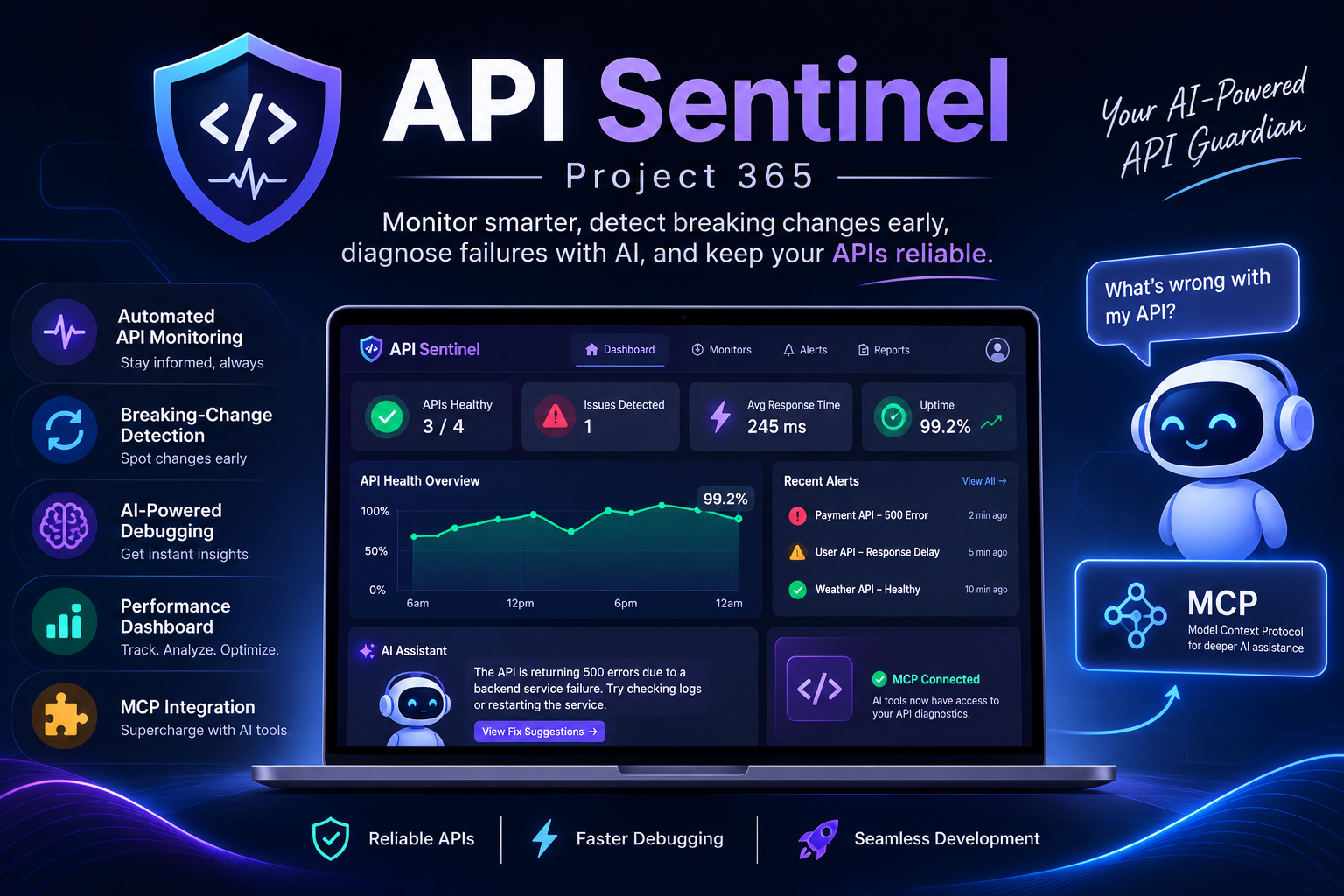
InspirationAPI Sentinel — Intelligent API Monitoring & Diagnostics
Inspiration
Modern applications depend heavily on APIs to communicate with different services. However, API failures, unexpected response changes, slow response times, and breaking updates can cause applications to malfunction and negatively affect users.
Developers often need to manually test endpoints, inspect logs, and troubleshoot errors, which can be time-consuming.
We were inspired to build API Sentinel, a lightweight and intelligent platform that helps developers monitor APIs, detect problems early, and understand failures more easily.
What is API Sentinel?
API Sentinel is an API monitoring and diagnostic platform that allows developers to monitor REST API endpoints, track their health, identify failures, and analyze response times through a centralized dashboard.
The platform also provides basic API response structure comparison to identify potential breaking changes. AI-powered diagnostics help explain API errors in simple language and suggest possible solutions.
Our goal is to make API monitoring and troubleshooting easier, faster, and more accessible for developers.
How We Built It
We are building API Sentinel using a modern web development stack.
- Frontend: React, Vite, TypeScript, and Tailwind CSS.
- Backend: Python and FastAPI.
- API Testing: HTTP requests to monitor endpoint availability and response status.
- Database: PostgreSQL to store endpoint details and monitoring results.
- Diagnostics: Rule-based error analysis with AI-generated explanations.
- Visualization: Dashboard charts for API status and response-time trends.
Users can add API endpoints, run health checks, view monitoring results, and investigate detected failures through the dashboard.
Key Features
- API endpoint monitoring and health checks.
- HTTP status code and response-time tracking.
- Detection of failed or unavailable APIs.
- Basic response structure comparison for potential breaking changes.
- Dashboard for monitoring API health and performance.
- AI-assisted error explanations and troubleshooting suggestions.
What We Learned
Through this project, we are learning how APIs work in real-world applications, how to build backend services using FastAPI, how to connect frontend and backend systems, and how to store and visualize monitoring data.
We are also exploring how AI can assist developers in understanding technical errors and improving debugging workflows.
Challenges
One of our main challenges is building a reliable monitoring system within a limited timeframe.
We are addressing this by focusing on a practical minimum viable product, using a small set of test APIs, implementing essential monitoring features first, and adding advanced functionality only after the core system works.
Another challenge is presenting technical API failures in a way that is easy to understand. Our dashboard and diagnostic explanations aim to make troubleshooting clearer and more efficient.
Future Scope
Future improvements may include continuous scheduled monitoring, advanced breaking-change detection, alert notifications, historical analytics, and Model Context Protocol (MCP) integration to allow AI assistants to interact with API monitoring tools.
API Sentinel aims to become a simple, intelligent companion for developers who want to keep their APIs reliable and easier to maintain.
What it does
How we built it
Challenges we ran into
Accomplishments that we're proud of
What we learned
What's next for 1. API Sentinel — Project 365
Built With
- ai
- api
- artificial
- css
- development
- fastapi
- generative
- http
- intelligence
- monitoring
- postgresql
- python
- react
- rest
- tailwind
- testing
- typescript
- vite
- web

Log in or sign up for Devpost to join the conversation.