-
-
Platform
-
Stakeholder analysis
-
The Problem


Inspiration
In the COVID-19 pandemic, hospitals around the world are suffering from a shortage of Ventilators, the breathing machines needed to keep the most critical patients alive [1]. There are only a small number of companies who produce these highly specialized machines in Germany and worldwide, and they are struggling to meet increased demand [2].
On the other side, there has been a flood of offers from 3rd parties to assist in production. Car manufacturers like Tesla, Volkswagen[3], component suppliers, even students with 3D printers [4] have all offered to assist in production or even build their own prototypes.
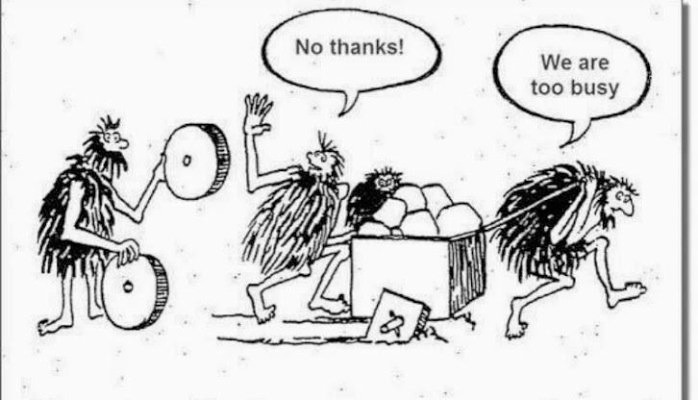
So the question is: how can others help ventilator companies make more machines, when ventilator companies are already working in task forces to meet the current demand and cannot look into every offer of help?
We have studied the ventilator shortage in more detail to see if unconventional 3rd-party suppliers like Automakers and Swarm-Intelligence solutions could be utilized to increase production.
Challenges we ran into
The challenge is indeed massive. Ventilators are technologically highly complex and invasive to the human body and require highly qualified assembly and operation personnel. Regulatory issues include safety testing, authorization of suppliers and producers and certifications. Supply chains are suffering from limited component availability globally.
We believe that we are missing the expertise to improve current initiative by car makers to produce ventilator components. Instead, we want to give people with the required expertise the chance to collaborate and realize these endeavors.
Swarm Intelligence
Factories with 3D printers are running idle, while highly skilled workers (e.g. software) stand ready to participate from home-office. We see this as a latent opportunity for Swarm Intelligence - contributions through community participation.
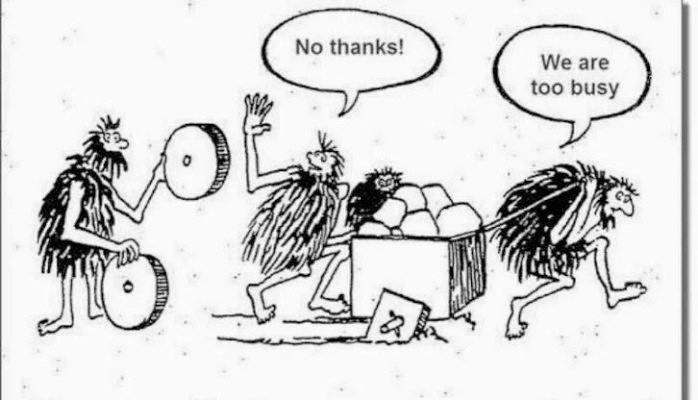
The question is, could all these parts come together, if at all? Could 3rd parties support ventilator manufacturers meaningfully without distracting them from their current important tasks?
Solution
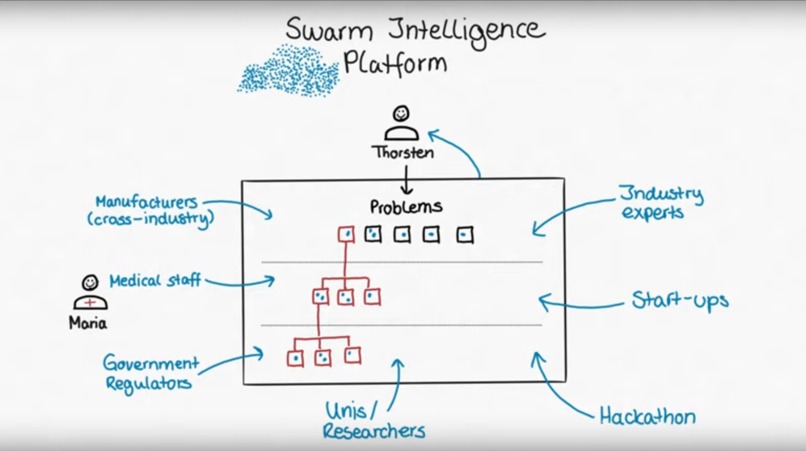
As a solution, we suggest the Swarm-Intelligence platform. It’s a platform, where ventilator experts can describe the current challenges they are facing. Without them getting involved too much after this, the challenge is splitted into sub-challenges and multidisciplinary teams of industry experts, production experts, regulatory experts and others will try to mitigate the challenge. If successful, their approach can serve as a solution or an inspiration to the ventilator maker that posted the challenge.
It is important to not only try to meet current regulatory requirements, but also to adopt them to enable unconventional production of ventilator components. Thus, government bodies have to be informed about respective requirements for lower regulation as well.
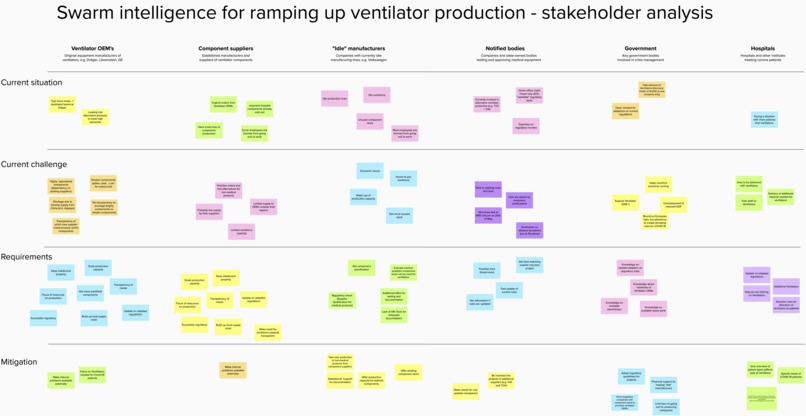
In our stakeholder analysis, we focused on six different stakeholder types contributing to the swarm intelligence platform. These are complimented by volunteers, e.g. university students or IT specialists, who could support specific challenges currently worked on on the platform.
The main stakeholders and their targeted benefits by offering the platform are the following: Ventilator companies, or ventilator OEM’s, can publish their internal issues externally, without losing focus on the current tasks forces and initiatives founded to meet the rising ventilator demand. Of course one has to take care that these companies do not lose their intellectual property, but adding current challenges might give them the capabilities to ramp up the highly-needed production.
Component suppliers for ventilators face similar issues as ventilator OEM’s. While they have the know-how and regulatory certification to produce components for ventilators, they also need to ramp up their production while keeping their know-how. The swarm intelligence platform can also allow them to get help with production, if they publish their demands.
Other manufacturing companies, e.g. automotive companies, are the main contributor when it comes to ramping up production capabilities of the first two stakeholders. Through the platform, they could take over production of required components. Further, it might be possible to offer their own existing stock to the ventilator and component manufacturers if it matches their requirements.
Notified bodies, like Germany’s TÜV, are experts when it comes to benchmark products on whether they meet the regulatory requirements, and this is one of the most important tasks for any medical equipment. Through the platform, they can participate in promising projects and advise on how regulatory requirements can be met. Further, they can consult the government on which regulatory requirements have to be lowered in the current crisis.
Government bodies have to be involved in this platform as well. They can assign companies to free their capacity or stock for ventilator production where needed. And, through direct connection to notified bodies, they get an overview of which regulatory requirements are currently limiting the ventilator production.
Hospitals and their staff should participate to update other stakeholders on what is needed. We have learned through our research, that COVID-19 often does not require a full-blown ventilator, but simpler versions can also be used for most cases. Thus, the transparent demand on which ventilators are needed and where they are needed will help ventilator OEM’s, suppliers, idle manufacturers and the government to prioritize projects and production.
Conclusion
In conclusion, we recommend transparent communication of production bottlenecks to such a platform in order to unleash Swarm Intelligence through community participation. This would serve to support current producers without getting in the way. Existing organizations, such as the BVMed [5] could be utilized to establish contact between producers and 3rd parties.
Our study offers a framework in which to understand the ventilator production problem. We believe there is real potential from 3rd party participants, but only if they receive the information they need to contribute. Our research is summarized in a Stakeholder Analysis and accompanying schematics.
One of the most important aspects we came across are the high regulatory requirements. If such a platform should succeed, we recommend to involve experts, who can consult on how to meet the requirements, and - even more important - consult the government on which requirements have to be lowered.
What's next for 06_Medizingeräteherstellung_Make ventilators not cars
We need industry input to validate this concept, and to study what form the platform should be taken into account for further development and start of implementation. We are actively seeking contact with relevant medical companies.
Sources
[1] https://www.nytimes.com/2020/03/18/business/coronavirus-ventilator-shortage.html
[2] https://www.noz.de/deutschland-welt/wirtschaft/artikel/2017949/loewenstein-medical-firma-aus-rheinland-pfalz-liefert-beatmungsgeraete
[3] https://www.spiegel.de/wirtschaft/unternehmen/corona-krise-vw-richtet-sich-auf-bau-von-medizintechnik-ein-a-061b3503-2310-45c9-b7c6-cbcd78f97fd9
[4] http://news.mit.edu/2010/itw-ventilator-0715
[5] https://www.bvmed.de/


Log in or sign up for Devpost to join the conversation.