-
-
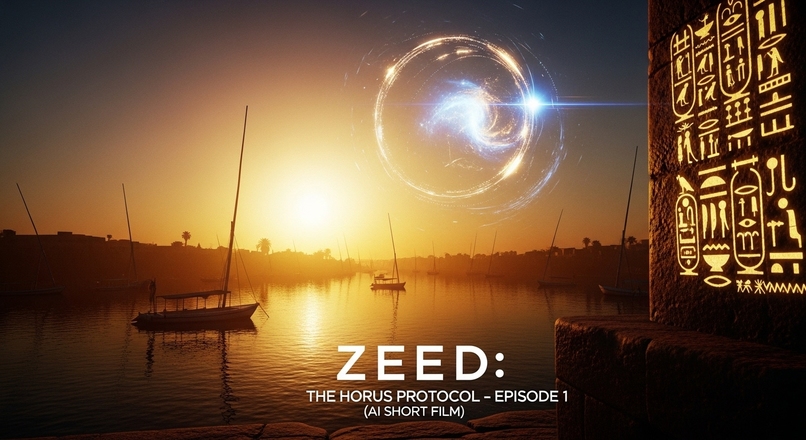
Official poster for “ZEED: The Horus Protocol — Episode 1”, an AI short film inspired by Aswan, ancient Egypt, and cinematic sci-fi.

Inspiration
“ZEED: The Horus Protocol – Episode 1” was inspired by a deep desire to merge Egypt’s ancient legacy with the power of next-generation AI cinema. Growing up in Egypt, I’ve always been fascinated by the unanswered mysteries behind the pyramids, lost inventions, and the mythological symbols found along the Nile. Aswan, with its stunning golden sunsets and timeless landscapes, became the perfect starting point for a story that blends history, sci-fi, time travel, and cinematic emotion. This project explores a simple question: What if a young inventor from Aswan accidentally activated an ancient device that rewired history itself?
What it does
The film introduces Zeed, a brilliant young inventor who discovers and activates a mysterious ancient mechanism hidden near the Nile. The activation triggers a time-rift, setting the stage for a larger story universe involving ancient technology, forgotten knowledge, and Egyptian cosmology—all told through AI-driven cinematography. This episode is designed as a micro-film that feels like the opening of a larger Netflix-style sci-fi series.
How we built it
Google Veo 3
ImageFX
Whisk
Runway Gen-3 Alpha
Suno AI
ElevenLabs
Final Cut Pro
Motion FX
AI Upscaling Tools
Challenges we ran into
Building an AI-driven micro-film that feels truly cinematic came with several challenges: Ensuring consistent character appearance across different AI models Achieving natural reflections and water motion in the Nile scenes Creating a believable time-rift effect without breaking realism Finding the balance between historical accuracy and sci-fi imagination Compressing a complex story idea into a 15–25 second cinematic sequence Each challenge pushed the visual quality higher and helped refine my AI filmmaking pipeline.
Accomplishments that we're proud of
Creating a fully cinematic AI short film that feels like the opening of a major sci-fi series. Achieving realistic Aswan landscapes, Nile reflections, and golden-hour lighting entirely through AI. Building a consistent visual identity for Zeed across multiple multimodal models. Successfully blending Egyptian history with futuristic concepts in a short micro-film format. Developing a fast and efficient AI filmmaking pipeline capable of producing high-quality shots in minutes. Crafting a compelling time-rift effect that remains grounded in realism.
What we learned
How to direct AI tools like a full film crew—camera, lighting, art direction, sound, and post. Techniques for achieving character consistency across different AI video and image generators. How to merge historical references with imaginative sci-fi concepts without losing authenticity. The importance of pacing and cinematic rhythm when making micro-films under 30 seconds. How multimodal AI can drastically speed up pre-production, world-building, and visual design. That AI is not replacing creativity—it’s expanding what a single creator can achieve.
What's next for ZEED: The Horus Protocol — Episode 1 (AI Short Film)
Episode 2: The Time-Gate of Philae — expanding Zeed’s journey deeper into ancient Egypt’s hidden technology. Introducing new characters tied to Egyptian mythology and scientific speculation. Developing longer AI-driven cinematic episodes (1–3 minutes). Creating an episodic AI series that combines history, sci-fi, and cinematic storytelling. Exploring interactive, branching storylines powered by generative AI. Building a complete “Horus Protocol” universe with consistent visual and narrative rules.
Built With
- 3
- ai
- alpha
- cut
- elevenlabs
- final
- fx
- gen-3
- imagefx
- motion
- pro
- runway
- suno
- upscaling
- veo
- whisk

Log in or sign up for Devpost to join the conversation.