-
-
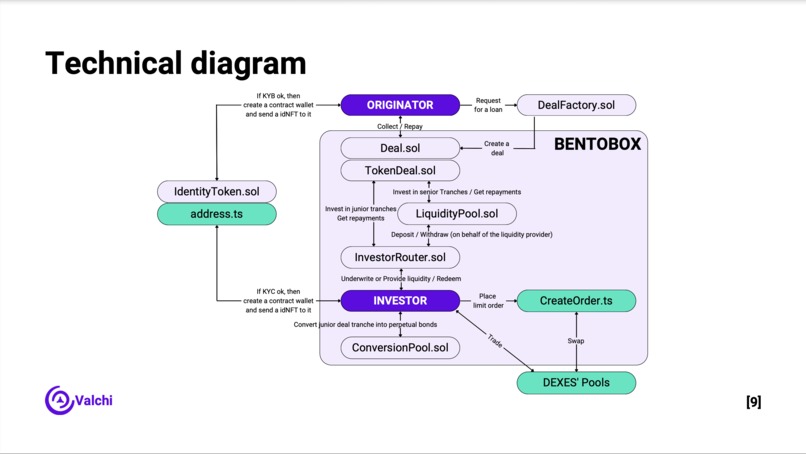
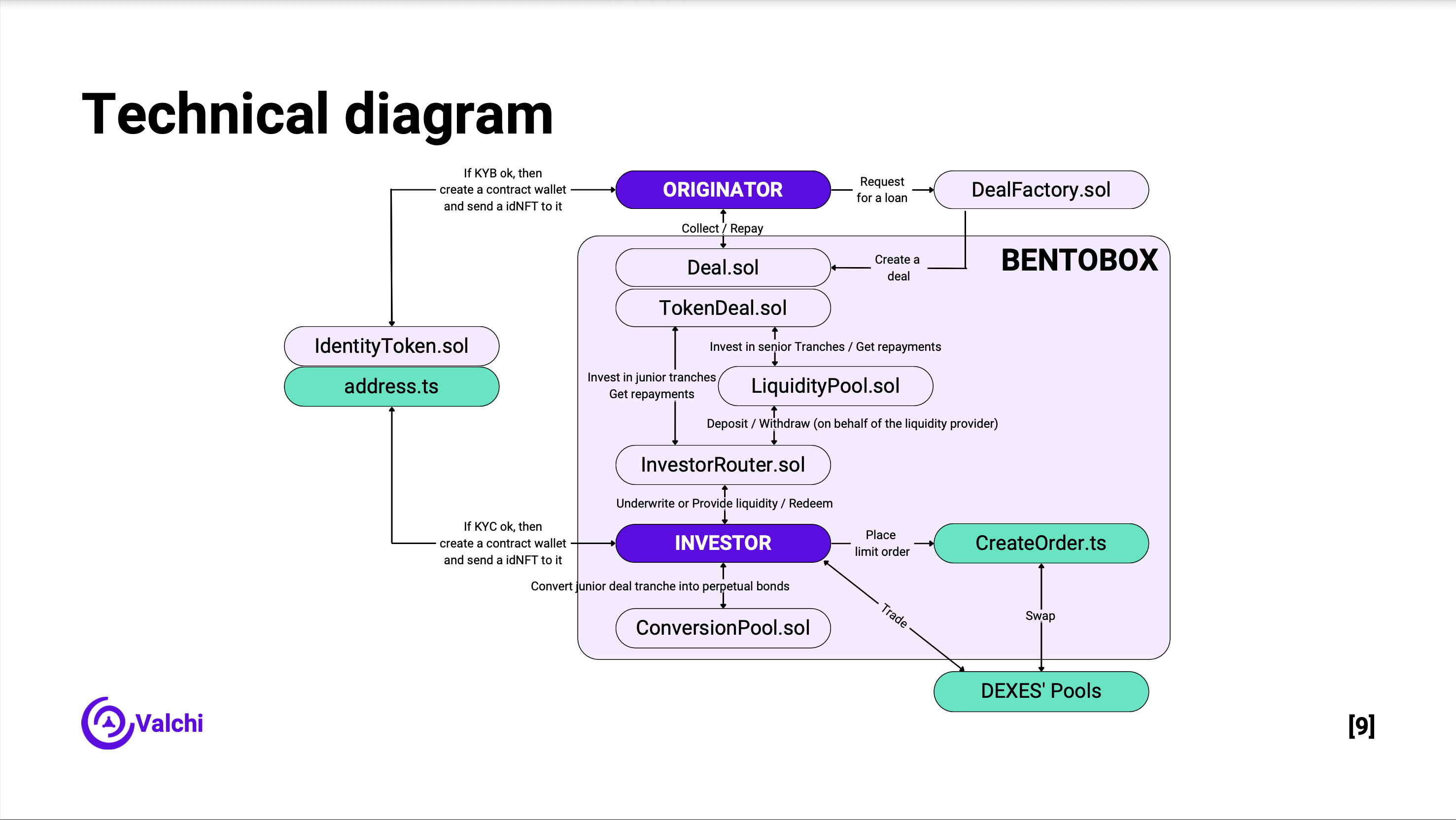
Architecture diagram
-
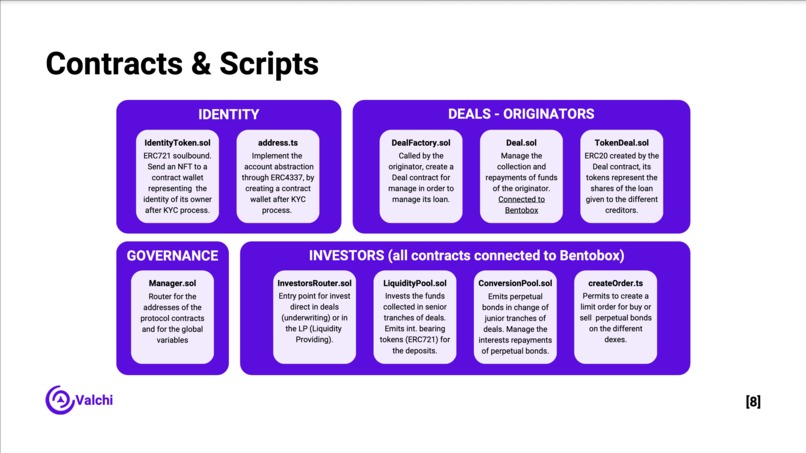
Contract descriptions
-
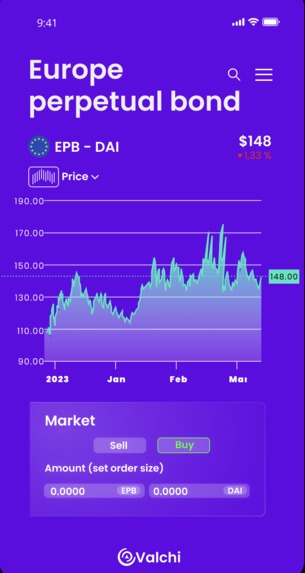
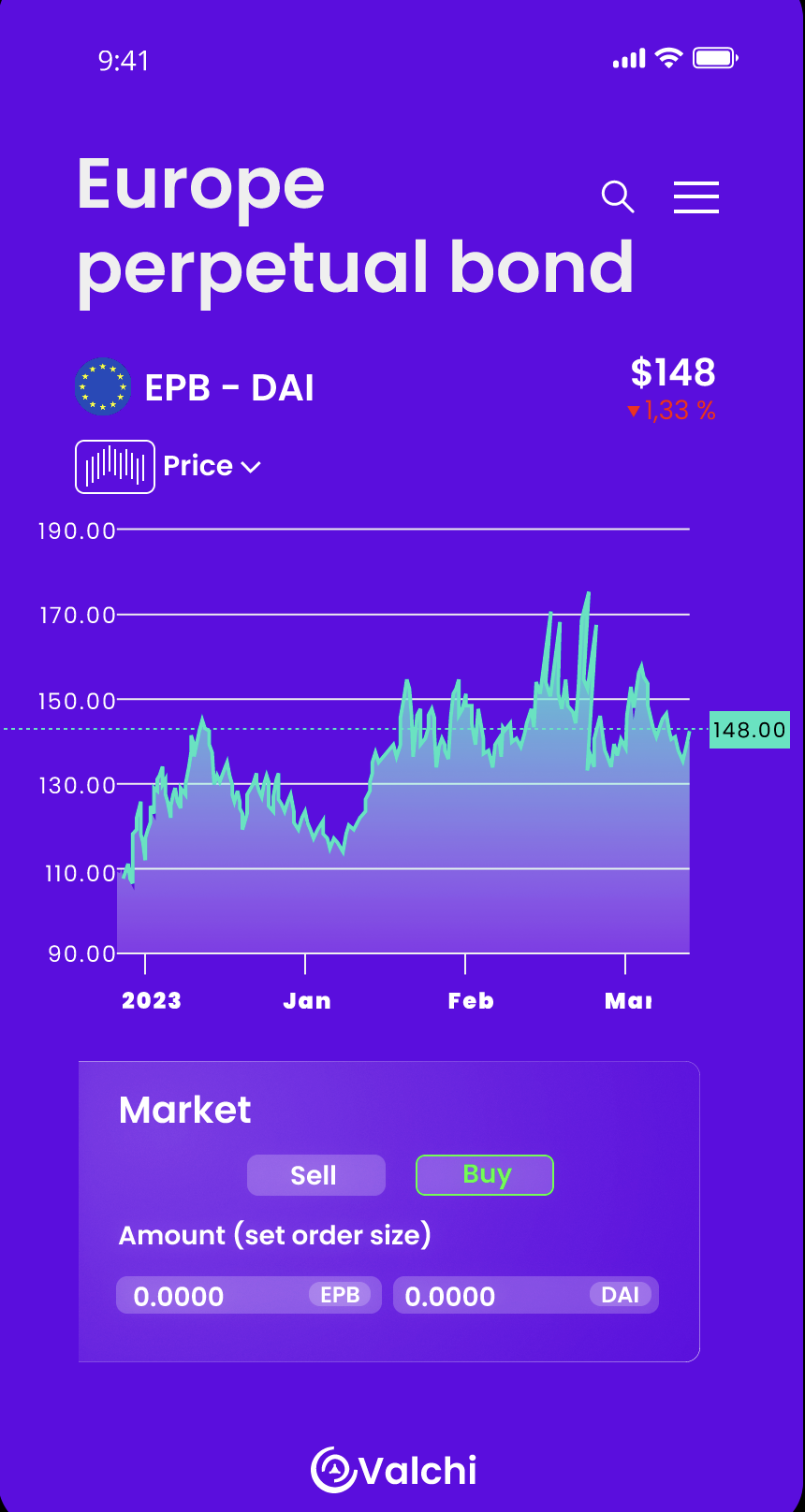
Perpetual Bonds page
-
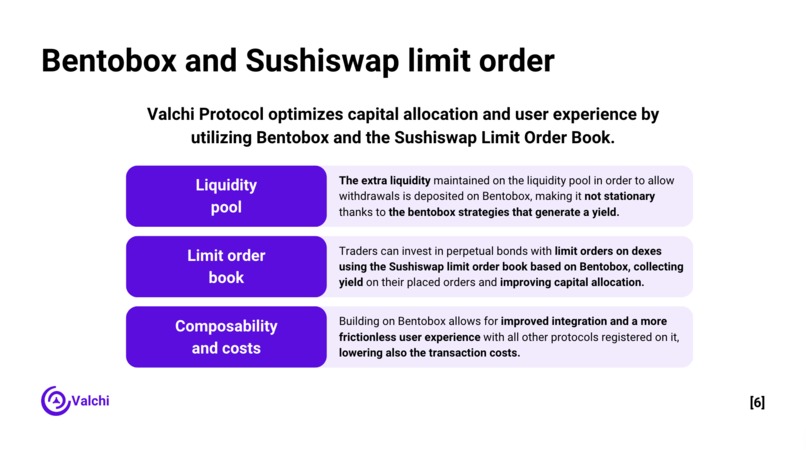
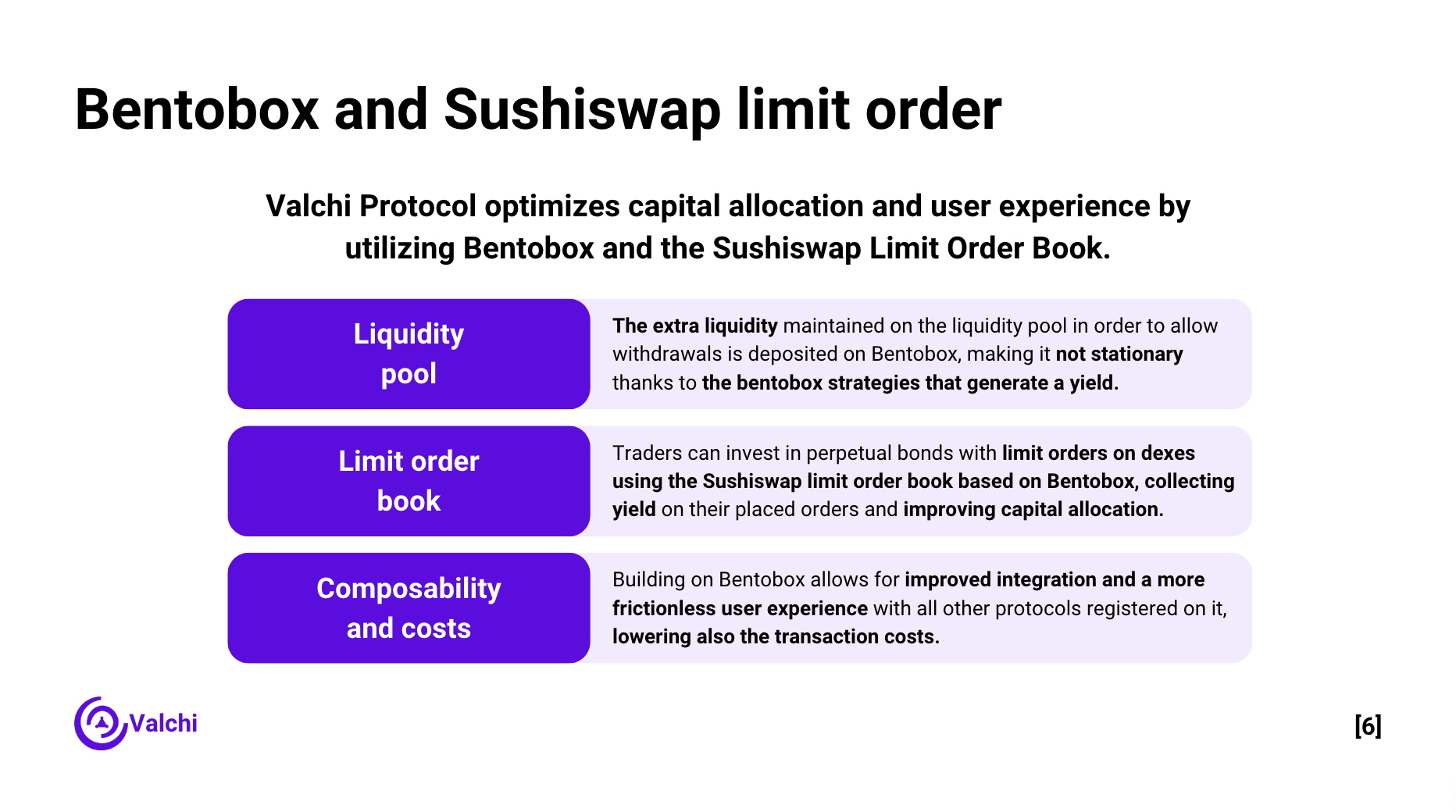
Why Bentobox

Inspiration
The fundamental motivation behind Valchi Protocol is the challenge we saw in getting small businesses financed fast and with good evaluation by banks and, after months of research, he thought that the best way to help companies can be to help the non-bank lenders' liquidity needs.
What it does
Valchi protocol architecture is the following: a non-bank lender lists a loan originated by himself on behalf of a borrower on the protocol and investors can invest in different ways in it. Valchi provides three different investment instruments, each designed for a particular category of customer. This allows all potential investors to participate in loans with varying risk levels and goals, boosting the volume of liquidity that converges into non-bank lenders and consequently helping them in satisfying more borrowers. The investors can act as underwriters, liquidity providers or traders: Underwriters invest in the loans' junior tranches. Liquidity providers deposit liquidity in a pool that includes all of the platform's senior tranches. Traders invest in perpetual bonds. This asset pays monthly interest but is not redeemable and it refers to a collection of junior tranches in a pool known as the conversion pool. Perpetual bonds are created in order to generate significant transaction volumes on the platform; they can be listed in Dexes and Cexes due to their quicker price discovery and increased liquidity. Focus on perpetual bonds: they are created by underwriters who purchase junior tranches and exchange them on the conversion pool for a specific number of perpetual bonds. After that, they sell them on the market. They operate as market makers and receive a market maker fee from Valchi in exchange.
How we built it
For this Hackaton, I created the smart contract architecture on Polygon and a Figma in order to showcase the platform's functionalities. For a better user experience I implemented also a script in order to use the ERC4337 standard (account abstraction), leaning on the bundler service offered by stackup.sh The protocol is integrated with Bentobox, used as a layer 0. It improves user experience and enables for very good capital allocation for surplus liquidity in the liquidity pool and limit orders on dexes for perpetual bonds.
Challenges we ran into
The primary difficulty I had was prototyping the protocol's architecture, particularly the perpetual bonds functions. In order to disrupt the market, a successful credit marketplace requires a highly liquid and tradable asset capable of attracting the same investors that trade and invest in equities today and the perpetual bond is that asset.
Accomplishments that we're proud of
I'm really proud of having been able to create both a v0 of the architecture and a figma demo. It's a good starting point for the following steps in Valchi development.
What we learned
I mostly improved my solidity development skills, particularly in the use of the standard EIP712 and ERC4337. Moreover, I also improved my financial knowledge by prototyping different investment products and by doing research.
What's next for Valchi protocol
I will keep developing Valchi, and this hackathon allows me to validate the concept further, both on the problem and solution sides. The next phase is to perform customer validation and create a version 0 of the protocol to offer to Valchi's key partners: alternative lenders (non-bank lenders).
Polygon scan contract addresses
Manager.sol: https://polygonscan.com/address/0x2Cdf4844455c7dA5112B8e48341b964FD2e67727 IdentityToken.sol: https://polygonscan.com/address/0x004Cbc72d87EFEAD5937498AeD148C2532B1842B DealsFactory.sol: https://polygonscan.com/address/0xB0B7a601b73E3ee65ec6eC149397f260374f0BE9 InvestorsRouter.sol: https://polygonscan.com/address/0xe01D582E3F06BBa926AF1Ea6A423b6e356fd342D LiquidityPool.sol: https://polygonscan.com/address/0x880eDC3Fbd97657Bd141427De2ef6f3c5600E525 ConversionPool.sol: https://polygonscan.com/address/0x5f0d86d459b4bb14705aa6812536bbf5118191d7
Built With
- bentobox
- ethers
- figma
- hardhat
- polygon
- solidity
- sushiswap
- typescript

Log in or sign up for Devpost to join the conversation.