-
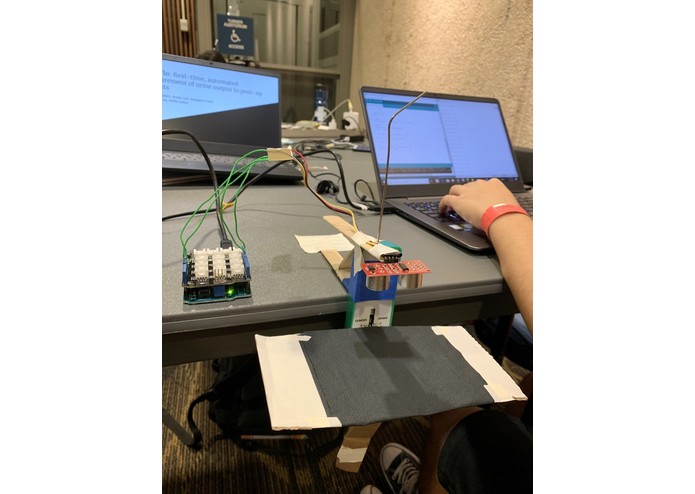
The set-up of the Uro-Flo
-
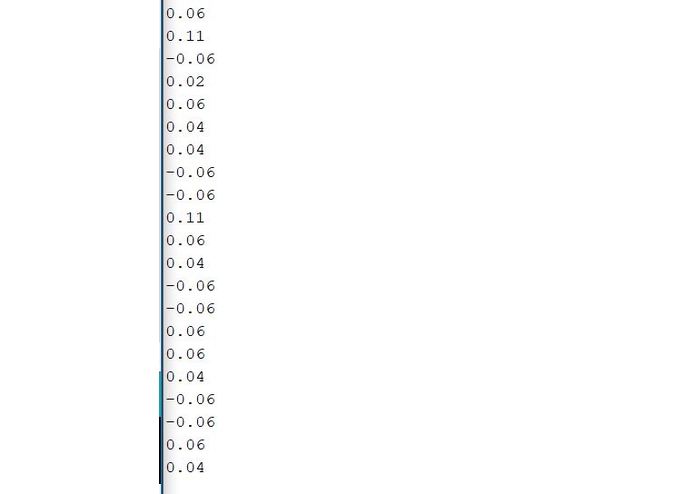
Example of urine output measurements from serial monitor
Inspiration
Of all the vital signs, such as blood pressure and heart rate, urine output is the only one not measured in real-time by a machine. Real-time weight-based measurement of urine output in post-operational patients can not only demonstrate factors of recovery, but also serve as preventative measures of certain diseases. According to a 2018 post-cardiac surgery study, Acute Kidney Injury (AKI) is not uncommon following cardiopulmonary bypass surgery (CPB). Moreover, Acute Kidney Injury is associated with decreased urine output. The development of AKI post-operatively is ultimately correlated with longer hospital stays, increased in-hospital mortality, and higher rates of morbidity overall in comparison to patients without AKI. Currently, while perioperative urinary output is collected, their collection rates are somewhat arbitrary throughout cardiopulmonary bypass surgeries and are often visually estimated. With this method, there are time points that are missing in between measurements, and less opportunity to determine critical moments in the development of post-operative health issues, like AKI. The process is also tedious for the nursing staff, whose time could be better spent. These limitations further suggest that in order for improvements to be made, there needs to be a more precise, real-time measurements of urinary output. Based on this background literature, our goal was to approach this problem over the 36 hour working span of this conference.
What it does
With the aforementioned findings in mind, we designed Uro-Flo, which is a sensor-based urinary output measurement mechanism. The goal of our device is to serve as an intervention to post-operational health issues, among others, by providing constant real-time measurements. This device would compensate for human error and allow for continuity in urinary output collection. With humans taking measurements, there is often the likelihood of inaccuracy due to the positional shifting of the volume of urine when measurements are being read, the lack of precision in the timing of measurements, and the possibility of measurements to be forgotten by nurses or healthcare providers. In order to address these issues, our device would provide automated and accurate measurements in real time without the requirement of human labor. All output measurements would be collected with a direct interface with medical database records, granting more cautious care for patients due to improved specificity. Overall, it will allow nurses to focus more on patient care while leaving routine and time-consuming tasks to our device.
How we built it
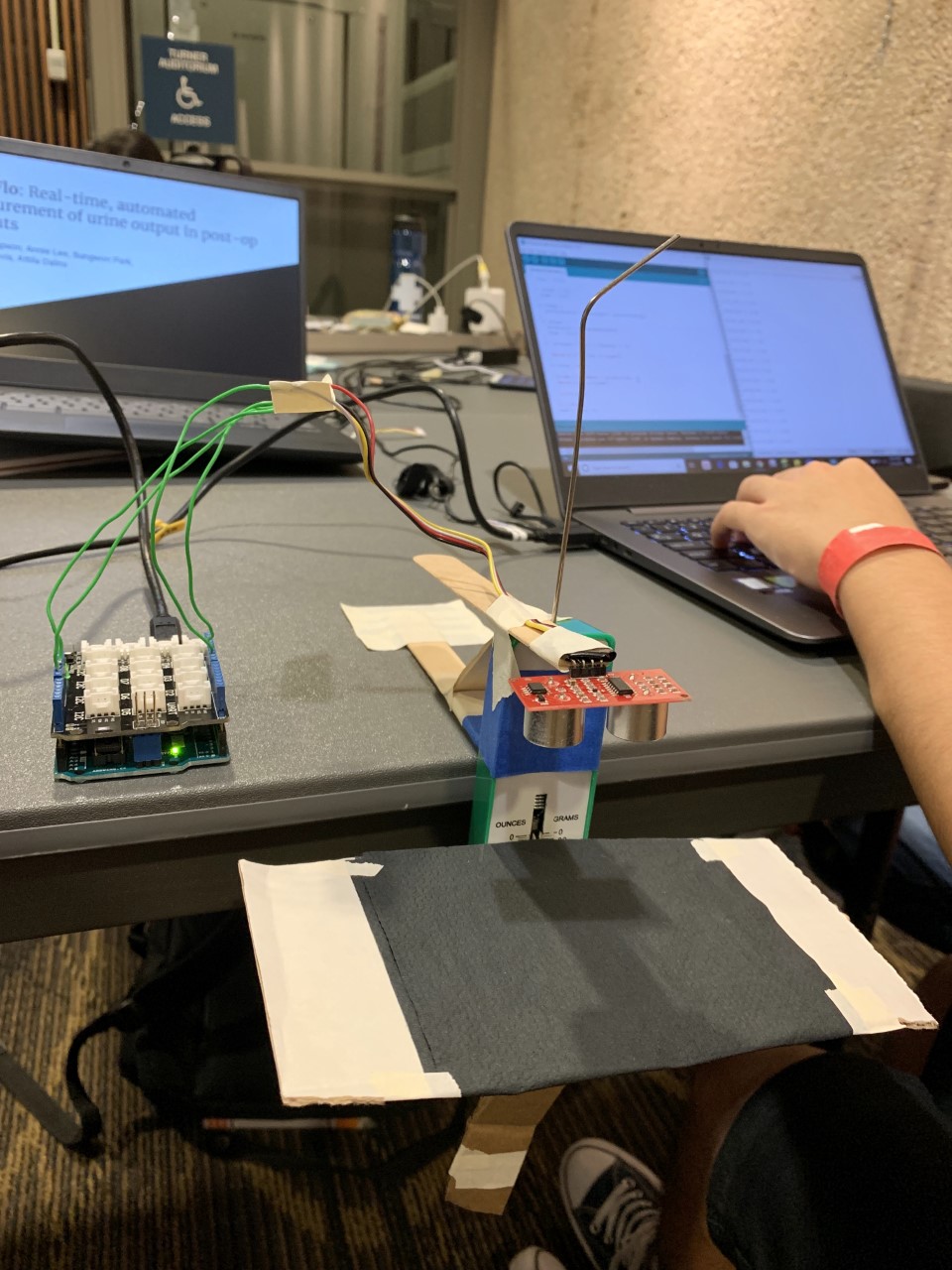
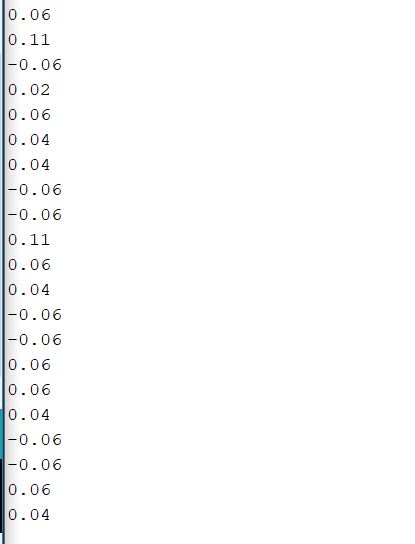
Uro-Flo is comprised of two parts: a weight sensor with a fluid bag attached at the bottom and real-time data display. Since there was not a force sensor available, we had to improvise with a force gauge and ultrasonic sensor. As the fluid bag pulled the gauge down, the ultrasonic sensor detected a change in distance. We compared this value to an initial distance value to calculate the net change. We collected the distance change and its time stamp every second. Putty was used to store these values in a text file, which can be used by other programs in the future. In the situation that a nurse emptied the bag, we implemented a reset button to recalibrate the "zero" value, which would be used when nurses empty the bag.
Challenges we ran into
Our first challenge was how to measure volume — whether we use a flow turbine or by weight. Once we chose the weight method, we had to improvise the force sensor. While we chose this project for its feasibility, we found that this first obstacle delayed us by about half a day. Our group also did not have extensive coding experience outside of MATLAB, so we struggled through writing scripts in JavaScript and Python in order to interface the data with the computer.
Accomplishments that we're proud of
Synchronizing the Arduino and MATLAB. Not giving up. Interfacing separate programs in order to transmit one type of data to another. And not dying of a caffeine overdose.
What we learned
We learned a lot about programming, data acquisition, and data analysis — which is what we came to Medhacks for.
What's next for Uro-Flo
Most significantly, we want to upload to FHIR to contribute to the medical database, especially since the urine output measurements are more frequent and standardized. We can also work on integrating the force sensors into the urine bag in a manner closer to our original conception, which would be far less clunky than our current proof of concept. Another future direction would be adding threshold values that are indicative of shock, which would immediately alert the medical staff to shock.
Sources
Alvarez, A. P., Demzik, A. L., Alvi, H. M., Hardt, K. D., & Manning, D. W. (2016). Risk Factors for Postoperative Urinary Tract Infections in Patients Undergoing Total Joint Arthroplasty. Retrieved September 28, 2019, from https://www.ncbi.nlm.nih.gov/pmc/articles/PMC5149596/ .
Chang, A. J., Nomura, Y., Barodka, V. M., Hori, D., Magruder, J. T., Katz, N. M., … Hogue, C. W. (2017, December). Validation of a Real-Time Minute-to-Minute Urine Output Monitor and the Feasibility of Its Clinical Use for Patients Undergoing Cardiac Surgery. Retrieved September 28, 2019, from https://www.ncbi.nlm.nih.gov/pmc/articles/PMC5726301/.
Chenitz, K. B., & Lane-Fall, M. B. (2012, September). Decreased urine output and acute kidney injury in the postanesthesia care unit. Retrieved September 28, 2019, from https://www.ncbi.nlm.nih.gov/pmc/articles/PMC3447626/ .


Log in or sign up for Devpost to join the conversation.