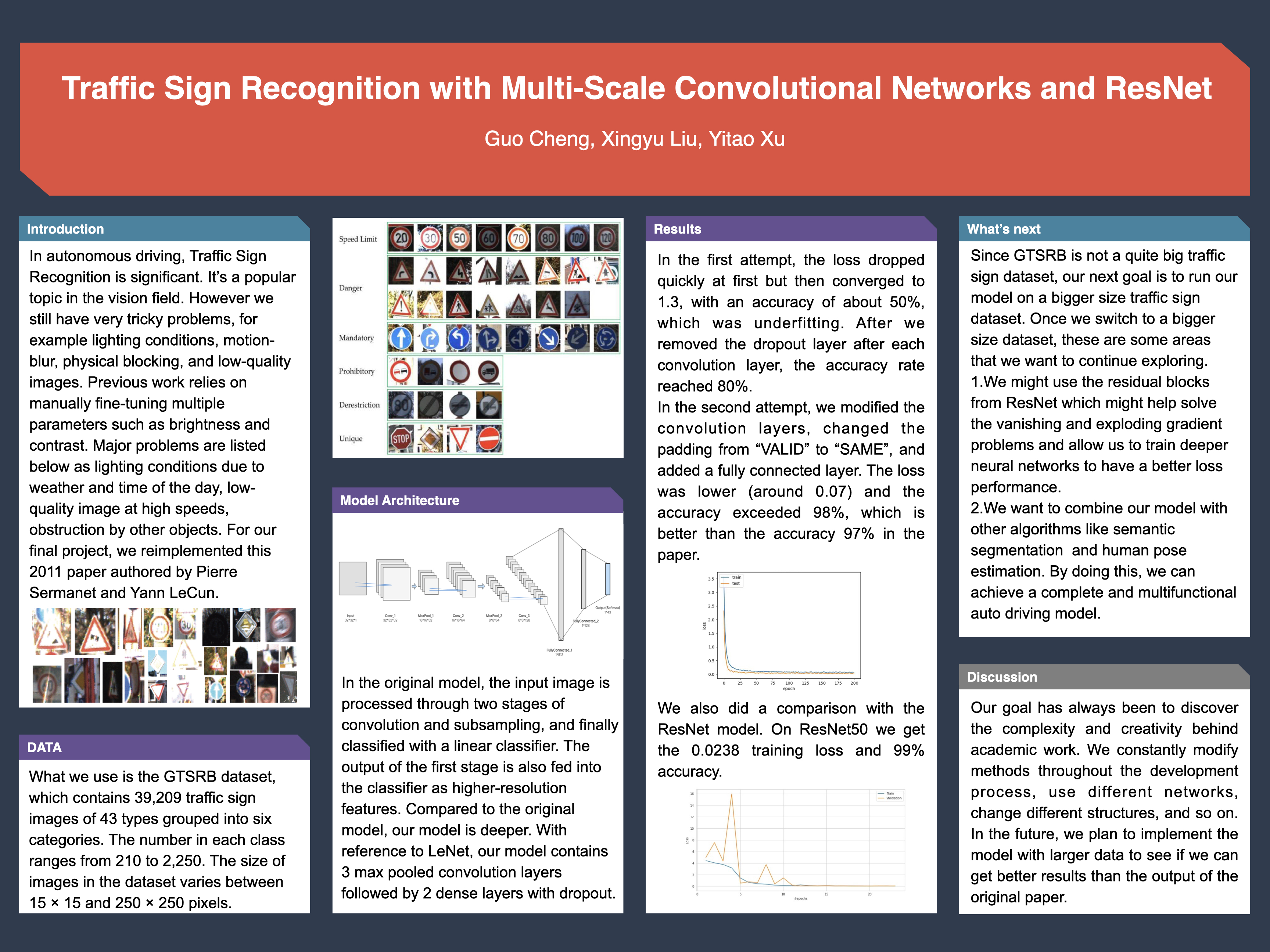
Introduction
We implemented the paper "Traffic Sign Recognition with Multi-Scale Convolutional Networks". This paper aims to conquer a key point in the auto-driving area. We believe it's a suitable topic for us because it can facilitate our life by solving the traffic signs recognition problem, the dataset of traffic signs can be accessed easily, and implementing the proposed network structure can help us strengthen what we learned from the course. (http://yann.lecun.com/exdb/publis/pdf/sermanet-ijcnn-11.pdf )
Group Members
Guo Cheng; Xingyu Liu; Yitao Xu
Related Work
In the paper listed below, a fast detector was used for round speed signs, based on a simple cross-correlation technique that assumes radial symmetry. Unfortunately, such color or shape assumptions are not true in every country. (Barnes, N, Zelinsky, A, and Fletcher, L. Real-time Speed Sign Detection using the Radial Symmetry Detector. IEEE Transactions on Intelligent Transport Systems, 2008.) Since the paper to be reimplemented was published several years before, the network used is somewhat out-of-state. We'd like to modify the present network in that paper. This paper is used to help us optimize our network. (https://arxiv.org/abs/1802.07042)
Data
We download the dataset from German Traffic Sign Benchmarks (rub.de). It contains 39,209 traffic sign images of 43 types grouped into 6 categories. It's about 120MB. We will augment and balance the data. (https://benchmark.ini.rub.de/gtsrb_news.html)
Methodology
We build our model based on the following two steps: 1) Data Preprocessing. We use data augmentation method to generate more data and preprocess those data by passing them through some filters. 2) Network Modification. We replace part of the network presented in the paper with other more useful structures. For example, we use RELU as the activation layer, rather than the one mentioned in the paper. 3) Model Training. We train our model based on the BP algorithm.
Metrics
We also use "accuracy" as an index for our project. The original paper aims to classify traffic signs effectively, and they have achieved an accuracy of 97%. Our base goal is to build a model that can work successfully; our target is to achieve the accuracy the same as the original paper, and our stretch goal is to optimize our model to achieve an accuracy of 1% higher than the paper achieved.
Ethics
What broader societal issues are relevant to your chosen problem space?
Cameras play a pivotal role in autonomous driving. Just like human eyes, cameras combined with image recognition technology can quickly identify vehicles, pedestrians, and traffic signs, providing an environmental perception guarantee for the current autonomous driving technology. In driving assistance systems or autonomous driving scenarios, the recognition of traffic signs can provide corresponding assistance for vehicle control. For example, prohibition signs can help the system predict potential danger and warning signs help the system avoid obstacles in advance. The more accurate the recognition is, the less likely a traffic accident will occur and the safer the driver.
Why is Deep Learning a good approach to this problem?
The traffic sign dataset includes 43 different traffic signs. In actual driving scenes, there are many kinds of traffic signs and many noises due to lighting conditions, occlusions, color fading, and so on. Thus, the traditional algorithm is not suitable for so large datasets and so many noises. However, training a robust deep learning model requires lots of data and some noises. Thus, deep learning is a good approach to this problem.
Division of labor
Data Pre-process and augment: Guo Cheng, Yitao Xu; CNN Model design, Training, parameters tuning: Guo Cheng, Yitao Xu; ResNet Model implementation and comparison visualization: Xingyu Liu.
Built With
- cnn
- python
- resnet


Log in or sign up for Devpost to join the conversation.