

Inspiration
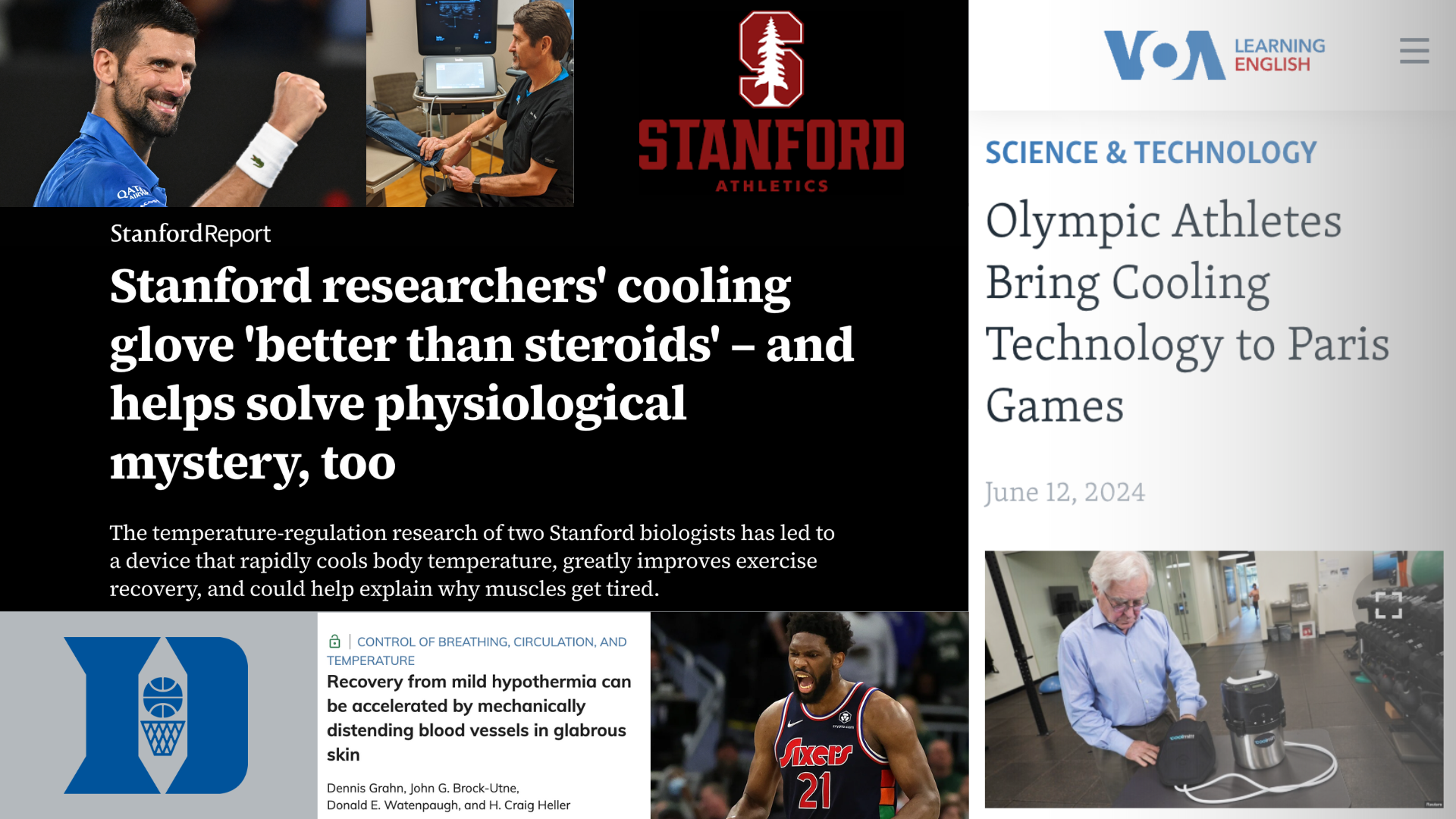
Our project is inspired by the fascinating thermoregulation research conducted by Professors Craig Heller and Dennis Grahn at Stanford University. Their work captivated us (papers linked below), and we had the opportunity to take Professor Heller’s class, where we directly experienced how temperature affects physical performance, health, and disease. For some scientific context, our body's glabrous skin (hairless areas rich in specialized blood vessels called arteriovenous anastomoses, or AVAs) plays a critical role in heat exchange. The soles of our feet and the palms (made of glabrous skin) of our hands act as thermal windows, regulating heat dissipation and conservation. When the body needs to cool down, AVAs dilate, increasing blood flow to the skin’s surface for heat loss. Conversely, when warmth is needed, AVAs constrict, reducing heat loss.
In Professor Heller’s class, we were actually able to test this research by experimenting on ourselves. We pushed our aerobic and anaerobic limits with and without a cooling stimulus applied to our palms. The results were mind-boggling: we could do more reps and sets of strength exercises, and we nearly doubled our running time in a 100°F room with cooling applied. Experiencing this research firsthand fueled our interest in its potential as an incredibly useful healthcare-engineering project.
However, the cooling setup we used in class had some serious drawbacks. It relied on a liquid cooling pump attached to tubes which were bulky, messy, and far from portable. Wearing large cooling gloves made using our hands impossible, which was impractical for real-world applications. Accordingly, we set out to solve this problem by shifting the cooling mechanism to the soles of the feet and designing a compact, self-contained system capable of both heating and cooling. Our goal was to create a wearable thermoregulation device that eliminates the need for a liquid cooling pump while maintaining efficiency, portability, and usability. We also saw an opportunity to integrate healthcare analytics, leveraging data from the device to provide valuable insights for both medical and performance-based applications. In short, we had to create a miniaturized HVAC system that seamlessly fits in the sole of a shoe without the bulk, without the mess, and without interfering with daily activities.
What it does
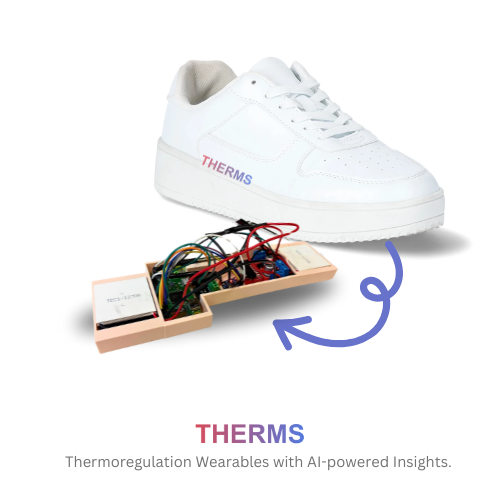
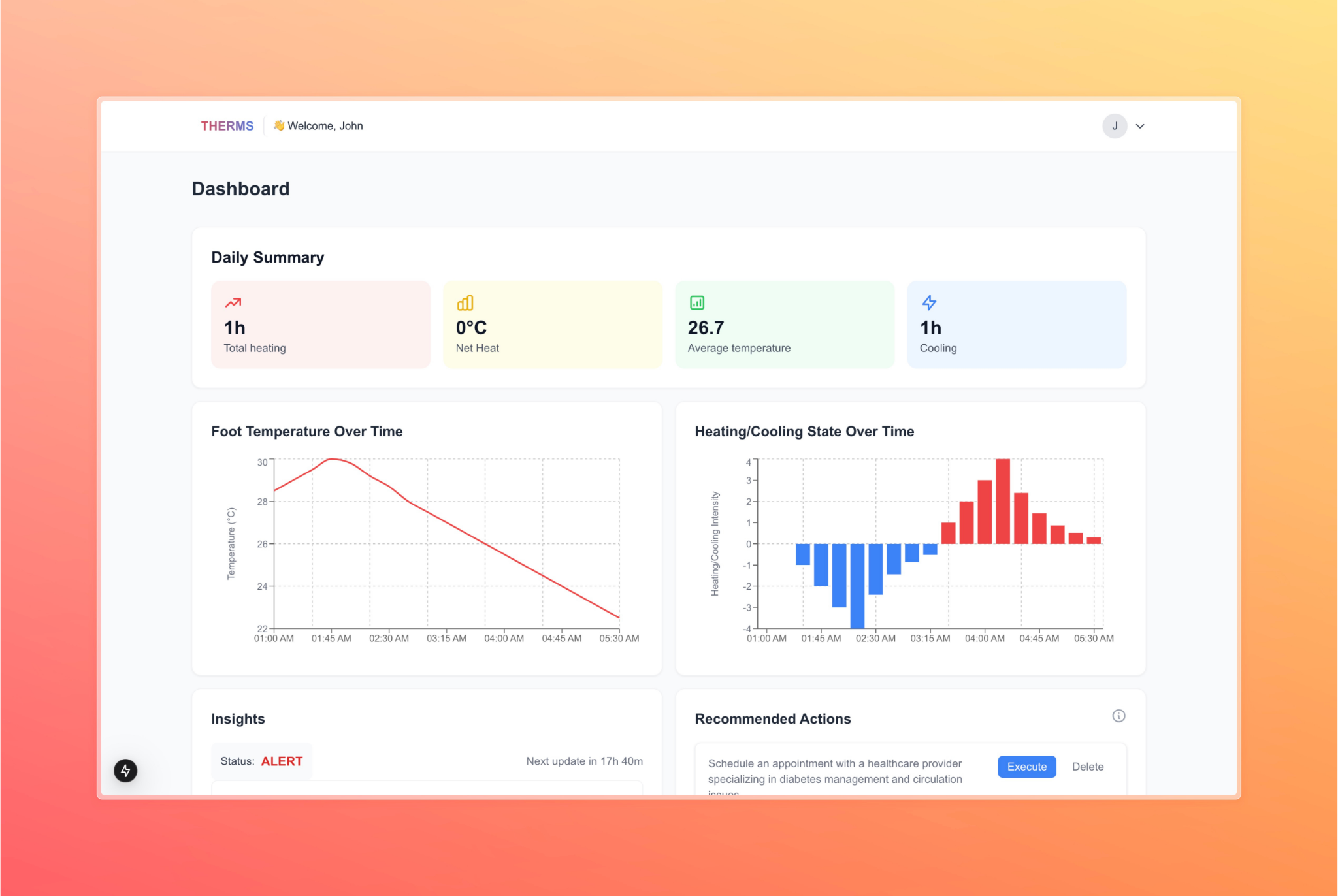
Therms is a wearable thermoregulation device designed to actively regulate body temperature by targeting the glabrous skin on the soles of the feet. Therms uses thermoelectric Peltier modules to provide rapid, reversible heating and cooling. Our design uses a reversed-polarity model to switch the system between heating and cooling states. An embedded sensor continuously monitors foot temperature, ensuring the system responds in real time to thermal needs. AI-powered analyses of temperature data alongside health metrics (e.g., activity levels, medical conditions) help predict and preemptively adjust stimuli responses, optimizing comfort and performance. Therms also connects to APIs (Terra, Scrapybara, OpenAI) to incorporate additional physiological data, such as heart rate, sleep patterns, and chronic conditions. This enables personalized thermoregulation strategies and early detection of anomalies. For example, if a diabetic user’s foot temperature rises abnormally, Therms can cool the area to prevent tissue damage and AUTOMATICALLY book an appointment with a healthcare professional.
Therms has medical applications, supporting individuals with thermoregulation dysfunction, such as those with spinal cord injuries, diabetes, or neurodegenerative disorders, by stabilizing foot temperature and preventing complications. Therms is also focused on performance-based applications to enhance recovery and endurance by optimizing thermal regulation during and after intense activity (soldiers, athletes, manual laborers). Finally, Therms has immense geriatric applications by protecting elderly users, who are particularly vulnerable to hypothermia and hyperthermia, with preemptive adjustments based on real-time data.
Overall, Therms combines advanced thermoelectric technology with a deep understanding of human physiology to create a wearable system that actively supports thermal homeostasis. By targeting the glabrous skin on the feet, Therms achieves efficient, non-invasive thermoregulation while integrating AI-powered insights to improve health outcomes and performance.
How we built it
After hours of whiteboard sessions and squabbling with one another, we designed a modular wearable system that efficiently manages heat transfer while leveraging AI-powered analytics for personalized thermal regulation.
Miniaturizing an HVAC-like system into a shoe sole required replacing traditional liquid cooling with Peltier boards for precise heating and cooling. These boards were placed on top of a heat sink that were connected with a copper foil so that any heat accumulated on the Peltier after the current was turned off was dissipated away. A motor controller dynamically adjusts polarity and current flow to switch between heating and cooling states. A copper foil was also placed on the top of the frame to connect the Peltier boards and distribute heat transfer evenly among the surface area of the foot, while a temperature sensor was placed next to the top copper layer, but insulated from it, to provide real-time thermal feedback. A microcontroller coordinates these components and processes sensor data, while an IMU sensor tracks movement to provide additional activity insights. The entire system is housed in a modular sole frame (durability, extendability, and ease of integration into different footwear).
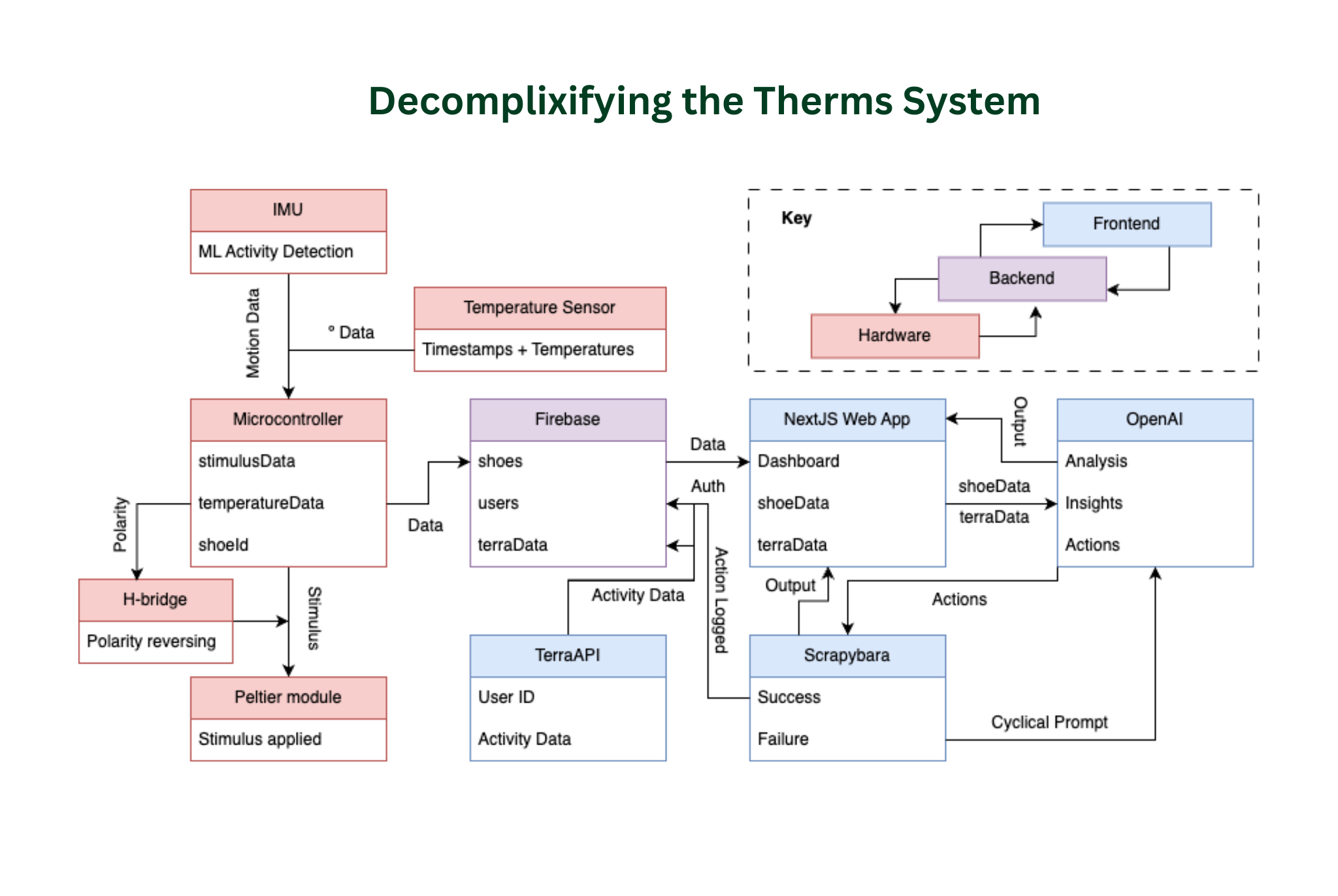
The software ecosystem enables real-time data processing and automation. Firebase handles seamless communication between the device and the web application, while Terra API integrates external physiological data from other wearables. ChatGPT processes the integrated thermal and health data, identifying anomalies and optimizing thermoregulation strategies. Scrapybara automates tasks such as booking medical appointments and managing prescriptions based on detected trends. A Next.js frontend and Node.js backend ensure a responsive and scalable platform for users to monitor and personalize their Therms experience.
Challenges we ran into
A major challenge came from Peltier technology, which can prove to be incredibly inefficient energy-wise and temperature-wise. When turned off, the boards retained and radiated heat on both sides, causing unwanted warming immediately after cooling. To counter this, we created an optimized heat sink system with our modular sole frame that captured as much heat as possible and dissipated it through a copper layer; this significantly reduced the risk of overheating.
The modular design we keep talking about was one of the most challenging parts. We had to design a system that allowed for easy upgrades and customization and incorporate several different hardware modules in a very small space. After multiple iterations of our 3D models, we refined the design to maximize space efficiency while ensuring easy assembly and part replacement.
On the software side, we built a pipeline incorporating three different data sources and three third-party APIs: shoe data + user data + Terra API activity data → OpenAI insights → Scrapybara automation. Our streamlined process looked great in theory but proved far more complex in execution. Ensuring data consistency across different technologies was a tedious task, with unexpected bugs that took considerable time and patience to debug.
Accomplishments that we're proud of
We are incredibly proud to have successfully created one of the first completely pump-less, battery-powered heating and cooling systems in a wearable format. Several reports said Peltier technology is inefficient and that using a liquid cooling/heating system that wasn’t mobile was the only way to effectively thermoregulate. We also had no design blueprints to reference, so it was exciting and also gratifying to see our hacky model come to life. Getting the entire design, code, and actual working device done within 36 hours was incredibly rewarding and helped us each hone and develop new skill sets that will serve us for life.
Beyond hardware, we integrated incredibly varied technologies like Terra API, Scrapybara, and OpenAI and created a fully working web application portal that can pair shoes, collect user data, provide insights, and display professional data visuals. We are also proud of the research-first approach we took, where we used mathematical and biological models to quantify stimuli responses, healthcare insights, and have a solid grasp of why this technology is so important to human performance and health.
What we learned
Throughout this project, we gained hands-on experience in developing scalable software and hardware. Our software required multiple APIs and a plethora of data being transmitted to different endpoints, which acted as a forcing function to make our application lightweight and scalable. We can expand the number of shoes, user metrics, wearables integrated through Terra, and much more without any latency using our Firebase + NextJS architecture. We refined our skills in CAD modeling and 3D printing, iterating through multiple designs to achieve a compact and efficient wearable.
On the hardware side, we learned how to integrate super niche hardware modules, from thermoelectric modules to motor controllers, while balancing thermal physics, power efficiency, and real-world usability. Additionally, we explored IMU sensor modeling, developing a system that extracts motion data to enhance user tracking and inform advanced healthcare analytics. Finally, working with Terra API and Scrapybara taught us how to streamline data integration across multiple platforms, ensuring seamless communication between hardware, software, and AI-driven automation.
What's next for Therms - Thermoregulation Wearables with AI-powered Insights
We plan to refine and optimize Therms with the goal of commercializing it for users who need to condition/train heavily (athletes and soldiers) or users who have thermoregulation dysfunction symptoms. Our next steps include enhancing energy efficiency, ensuring that heating and cooling functions operate with minimal waste, and redesigning the form factor so the entire system fits nicely within the shoe.
From this business and research perspective, we aim to scale Therms into a consumer-ready product that enhances human performance and recovery in athletes, workers, and everyday users by reducing fatigue and optimizing thermal regulation. Additionally, Therms has critical healthcare applications, particularly for senior citizens, providing a continuous, non-invasive way to monitor body temperature and mobility, reducing the risk of temperature-related health issues.
By integrating advanced AI-driven insights, real-time health tracking, and an ergonomic design, we envision Therms becoming an essential, wearable thermoregulation solution for both performance enhancement and preventive healthcare.

Log in or sign up for Devpost to join the conversation.