-
-

Spotlyte_Logo
-
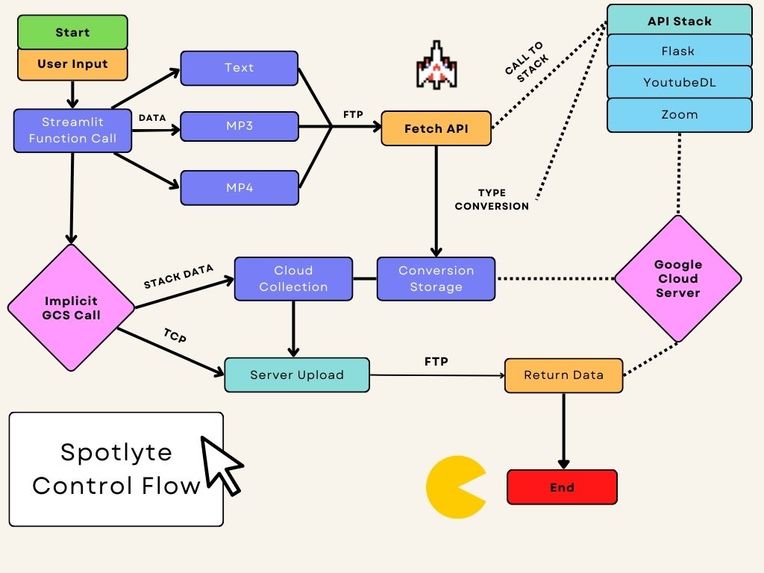
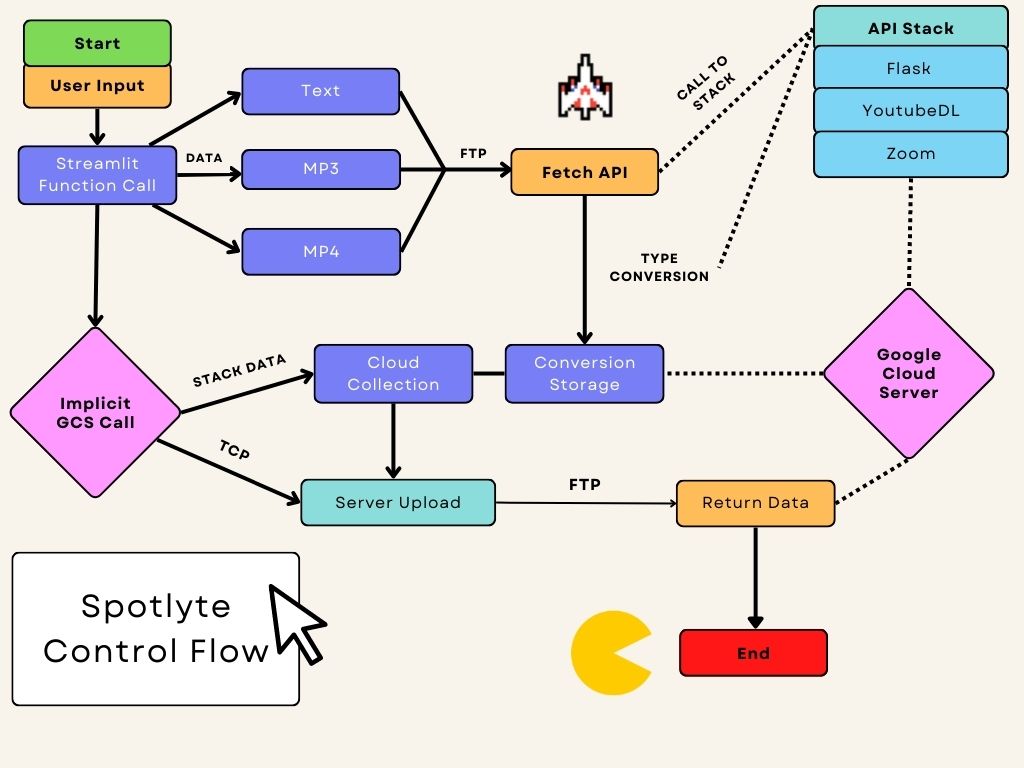
SpotLyte_Control_Flow
-
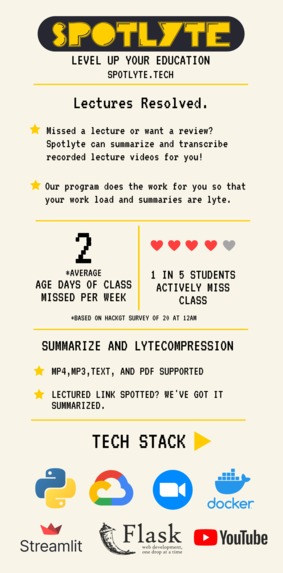
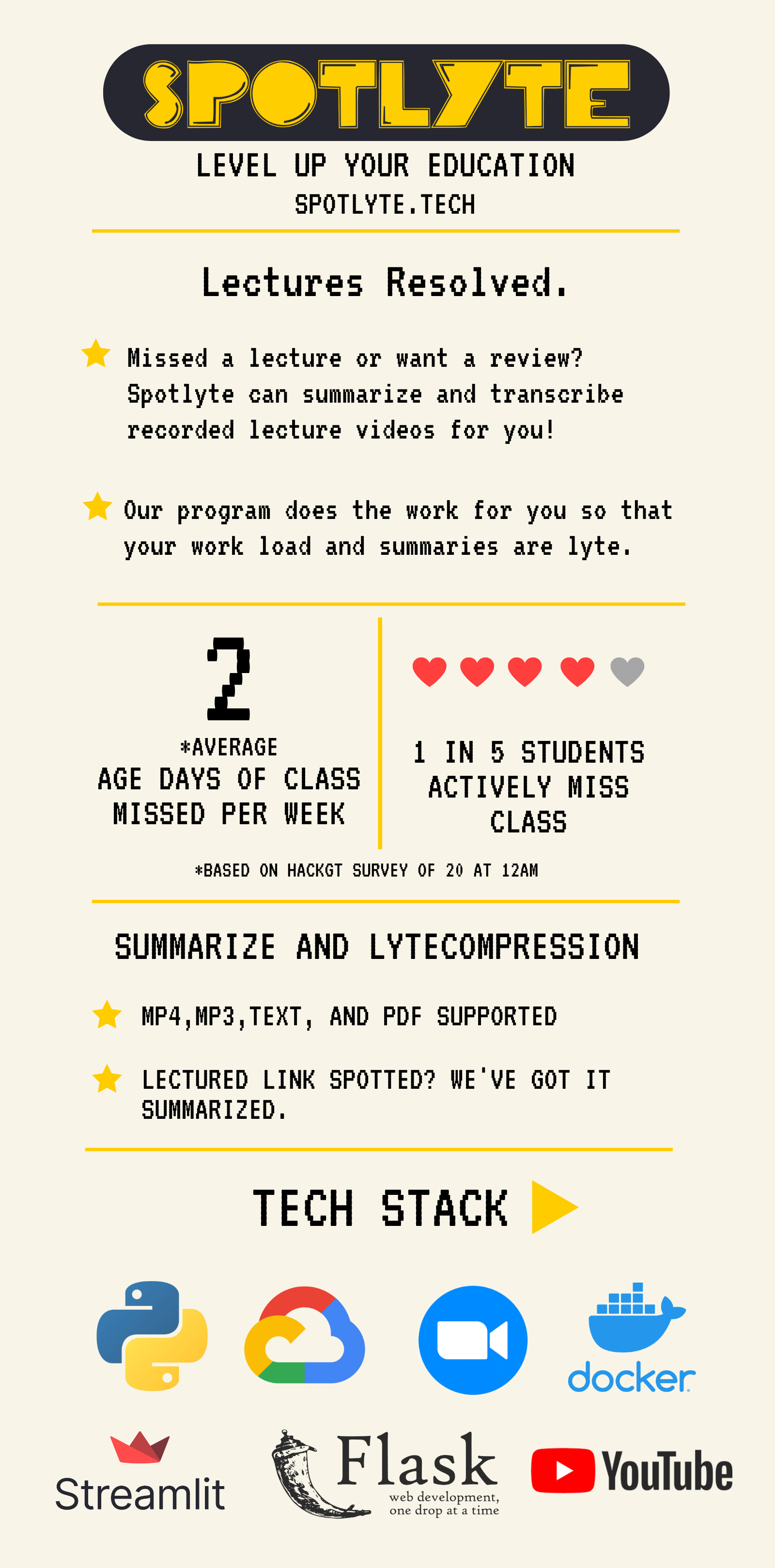
SpotLyte_Infographic

We would like to be judged for cheat-code hack and data-driven hack
Inspiration
College can be extremely challenging. Students must take every opportunity to ‘power-up’ and face these challenges to ‘level-up’. As four college students, we understand that with busy schedules making it to lectures only adds to the challenge. However missing just one lecture can be a ‘game-over’ especially when you are often missing key points in lecture, so we brainstormed a solution. From there Spotlyte was born to create a more efficient academic environment by providing students with accurate and informative notes with a retro Pac-Man twist. :)
What is Spotlyte?
Spotlyte is a multipurpose audio, video, and text converter that can be used to make college life easier by utilizing machine learning algorithms and APIs. College classes require a lot of information to be digested from lectures for students to learn; Spotlyte reduces the hassle of having to listen through long lectures and creates a summarized version of it. Spotlyte also utilizes APIs to compress mp4 and wav instance footages from Youtube and Zoom to signal key movements and events that may signal action words. Overall, Spotlyte is capable of providing efficient summarized data to students through its conversion and detection systems revolving around APIs.
How we built it
Spotlyte was created with the use of three main APIs: FlaskAPI, YoutubeDL, and ZoomAPI that allows for text, audio, and video files to be converted and downloaded by the user. Text, audio, and video files are all compressed and summarized into text files using Google AI TTS. The server is hosted on the Google Cloud, utilzing a Linux based VM instance and a Streamlit front end.
List of tools used: Python, Streamlit, FlaskAPI, YoutubeDL, Google Cloud, ZoomAPI, Google AI.
Challenges we ran into
The creation of the back and front end of our work took lots of time to create, however, setting up a server through Google Cloud and connecting our custom domain from Domain.com proved to be more difficult than we anticipated. The Google Cloud was later discontinued to server as a host after open port servers were taken over by monero miners in a crypto miner attack. We fortunately were able to configure some libraries from Google API to create localhost and complete our objective. There was some delay in the setup of our server and Watson due to verification code issues with promotional codes by sponsors as well.
Accomplishments that we're proud of
The creation of everyone's first-ever full-fledged project hosted online with functional programs is an accomplishment of its own. Utilizing AI and APIs helped us organize and compress data which enacted us to successfully develop our detection and conversion systems. We are extremely proud of our ability to create a full-stack program with a unique concept in a timely manner to present at the exposition.
What we learned
As beginner hackathon participants, we were exposed to many different tools and topics beneficial to us by sponsors and other peers during workshops that contributed to the success of our project. We learned to develop a server implementation off-site from a local host and create a domain to host our creation. Our first-hand experience with brand new full-stack equipment like Docker and IBM Watson allowed us to explore topics of computer vision and AI that we could’ve possibly implemented. Mentors and sponsors alike were great assets in our development of the project.
What's next for Spotlyte
We see the potential for this software in other applications. By integrating Spotlyte with IBM Watson to compress mp4 and wav instance footage to key moments in the video, we could detect potential suspicious activity. ZoomVideo API could be applied to security by using IBM's natural language processing system, Watson, to analyze, predict, and log actions in given video segments. We hope to develop more file types to be integrated and convert as well as add a compliant point detection system with motion sensors that can possibly utilize Twilio API for alerts of activity to prevent further, repeated, incidents.


Log in or sign up for Devpost to join the conversation.