-
-
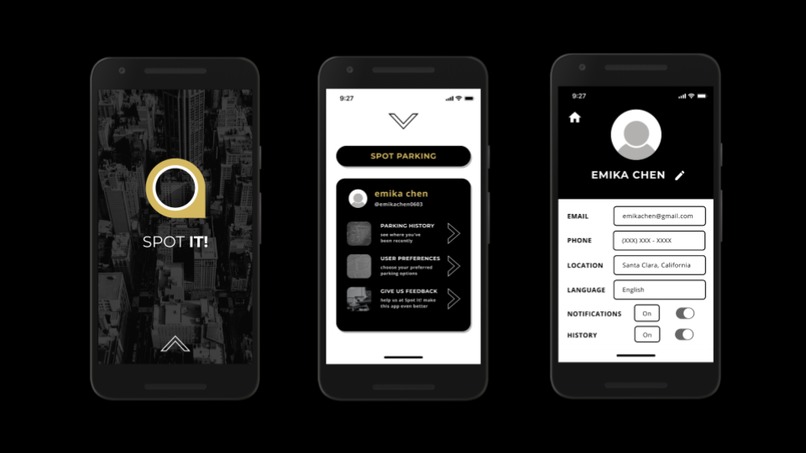
Wireframes (Part 1)
-
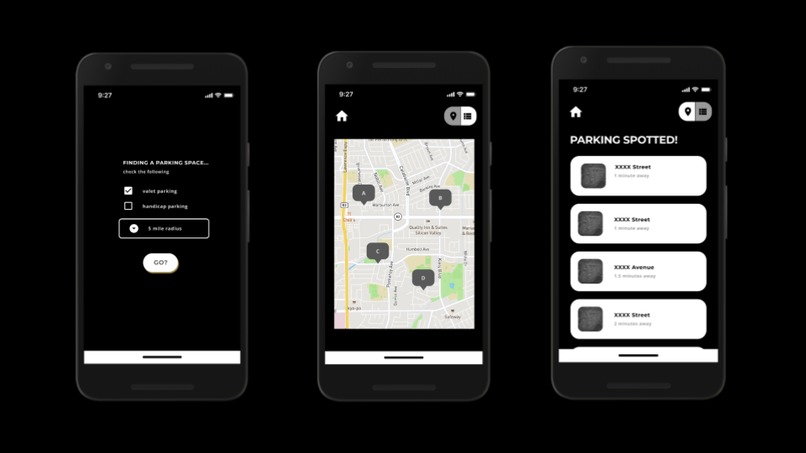
Wireframes (Part 2)
Inspiration
In our hectic schedules, commuting from place to place has become a daily necessity. In many places, it is almost impossible to get from place to place without taking a car, and with this mode of transportation, comes the task of parking. Living in the Bay Area, all of our team members have firsthand experience of life in an urban/suburban city. Having driven to a crowded area before, all of us know how crowded the streets can get, and oftentimes, parking is not even available or hard to find for more than ten minutes away from the destination. For this reason, we wanted to find a solution that could put an end to this problem and figure out how we could improve the lives of those who have to commute regularly through their daily routines in a crowded city.
What it does
Spot It! is an app that helps users easily find available parking spaces near their current location. Spot It! will use real-time data to help determine the best possible spot for the user, and it includes a variety of features that gives them the most parking options. Ultimately, it aims to help people save time and resources when they are looking for parking, and the goal is that our app solves the problems associated with finding parking in busy or crowded areas.
In order to do this, it uses a variety of factors including the user’s location, personal preferences, real-time data of parking availability, and more, to calculate the closest available parking spot to the user’s location/final destination. By having this feature, Spot It! not only helps users make the most of their time, but it prevents parking from creating traffic in these areas and does more to save money and fuel wasted on looking for parking and wasted emissions going into the environment.
How we built it
In order to design this solution and achieve our goal, we looked into three different methods that could help us gather real-time data about available parking spots. The first of these is anonymous data collected from user’s smartphones. Through this model, the app is able to apply the data collected from users who have the app downloaded. By determining where each user is parked, the app can use this to determine possible vacant parking spaces. The second option we looked into is IoT hardware. By using cameras and sensors already implemented in cities, Spot It! can use AI to determine which parking spots are available and then process that information to choose the best spot. Lastly, a method we looked into was user input. By having users of the app input whether they are occupying a spot or not, the app can use this to figure out when spots are taken and when they are not.
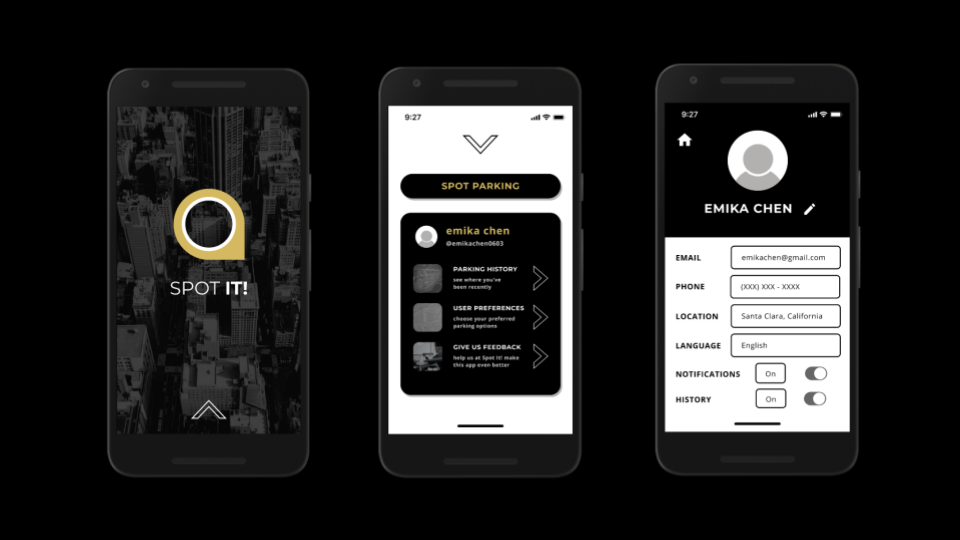
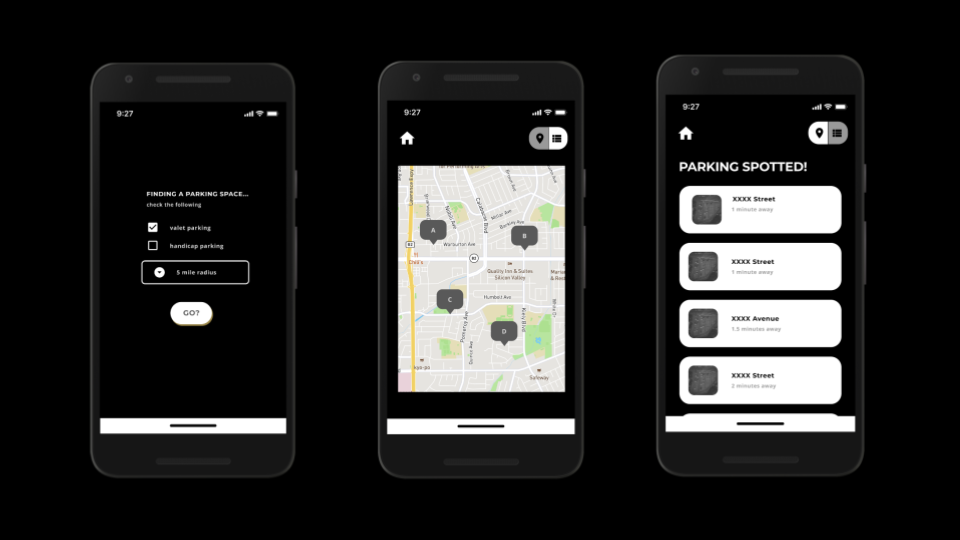
To build our app layout, we used Figma to create the wireframes for our app. By using Figma, we were able to visualize how our app would actually work for users and use that to help us better determine the details of our app.
Challenges we ran into
Throughout the hackathon, we had a pretty smooth run compared to past experiences, but of course, there were still quite a few challenges and constraints we ran into along the way. The first of these would be the time period itself. Due to other commitments that our team members had, we were actually limited to an even shorter amount of time than what we had originally planned. We had to begin Saturday morning and complete the entire project within nine hours. We worked for these nine hours with little break, all virtually, but we managed to overcome this issue. Additionally, this was our first time using Figma. As it was a completely new experience, we had to work with the added challenge of learning how to use the new platform. Lastly, although both of our team members have participated in hackathons before, we’ve always focused on building and developing code in some aspect. This time, our entire focus was on the proposal track, which was also a new experience for us. Overall, we were able to overcome these challenges and everything worked out in the end.
Accomplishments that we're proud of
Overall, we are really proud of how our entire project came out. From our original idea to the completed wireframe, everything turned out really well, and it is clear that the effort we put into this really paid off. The accomplishment that we would definitely be most proud of is our completed wireframe. This accomplishment signifies how well we were able to overcome the challenge that came with working with Figma, and it displays the effort we put into learning all of its features. In hindsight, the work that we did on this app is a fully functioning wireframe that we can both be proud of. Ultimately, we are really proud of putting this project together with the limited amount of time we had.
What we learned
Among all of the things we learned from our experience, our greatest takeaway would definitely be using Figma. Figma is a tool that neither of us had ever used before, so learning how to work it in such a short time span was a really great way to learn all of its features and applications. We learned how to create a wireframe from scratch and how to organize the components in a way to make the most of its resources. Figma is definitely a tool we will continue to use and implement in the future. In addition to Figma, we also learned a lot about the types of technology that are required for different navigation apps to run in real-time. It is a lot harder to implement ideas that collect real-time data on a large scale, so researching and looking into this was also a good learning experience.
What's next for Spot It!
Seeing that a lot of the techniques we plan on implementing in our app are already being used in technology today, creating a working version of this app may not be too far off in the future. Before we can do this, however, we would have to continue researching and planning out the finer details of our project. We could continue working on our proposal by further weighing out the pros and cons of each data collection technique and deciding on combining all three sources in a way that would work best for the app. We would further develop some of the features to give the users the best experience, and eventually, we may begin working on a functioning app to achieve our original goal.
Built With
- canva
- figma



Log in or sign up for Devpost to join the conversation.