-
-
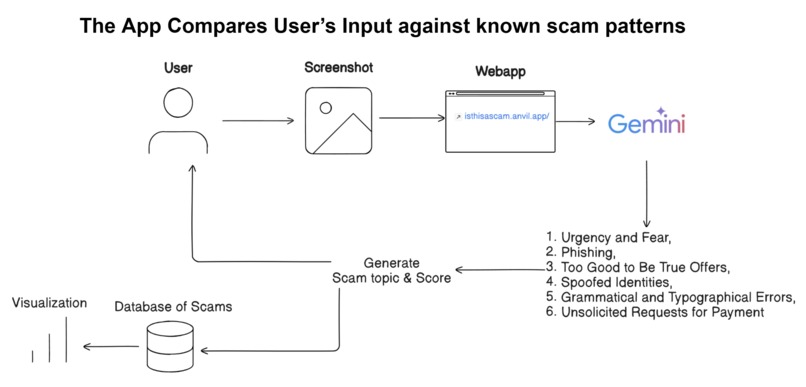
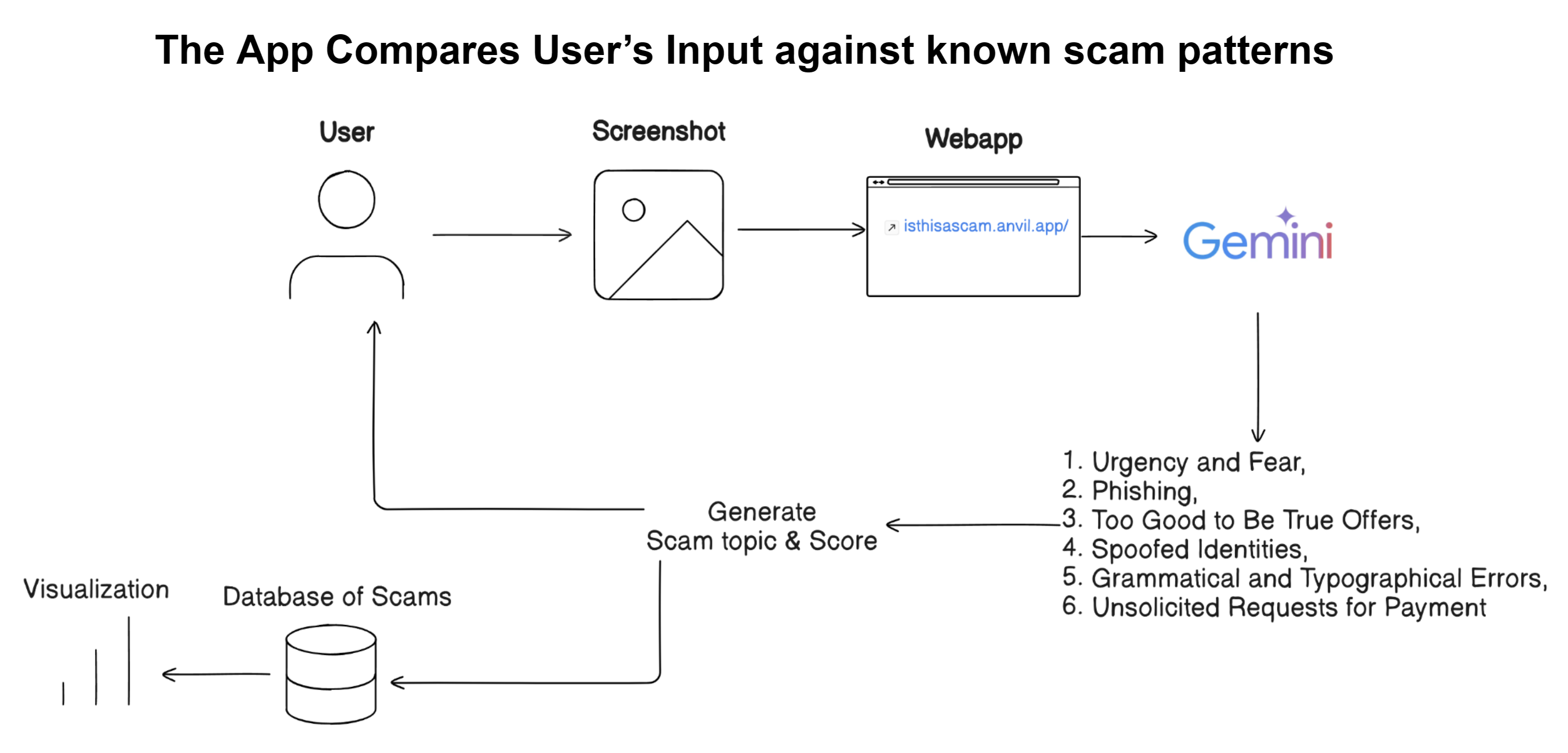
Diagram summary of the App
Inspiration
As a data analyst who originally had a bachelor's degree in Media and Communication, the idea of online scams still existing at a huge scale was something I couldn't understand. I saw all avaiable the data on scams and their patterns and knew that we can use it to do something! Finally, when I started working more with generative AI (Gemini in this case), I realized that it can be the answer to the problem.
What it does
The app allows users to upload a screenshot of different types of digital scams (emails, text, ads, etc.) and then returns a score of how likely that content is scam and the reason why. But more importantly it categorizes the scams reported by users into main topics and offers a public visualization of most reported scams by day, so it is more available to the public.
How we built it
Using Low code tools: Anvil for frontend and database, Managed notebook on Google Cloud for backend, and Google Ai Studio for interacting with the model.
Challenges we ran into
This was the first ever webapp I build so it wasn't easy to find the tools I need to use and learn what I didn't know, but it was worth it.
Accomplishments that we're proud of
When the app was live and started seeing the results and accuracy it was a simple milestone, but I was very proud.
What we learned
I learned a lot about low code tools, generative AI, and about Gemini and looking forward for this project to grow and to more projects after.
What's next for Scam Detection - Is this a scam?
As the app starts to get more traffic and users, the database of reported scams will grow and will help provide a public source of what scams are more recurring and which scams are growing further. Also, once the data of scams is sufficient enough, I can build more visualizations to look further into the data.


Log in or sign up for Devpost to join the conversation.