Inspiration
What inspired me to create Safe Routes was a single, harrowing statistic. I learned that in Los Angeles County, a staggering 58% of all homicides in 2023 were gang-related. I was also deeply disturbed by the fact that many children are exposed to environments with significant risks, including child trafficking and general neglect. These numbers represent not just data points, but real children whose safety is compromised every single day. I couldn't ignore the fact that the simple act of walking to school could be a terrifying and dangerous journey for so many. My personal motivation became clear: to build something that could give parents and their children a little more security and peace of mind.
What it does
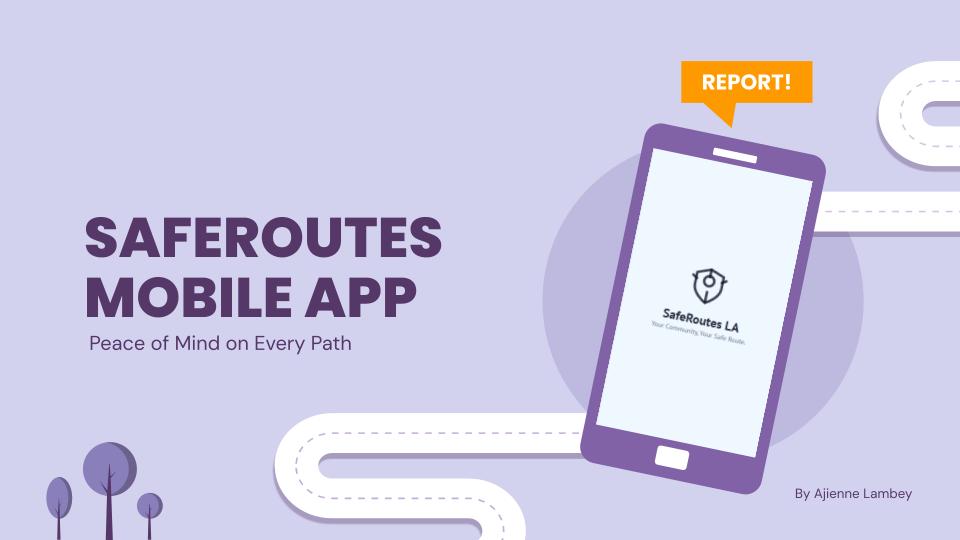
Safe Routes, provides a verified network of local businesses as 'safe havens.' We're not just creating an app; we're building a B2B platform that allows schools and cities to purchase a scalable solution for youth safety, giving parents peace of mind and creating safer communities for everyone.
How we built it
Given the time constraints of a hackathon, I had to be smart about how I built the project. I chose to create a high-fidelity, clickable prototype using a no-code tool instead of writing code. This allowed me to focus on the user experience and the core functionality of the app.
Challenges we ran into
The biggest challenge was shifting my mindset from B2C to B2B. Initially, I was thinking about features that would appeal directly to a parent, but I had to pivot to think about the features that would appeal to an organization. This meant considering things like data security, administrative dashboards, and reporting tools. I had to quickly learn what schools and cities would need to justify the cost.
Another major challenge was grounding my emotional motivation in hard data. The statistics on gang violence and child trafficking in LA County are jarring, but they were essential for building a compelling case for my project's necessity. I had to research, verify, and properly cite these figures to prove to the judges that this was a real and urgent problem.
The time limit was, of course, a constant challenge. I had to prioritize ruthlessly and focus only on the absolute essentials for the prototype and pitch. It forced me to be creative and strategic in my approach, proving that even a powerful, complex idea can be communicated effectively with the right tools and a clear vision.
Accomplishments that we're proud of
I grounded my emotional mission in hard, verifiable data from sources like the Los Angeles County Sheriff's Department and The Times. This proves the project addresses a significant and urgent real-world problem.
I successfully transitioned the business model from a non-scalable, non-equitable B2C model to a robust and sustainable B2B social enterprise model. This demonstrates my ability to think critically and strategically about market viability and social impact.
What we learned
Building this project taught me that a powerful idea needs a viable business model to truly make an impact. At first, my instinct was to make it a B2C (Business-to-Consumer) app and charge parents a small fee. However, I quickly realized this would limit its reach to only those who could afford it, leaving the most vulnerable children behind.
I learned that a B2B (Business-to-Business) model was the key to scalability and social good. By selling the service to school districts, local governments, and community businesses, I could provide the app to children and families for free. This model turned my project into a social enterprise, where the business's success is directly tied to its social mission. I realized that my customers—the schools and cities—would be motivated by student safety, liability reduction, and public relations. Meanwhile, the community businesses would be motivated by corporate social responsibility and brand enhancement.
What's next for SafeRoutes App
My next steps are focused on turning this hackathon project into a real-world solution.
Phase 1: Secure a Pilot Program (Next 1-3 Months)
I will approach a single Los Angeles County school or community organization to pitch a pilot program.
The pilot will be a small-scale, neighborhood-specific test to validate the app's effectiveness and gather user feedback.
During this phase, I will also begin reaching out to local businesses to build the initial network of "safe havens."
Phase 2: Product Development & Network Expansion (Next 3-9 Months)
Based on pilot feedback, I will secure seed funding to build a fully functional, coded app (for both iOS and Android).
I will work to formalize the vetting process for safe haven businesses, potentially in partnership with local law enforcement or community non-profits.
I will begin to actively scale the business by reaching out to more school districts and municipalities across Los Angeles County.
Phase 3: Scaling & Data-Driven Insights (Next 9-18 Months)
I will launch an administrative dashboard for B2B customers, providing them with valuable data and analytics on app usage, safe route trends, and the impact of the network.
I will explore partnerships with other organizations working on youth welfare and safety.
The long-term vision is to expand the project to other at-risk cities, making the Project Safe Path model a national standard for community-based child safety.

Log in or sign up for Devpost to join the conversation.