-
-
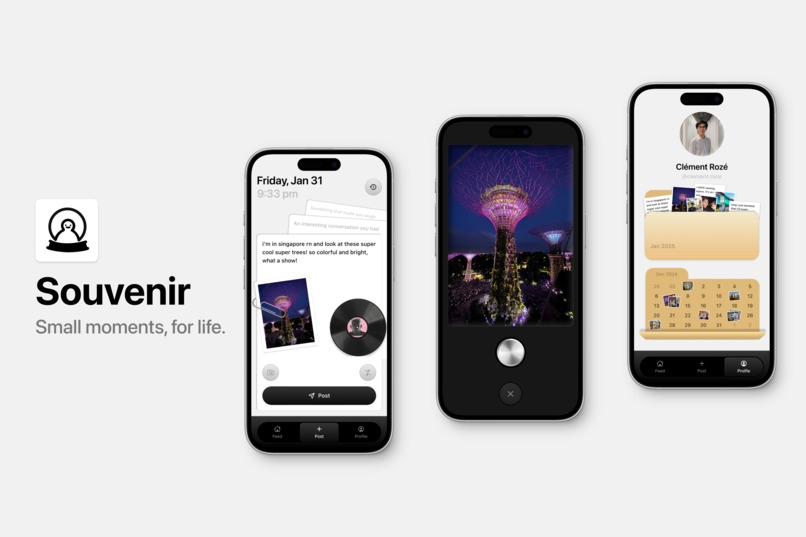
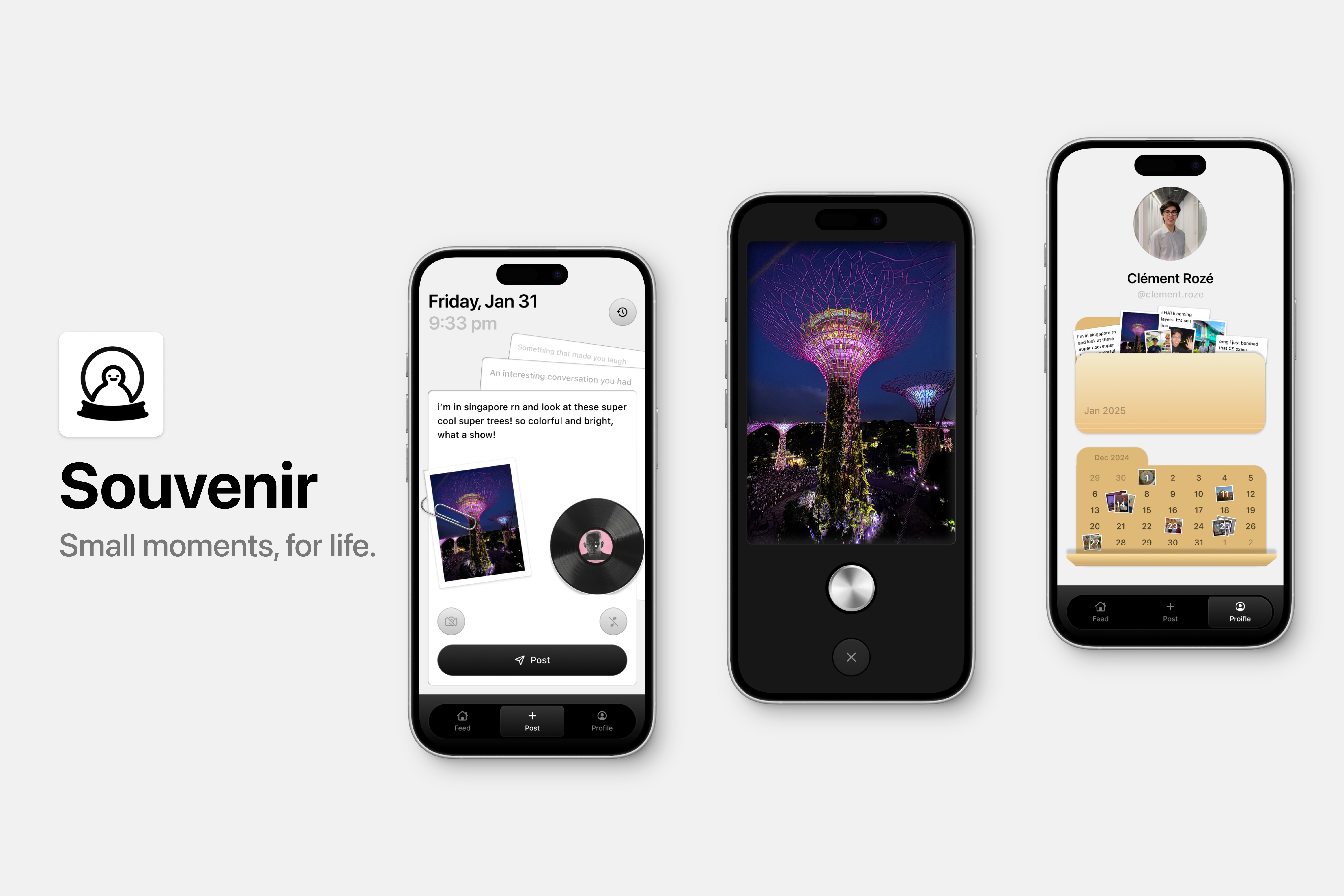
3 phones showing the Post, Camera, and Profile screens
-
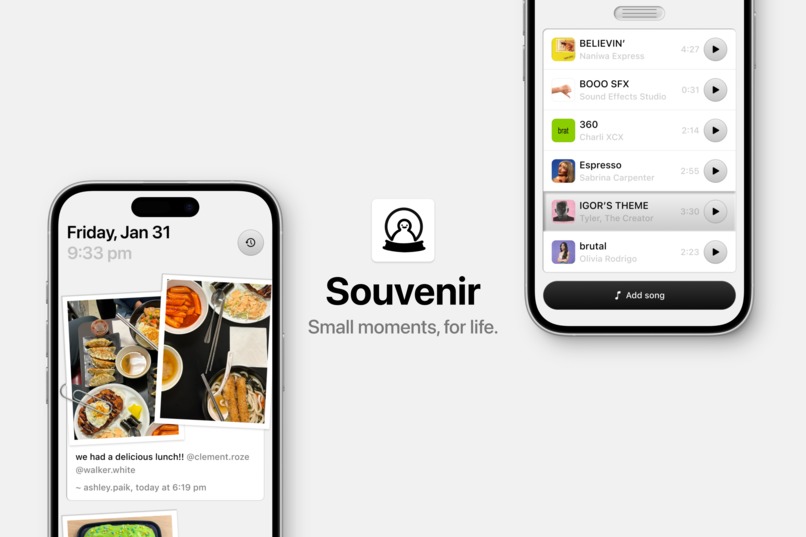
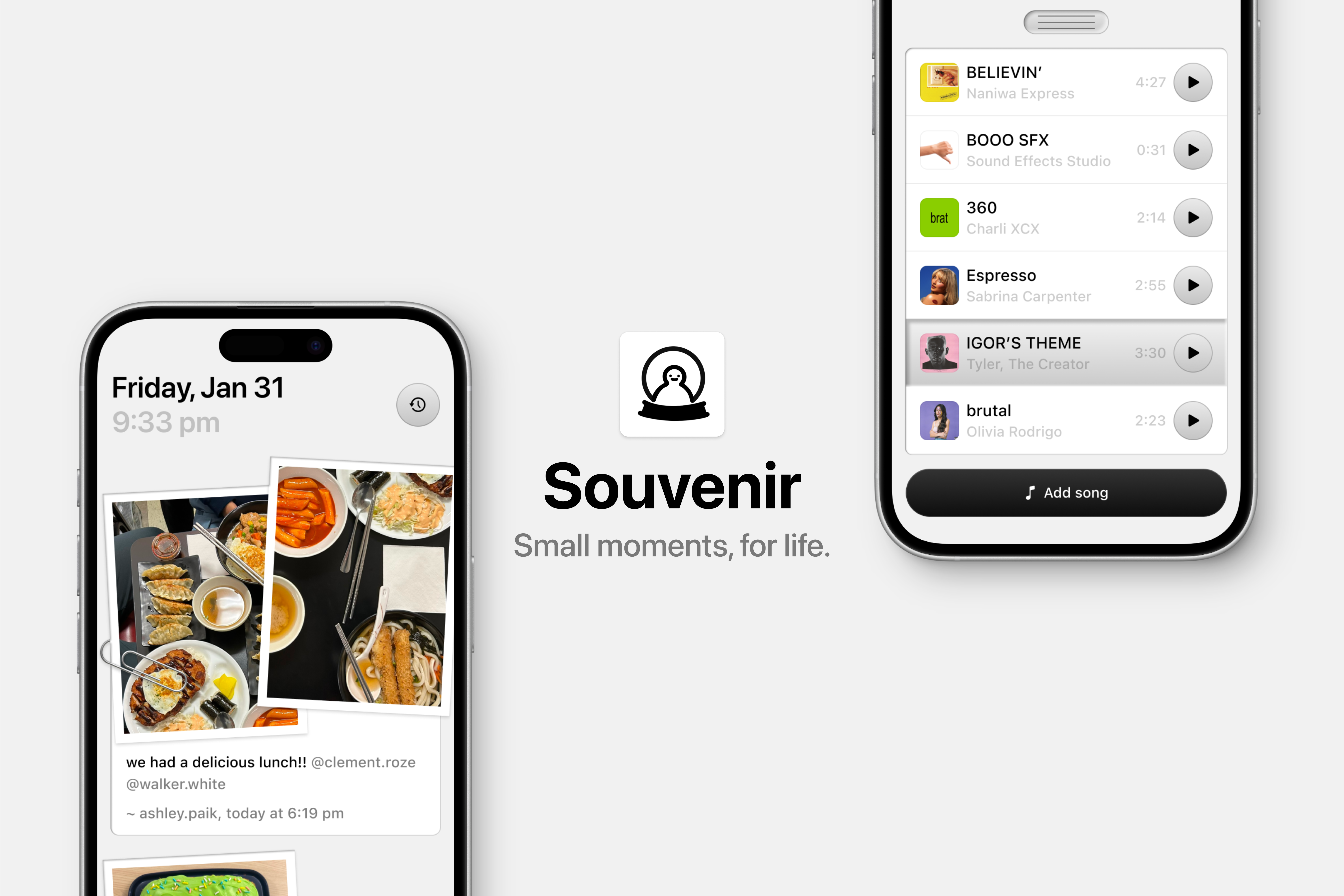
2 phones showing the Feed and Music Selector screens.
-
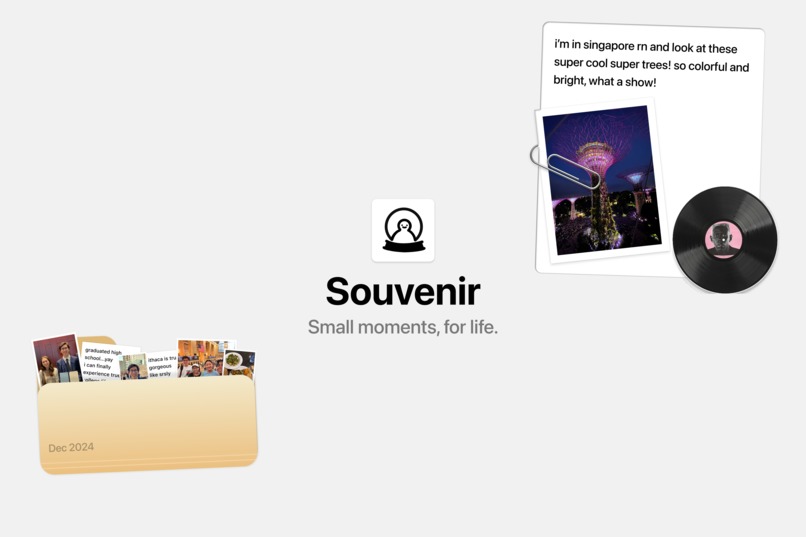
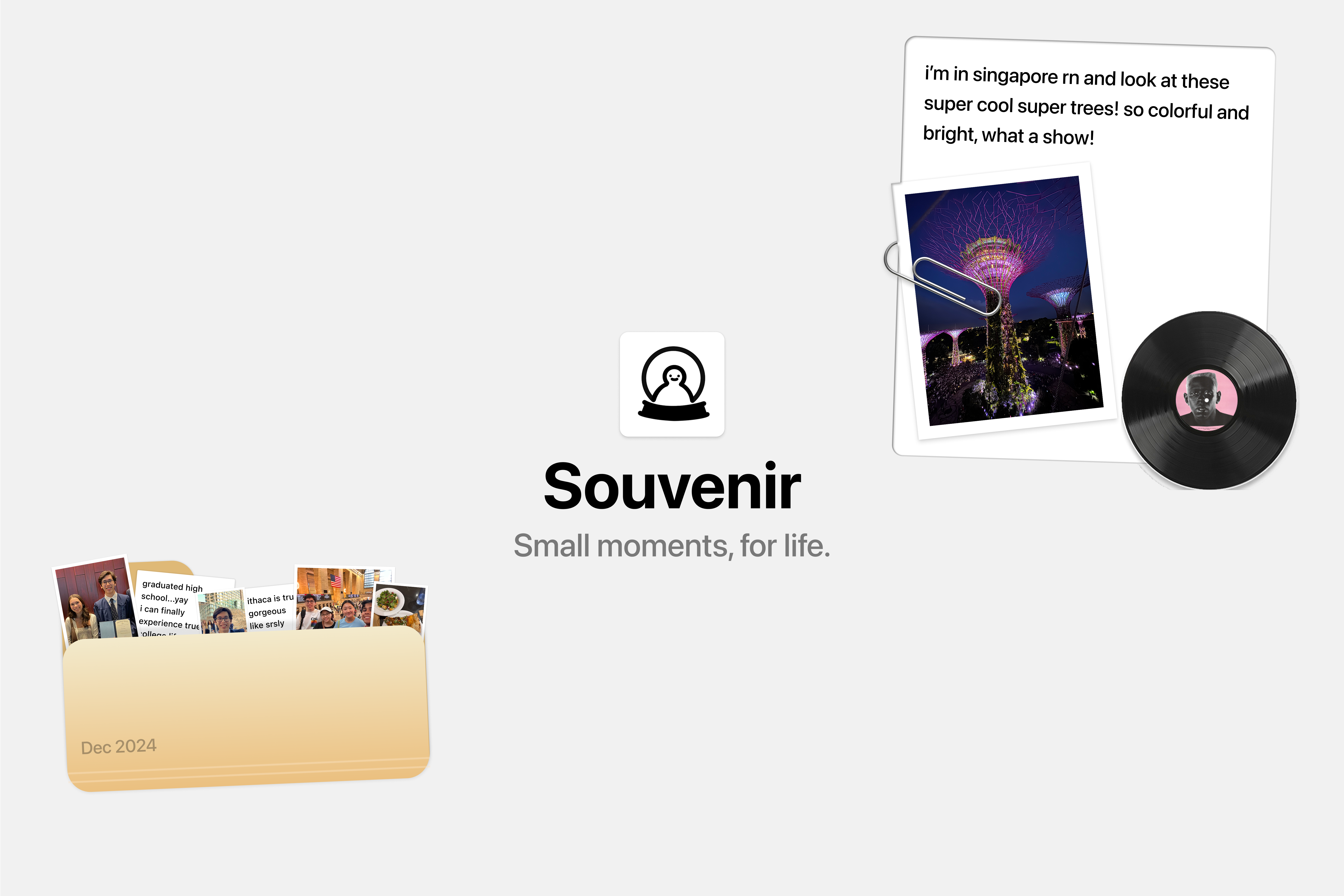
Various UI elements of Souvenir, including a folder and a post with an attached picture and accompanying audio
- Prototype link (Please submit a link to a playable prototype, not a link to your design file)
- Describe your project (max 150 words)
Souvenir is a social journaling app that encourages original thought and meaningful reflection on our daily lives. Unlike other digital journals, it encourages users to form a daily habit of capturing small moments shared with close friends and family that make their lives special.
When users open the app, they can quickly jot down daily moments and add a photo or song. Optional prompts (e.g., "What made you laugh today?") help spark deeper reflection. Entries can’t be copy-pasted, ensuring all content is original and intentional. Users posts appear chronologically in a social feed for friends to see, free from algorithmic curation.
Souvenir combines both personal reflection with social engagement. Users can tag friends in entries, and on significant dates, the app resurfaces those shared moments. Alongside browsing past entries, a weekly recap compiles notable moments, offering an easy way to reflect on recent experiences.
- Describe your research process and findings. If you conducted any surveys or interviews, please include the survey form and/or interview questions here. If you conducted secondary research by pulling from online sources, please include a link to your sources. (Max 500 words)
In our user research, we dove into two main questions: how do people currently capture and share their personal memories, and how is AI's growing presence affecting the way we express ourselves online? We used a mix of interviews, surveys, and academic papers to get the full picture.
We conducted eight 1:1 interviews about how individuals document their lives, what motivates them to share personal moments, and how they feel about existing social media platforms. A particularly notable finding was that all participants wanted to document their daily experiences, but most struggled with consistency and felt overwhelmed by traditional journaling. This was due to a number of factors, ranging from a lack of motivation to sit down and write with pen and paper, to a lack of time stemming from a busy schedule. In terms of sharing everyday moments and sentiments, almost all interviewees expressed some hesitation in sharing personal moments, mentioning how they didn’t want to bother others with trivial concerns or observations.
To further quantify these insights, we distributed a survey on reflection habits, motivations for journaling, and social media usage to over 30 individuals, aged 18-45. We discovered similar results: 81.25% wished they documented their daily life more regularly, but more than two-thirds found traditional journaling too time-consuming. Perhaps most striking was that 87.5% said they feel pressure to "curate" their lives on current social platforms, while 62.5% wanted a more authentic way to share daily moments with close friends.
Our secondary research focused specifically on the intersection of AI and human creativity. A study of 36 participants showed that while AI tools increased the number of individual creative ideas by 15%, they actually lead to less diverse content at an overall group level. This same study also revealed that people feel less responsible and less connected to work they make with AI help, which raises concerns about how meaningful generated content really is. Adding to this, a paper from Frontiers in Artificial Intelligence argued that over reliance on AI may lead to a decline in human writing abilities due to reduced practice. Furthermore, research study found that although AI algorithms on social media increase user engagement, it may also contribute to echo chambers and conformity, highlighting a widespread trend of prioritizing short-term rewards.
What emerged from all this research was a clear mismatch between how people want to document their lives authentically and what current platforms and methods offer them, made even more complex by growing concerns about AI's impact on personal expression. The interviews and surveys drove home people's desire for easier ways to capture memories and more authentic sharing spaces, while the academic research highlighted just how important it is to preserve human-generated content as AI becomes more prevalent in our digital lives.
- Describe your most important design decisions. What research findings and/or user testing results led you to make these decisions? (Max 500 words)
Conquering the Blank Page
One of our most important design decisions was choosing to lean into the journaling side of this application rather than a traditional social media or long form blogging app. From our user interviews, a major concern was the time and effort needed to sustain journaling as a daily habit. After iterations on different lengths and types of entries, we decided to use small cards to represent our entries, as its lightweight format helps take away the challenge commonly associated with filling an entire page in a physical journal. Users can choose to write about multiple aspects of their lives by intuitively swiping through a small stack of prompts asking about different aspects of their day.
Interactive, but not Generative
Facilitating intuition and personal creativity is another major goal of this app. Souvenir does this by adding options to include different types of media in an entry, such as photos, music, and text, to give users power to express themselves. Text prompts encourage the user to mindfully write a short message without the help of external artificial tools. Other media types, like photos and music, draw from our findings in user interviews. Multiple interview participants described how music often triggered memories of everyday moments they wouldn't have otherwise recalled, with one noting "hearing a specific song brings me back to moments I had completely forgotten about." These physical reminders serve to make recollections of a specific memory more vivid and relatable in a way that text often cannot.
Secondary research reveals that AI can improve writing quality at the cost of individual creativity and content novelty. This pushed us to consider: can we encourage users to practice original thought while keeping the experience lightweight and fun? We chose to add additional, optional prompts asking users about different parts of the day. These prompts focus social interaction, reflection on meaningful events, and engagement with fun topics. Ultimately, Souvenir encourages users to be more conscious of what happens during the day.
A look with personality
For the visual design, we decided to incorporate skeuomorphic elements, referencing familiar analog items like folders and vinyl disks. This decision was driven by a combination of secondary research and intentional aesthetic choices. First, many studies indicate that non-digital objects provide a sense of familiarity and lower the learning curve of a software for older adults, while maintaining the same level in ease of use compared to flat or minimalist designs for younger adults. Additionally, the concept of childhood brand nostalgia, or the increased likelihood of using an app or feature based on nostalgic feelings evoked by the software, has influenced us to specifically incorporate design idioms that many gen-z and late millennial users have seen in technology popular during their childhood. This includes buttons inspired by the old iPod and iPhone home buttons, UI elements with perceived indentations and extrusions, and in-app photo layouts inspired by polaroid photos.
Built With
- figma


Log in or sign up for Devpost to join the conversation.