-
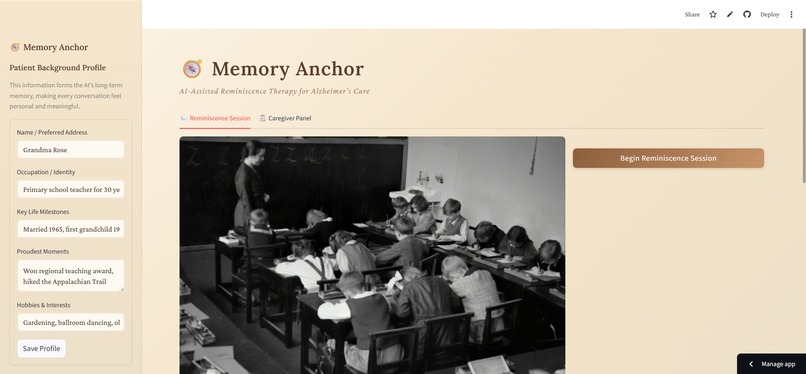
General view of the project
-
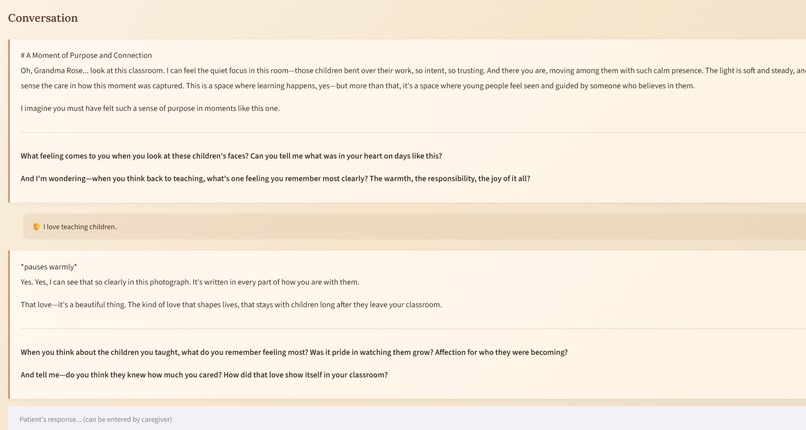
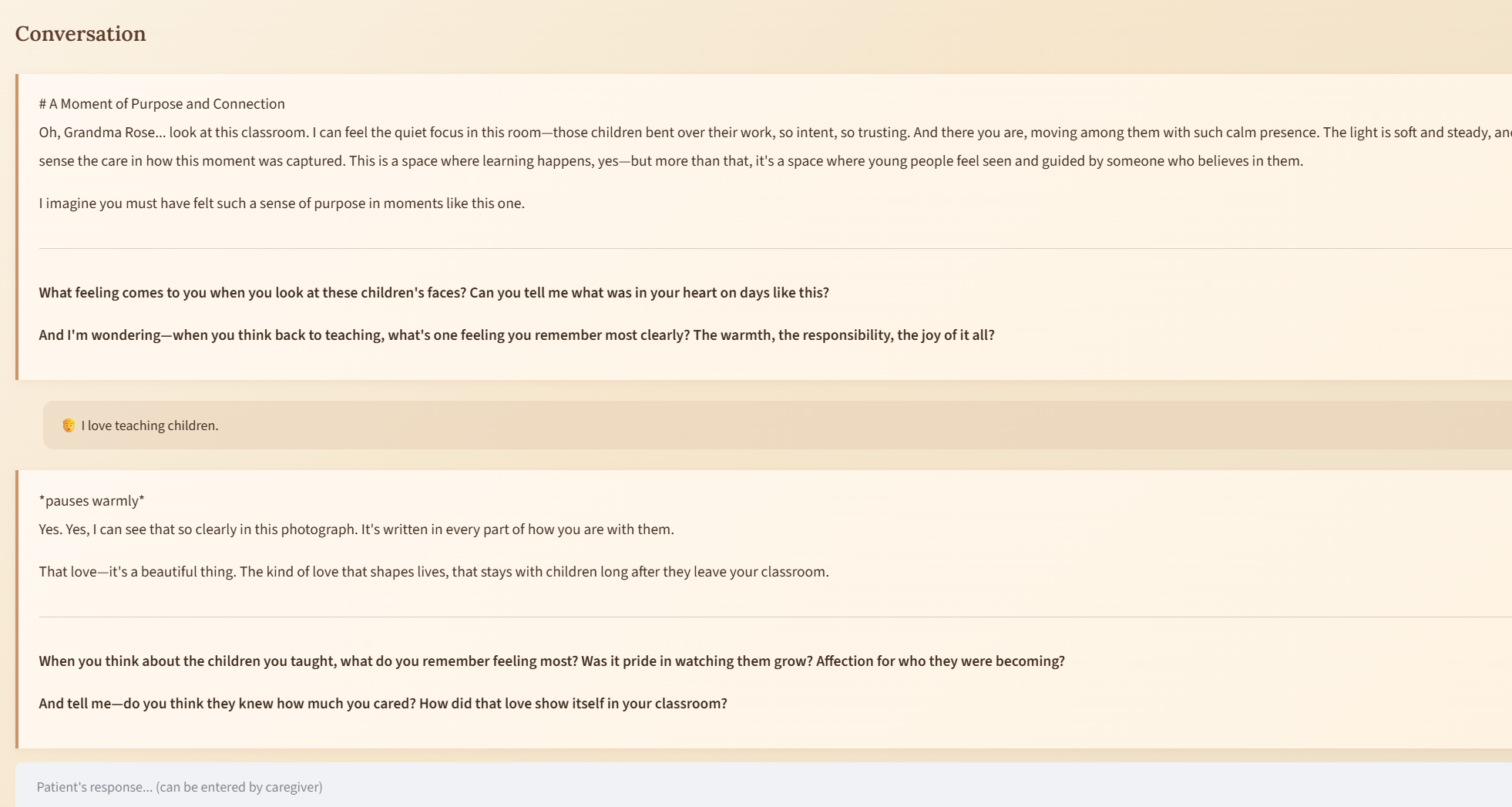
The conversation of reminiscence.
-
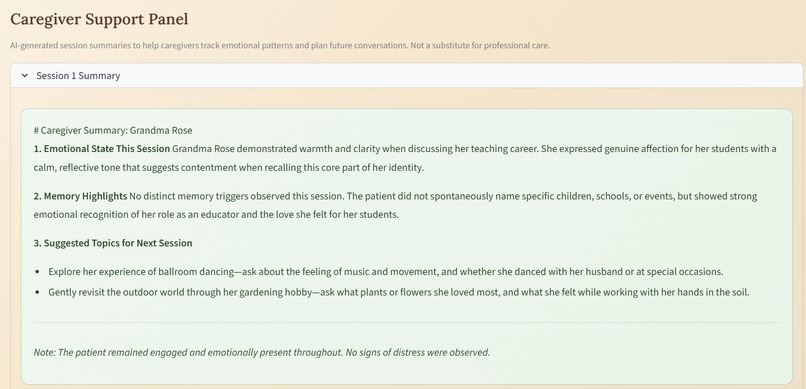
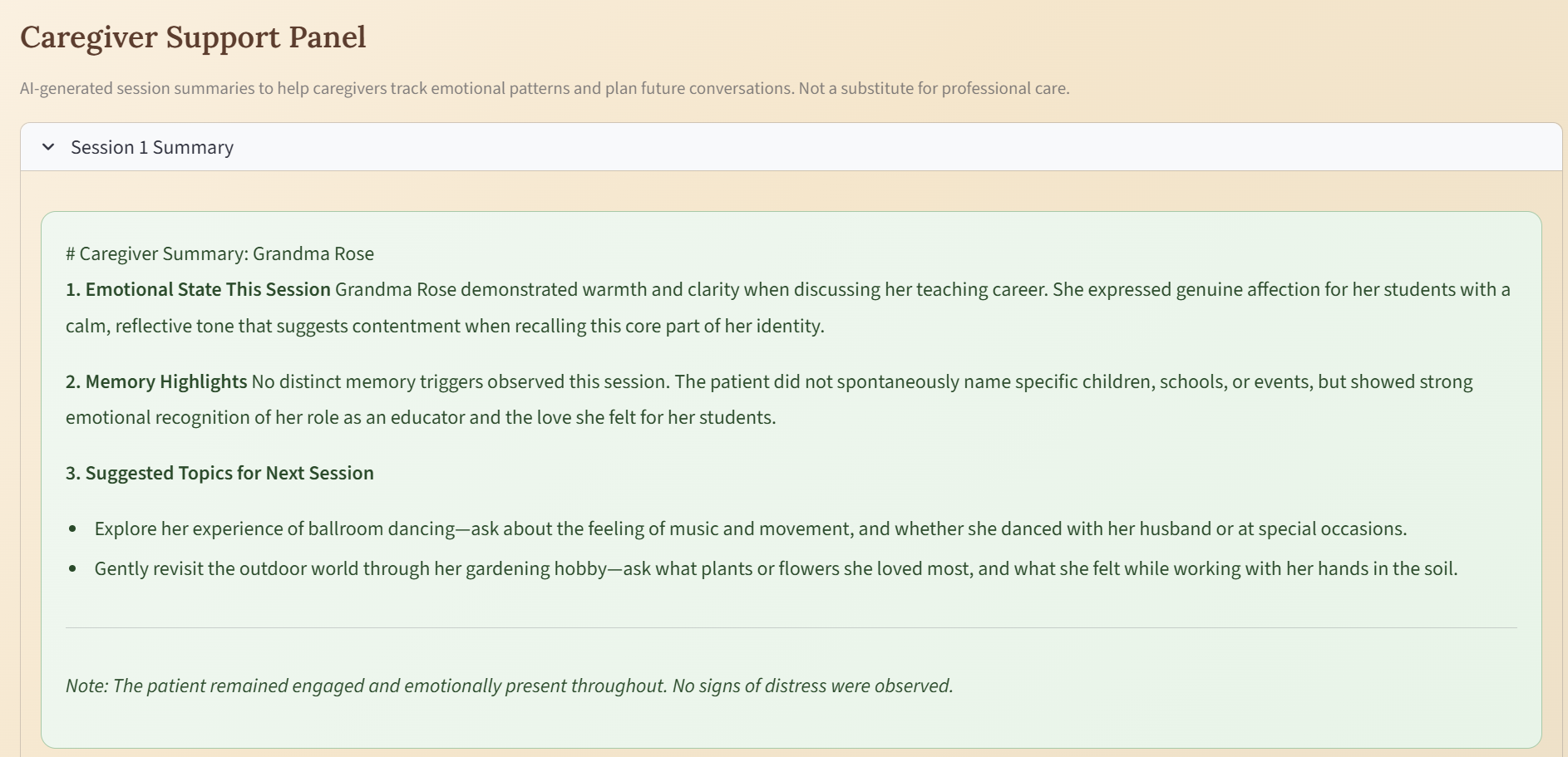
Summary for family members or caregivers
Inspiration
I focus on the most profound challenge of aging: Alzheimer’s disease. For the 55 million people living with dementia, the “fading of self-identity” is a silent tragedy. I realize that while short-term memory disappears, emotional resonance with the past remains. Memory Anchor was born from the desire to use AI not to replace or rebuild human memory, but to act as a “Cognitive Prosthesis” to reclaim dignity through the power of patients’ stories.
What it does
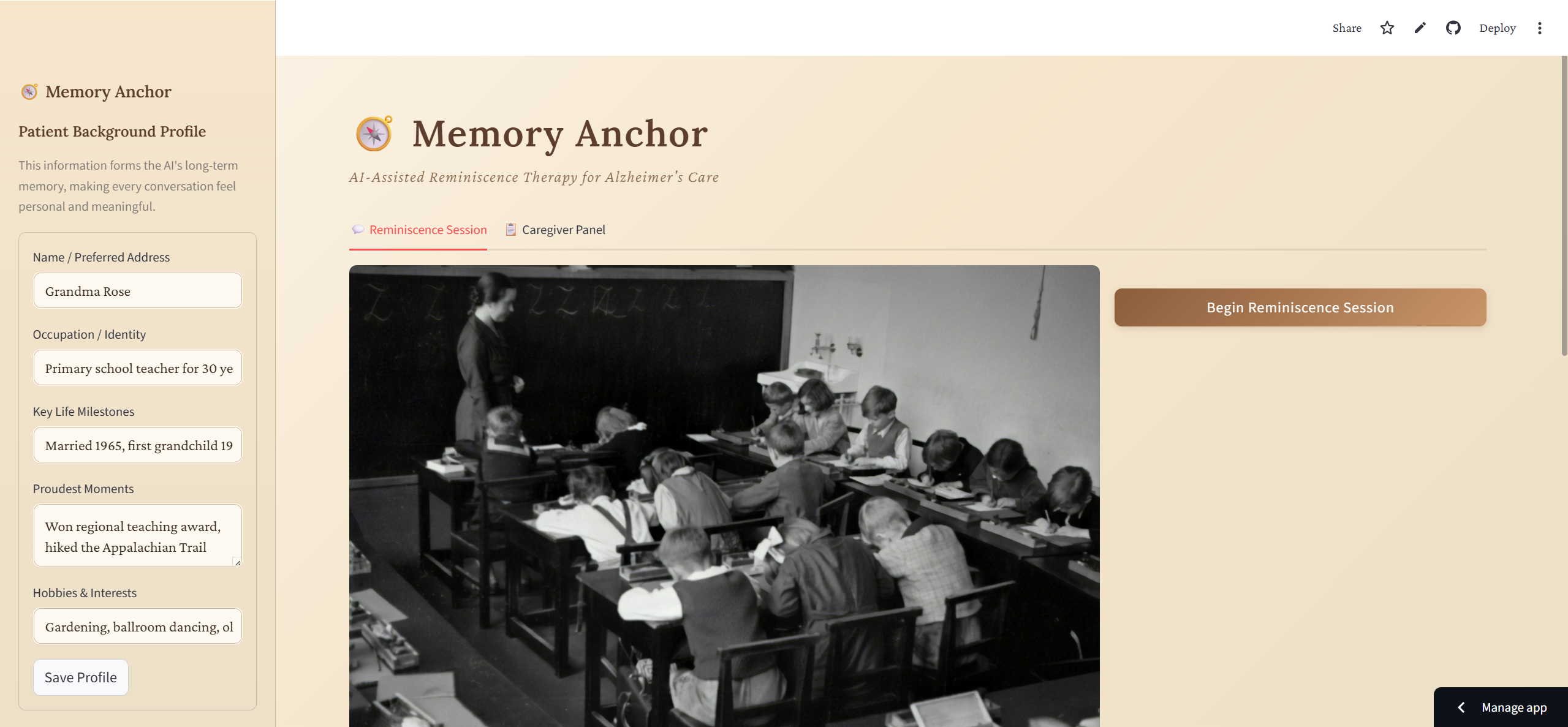
Memory Anchor is an AI-assisted Reminiscence Therapy tool. It allows caregivers to upload old photographs and combine them with a detailed Patient Background Profile.
1. Personalized Context Injection
Unlike generic AI tools, Memory Anchor starts with a Patient Profile. By injecting the patient’s life history—their career as a teacher, their love for the Appalachian Trail, or the year they married—directly into Claude’s context window, we ensure every interaction is rooted in the patient’s unique reality. This prevents "generic AI talk" and creates instant familiarity.
2. Nuanced Visual Empathy
We leverage Claude’s industry-leading vision capabilities to analyze faded, vintage photographs. In the example case, the AI doesn’t just “see” a classroom; it recognizes the 1970s-style chalkboards, the specific atmosphere of pride on a young teacher’s face, and the era-specific details that serve as “Memory Anchors.” It then weaves these visual cues together with the patient’s personal background to initiate dialogue.
3. Ethical Prompt Engineering
To ensure psychological safety, I implemented a Non-Testing Paradigm through rigorous Prompt Engineering. The AI is strictly forbidden from asking “Memory Tests” (e.g., “Who is this?”). Instead, it uses Emotional Induction (e.g., “The sunlight in this classroom feels so warm; you must have been so proud of your students that day”). This aligns with Validation Therapy—affirming the patient’s emotional truth rather than challenging their cognitive failures.
4. The Caregiver Insight Loop
Beyond the patient interaction, Memory Anchor generates Caregiver Summaries. It analyzes the session’s emotional tone and extracts “Memory Highlights”. This provides family members with actionable insights for their next visit, turning a solitary AI session into a tool for family reconnection.
How we built it
I used streamlit for fast deployment and claude for its world-leading multi-modal ability and long-context ability. Also, claude is used for writing some codes and debugging.
Challenges we ran into
I got into errors with api 404 and I/O. I also struggled with deciding whether the AI should be more curious or more gentle. A more curious AI may help the patient discover and remind more of momery details but also has a potential to ask so much that make the patient anxious.
It is also important to have a good privacy engineering. Now the personal data and pictures are only used when chatting, with no storage in the database. But if this is going to be a public platform for real patients, it's much convient not to type and upload every time they use it.
Accomplishments that we're proud of
Building a fully functional, vision-enabled, and ethically-grounded medical support tool in a short period of time. And I carefully balanced the cold technology with true warm human feelings.
What we learned
I know more about how a Alzheimer patient feel. This project is deeply personal. My partner was once misdiagnosed with Alzheimer’s, and during that period of uncertainty, I witnessed firsthand the terror and isolation this disease brings.
While we are fortunate to no longer live under that shadow, I realized that for millions of families worldwide, the 'all-clear' never comes. So this time I use my technical skills to help those who are suffering find moments of connection, dignity, and light. Memory Anchor is my way of turning personal gratitude into a purposeful contribution to global dementia care.
What's next for Memory Anchor
This is a system that help the patient and caregivers better life and experience. It needs more experts to carefully design what is the redline for AI and how to communicate better with patients. Maybe a voice can help a lot. And it can be scaled to a cross-platform app.
But as an AI, it still can go wrong even with great prompts. So it may still need some hard-coded regulations.
The three critical questions
Target Audience: Built for early-to-mid stage Alzheimer’s patients and their family caregivers.
Risk & Mitigation: Addressed "AI Hallucination" and anxiety by enforcing a Non-Quizzing Paradigm. It also provides an instant Caregiver Alert if distress is detected. And the system needs to have a good privacy engineering if deployed in real world.
Empowerment: It acts as a "Cognitive Prosthesis". It doesn't decide for the patient; it provides the conversational bridge they need to express their own remaining memories.
Built With
- claude
- python
- streamlit


Log in or sign up for Devpost to join the conversation.