Inspiration
It’s a Tuesday afternoon. The rain is pouring outside, but you’re (lucky?) to be stuck in Zoom meetings all day. Your neighbor, unfortunately, has to walk to the grocery store. Your latest-gen umbrella would save her from getting drenched, but you have no way of knowing her plans, and she doesn’t want to disturb you.
Situations like this happen every day, all over the world. Lockr’s state of the art IoT system that reduces wasteful purchases, encourages item sharing and fosters strong communities.


What it does
Lockr is an IoT Smart Locker System that connects item owners with people who need them the most.
If you have items you don’t use very often, you simply have to download our App find a Lockr near you set prices for your items place them inside a Lockr
We’ll take care of the rest. Lockr is enabling a community of people to rely on each other.
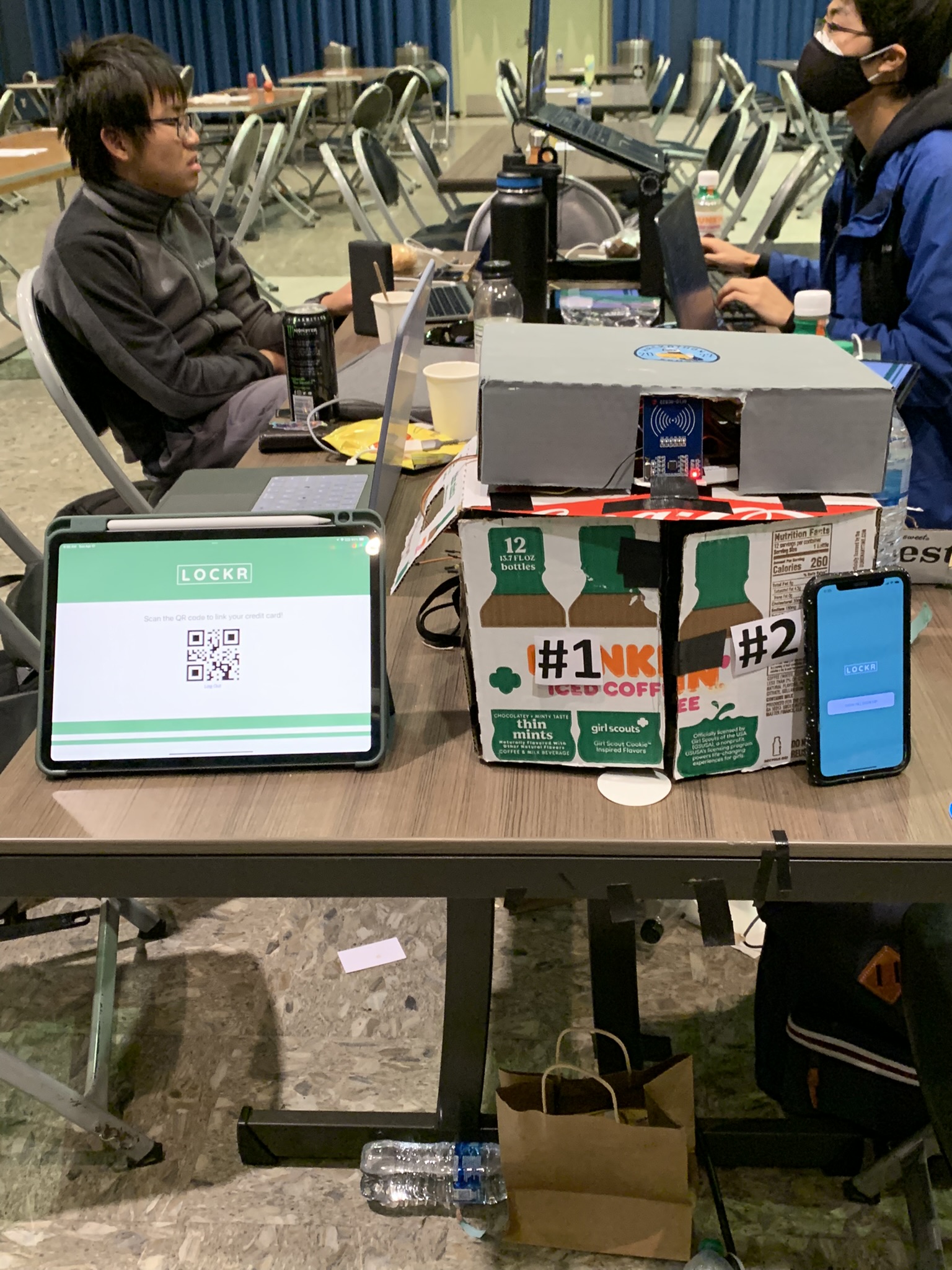
Buyers can use the Lockr App to find items, locate Kiosks and collect them immediately. We’ve integrated an RFID scanner into the lockers, so you can scan your credit card and use it to borrow items. We charge a rental fee, specified late fees and fully refundable deposits, enabling both sides to confidently transact through us.
While several companies are attempting to enable peer-to-peer rentals of household items, our integrated network with companion app, smart kiosks that control the lockers and built-in sensors that detect when items are removed, we make using a Lockr easier and more cost effective than buying items yourself, not to mention the reduced wasteful purchases of barely-used items.
In addition, we’re targeting industries that benefit from contactless item exchange, such as realtors giving prospective customers keys to a house and college dorms giving students access to shared commodities like Vacuum Cleaners
How we built it
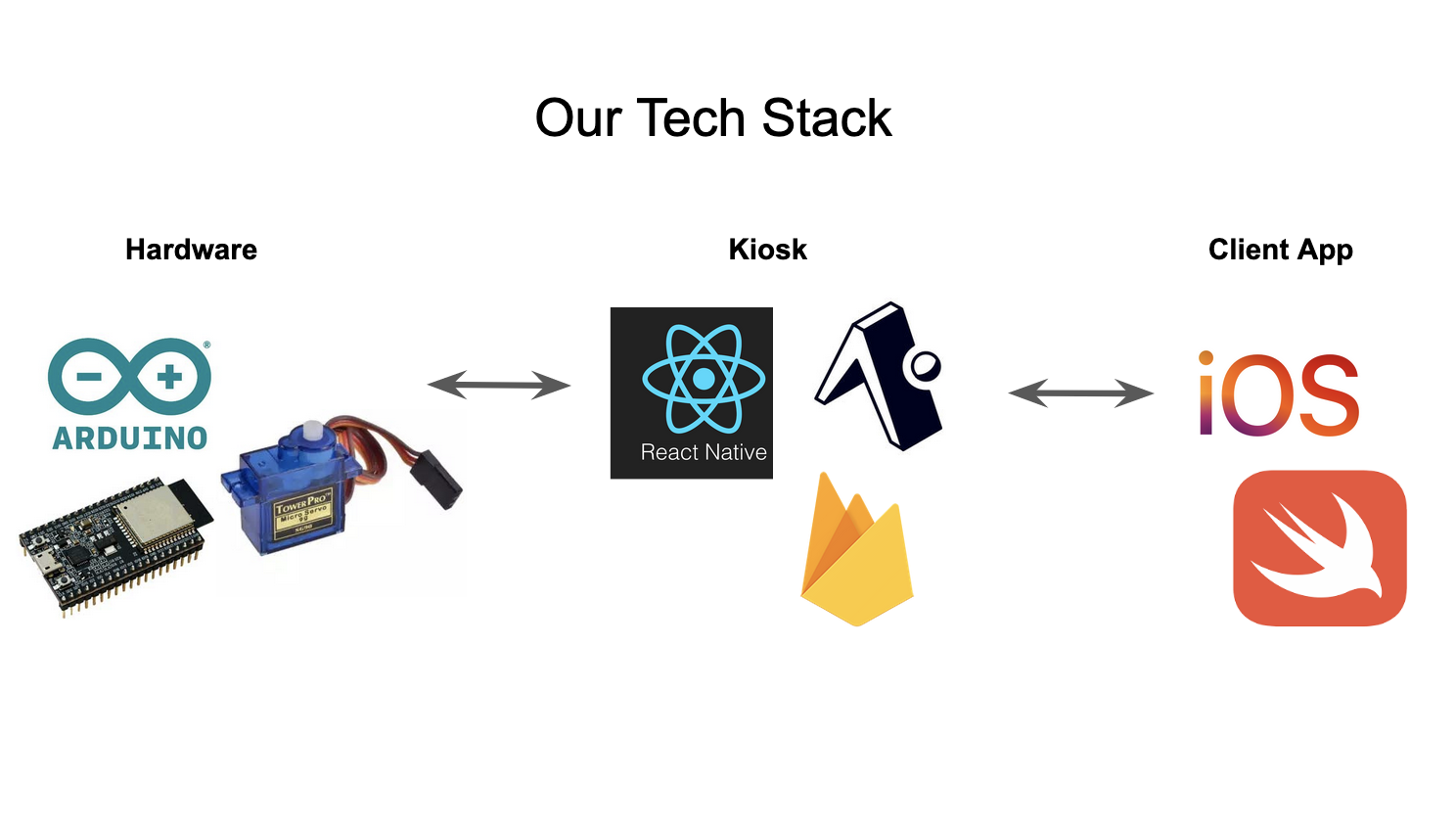
As a multifaceted IoT system, Lockr has an expansive tech stack for Lockr owners, borrowers, and lenders.
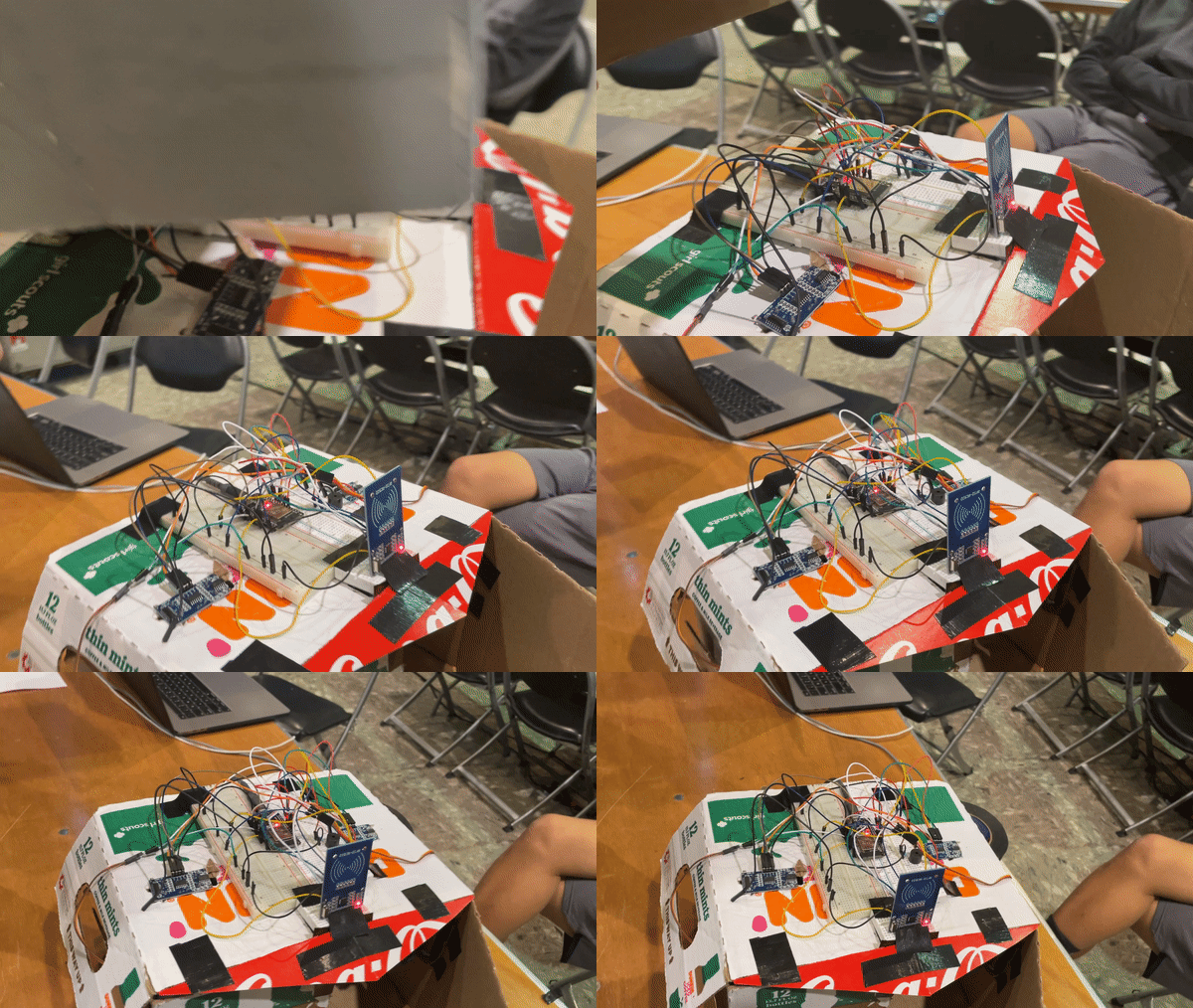
 The hardware was built with an ESP-32 Microcontroller connected to the cloud and our mobile/kiosk apps via on-board wifi. It utilizes an RFID chip to read user’s credit cards, uses servo motors to open and close the smart lockers, and ultrasonic sensors to automatically detect when to close the locker. The modularization of our hardware components are highly scalable and can be utilized in a multitude of different systems.
We also had issues with our door hinges, as a lack of high quality servo motors made it hard to properly close and fully open our doors. We improvised by using coffee stirrers to control our door movements, making full use of all the material available to us.
Challenges we ran into
On the hardware side, as a team of pure CS/CSE majors, using hardware peripherals proved to be challenging. From long upload times to faulty hardware to reinstalling python, we’ve truly seen it all. In particular, we struggled to find 2.4Ghz networks capable of supporting our RFID sensors, and faced challenges testing connections while campus WiFi was down. The RFID sensor also didn’t support our initial plan to connect BruinCards, leading to us having to pivot to Credit Cards instead.
For iOS app development, some challenges we encountered were being unfamiliar with Swift when developing our mobile app, and having multiple type match and certificate errors. We also had difficulty connecting our real-time database, with the lack of documentation complicating simple tasks.
For React-Native development, it was hard to interface with Firebase RTDB as Firestore is the more popular alternative, as well as syncing together our kiosk app with the hardware. QR code integration with the app was a struggle as well.
Accomplishments that we're proud of
Our proudest accomplishment is how, as a team, we overcame the last three paragraphs of challenges and doubts. Whenever one of us had a question or was struggling with code, the others would drop what they were doing and helped as much as they could. With our positive attitudes and never-ending list of bad taglines, we solved all our problems without feeling overwhelmed.
We’re also excited to have completed and exceeded our initial goal, which was beyond anything we could have expected. Being able to build fully functional and connected React Apps, a Swift App and an IoT System in under 2 days is testament to both the excitement we faced and the amazing support we received from the LA Hacks organizers and sponsors.
For one of our team members, this was also his first ever Hackathon (and all-nighter :)), so an amazing feat there.
What we learned
We’ve understood the importance of being calm in the event that things don’t go exactly the way we planned. On Sunday morning, just hours before the submission deadline, our entire system stopped working due to an authentication error on Firebase between Email and Apple. We were able to recover and repair our system quickly thanks to the collective effort of our team.
In addition, we’ve learnt so many new technologies. We challenged ourselves by using RFID drivers and programming languages we had only seen once or twice, and while it made some tasks challenging, we feel much more confident using these after this competition.
What's next for Lockr
Lockr is ready to take over the tri-state area! We have several exciting plans in the pipeline.
The main thrust for improving Lockr is through the iOS app. We are hoping to further integrate the backend with the front end for a more seamless experience. This would mean: Having location data of the lockers pulled from Firebase and reflected in the map Tapping the pins in the map will bring up a view of the tapped Lockr The search feature provides stronger and more relevant results, where searching for an item results in finding the closest Lockr with data and capacity information Acquiring a wifi router for increase stability and performance Implement advanced features with vision and recordings for security


Log in or sign up for Devpost to join the conversation.