Inspiration
There is a very specific, sharp, and heartbreaking smell when an onion harvest begins to rot in a storage godown. For a farmer in India or Nigeria, that smell doesn't just mean a bad crop; it means four months of backbreaking labor in the sun evaporating into thin air. We realized that losing nearly 40% of agricultural produce post-harvest isn't a farming failure it's an infrastructure failure. Farmers are growing enough food, but they are forced to watch it decay because traditional storage is blind, and commercial cold storage is completely unaffordable. We built Kanda Krates because we believe a farmer's anxiety shouldn't peak after the harvest is brought in. We wanted to build a bridge between high-tech spoilage prevention and the dusty, low-connectivity realities of rural agriculture.
What it does
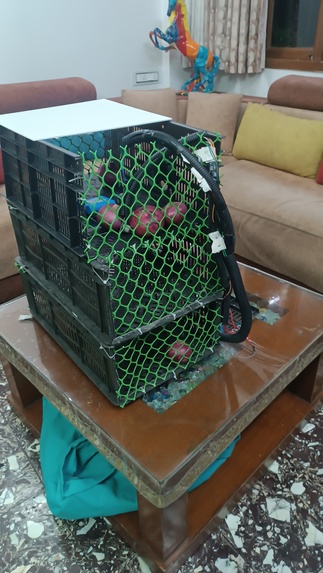
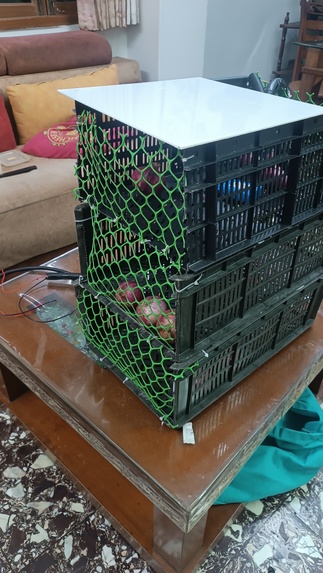
Kanda Krates is a guardian for the harvest. It’s a modular, 5-ton smart storage unit that retrofits right into the existing godowns farmers already use. Instead of relying on expensive refrigeration, it acts as an early-warning system. The unit is packed with industrial-grade sensors that monitor temperature, humidity, and the specific gases released just before onions begin to sprout or rot. When our system detects a hotspot forming in a specific crate, it doesn't just trigger an alarm it automatically activates targeted ventilation and chemical filtration to clear the gas buildup. More importantly, it translates invisible data into a simple, highly accurate directive for the farmer: Store, Ventilate, or Sell Immediately.
How we built it
We knew this couldn't be a fragile, cloud-dependent software project; it had to survive in the dirt and heat of a real farm. We engineered the hardware foundation using ESP32 microcontrollers because they are rugged, cheap, and capable of processing data locally on the edge. We wired up an array of industrial-grade gas, temperature, and humidity sensors and built a custom local network that thrives even when the internet completely drops out. On top of this hardware, we trained our AI predictive layer using historical decay rates and environmental data. The AI acts as the brain, constantly analyzing the sensor inputs to predict spoilage days before it becomes visible to the human eye, managing the automated exhaust systems to keep the microclimate stable.
Challenges we ran into
Building hardware for agriculture is unforgiving. Our first major hurdle was the environment itself godowns are dusty, humid, and subject to extreme temperature swings, which initially threw our gas sensors out of calibration. We had to spend significant time designing physical enclosures and filtering mechanisms to protect the sensors without blocking the air they needed to read. Secondly, connectivity was a nightmare. Relying on cloud computing in rural Nigeria or India is a setup for failure, so we had to aggressively optimize our AI models to run on local edge devices, ensuring the system could still make life-saving "ventilate or sell" decisions even when entirely offline.
Accomplishments that we're proud of
We are most proud of the economic reality of Kanda Krates. We didn't just build a cool piece of technology; we built a financially viable tool for people operating on razor-thin margins. By stripping away the need for expensive cold storage and utilizing localized AI, we kept the manufacturing and deployment costs so low that a farmer can recover their entire investment in just a single harvest cycle through saved produce. We are also incredibly proud of the fact that it retrofits. We aren't asking farmers to tear down their sheds and build new ones; we are just making their current sheds infinitely smarter.
What we learned
We learned that farmers don't want data; they want decisions. In our early iterations, we thought showing farmers a dashboard of temperature graphs and gas-level parts-per-million would be enough. We quickly realized that a farmer juggling a hundred tasks doesn't have time to be a data analyst. That fundamentally changed our approach to the AI. We shifted the focus from merely displaying metrics to outputting direct, actionable business advice: “Crate 4 is entering a risk zone. Ventilate now, or sell it by Tuesday.” We learned that true innovation in agriculture isn't about making things complex; it's about making complex things brilliantly simple.
What's next for Kanda krates
Our immediate next step is getting our boots on the ground for wider pilot testing across different micro-climates in India and Nigeria to fine-tune our spoilage prediction models against regional weather anomalies. From a product standpoint, we are working on a low-bandwidth SMS integration so farmers can receive critical "sell or store" alerts on basic feature phones, removing the need for a smartphone altogether. Ultimately, while we started with onions (Kanda) because of their high volatility and massive market, our vision is to adapt the chemical filtration and AI models to protect other high-risk, high-reward crops like potatoes and garlic, systematically eliminating post-harvest loss crop by crop.

Log in or sign up for Devpost to join the conversation.