-
-
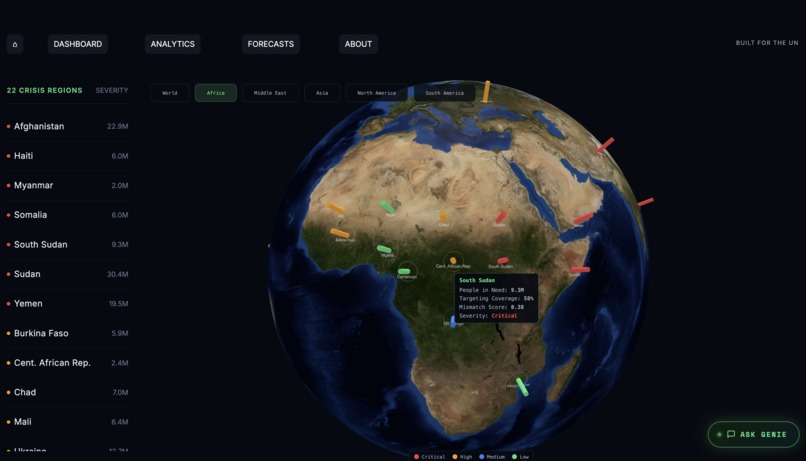
Primary Visualization
-
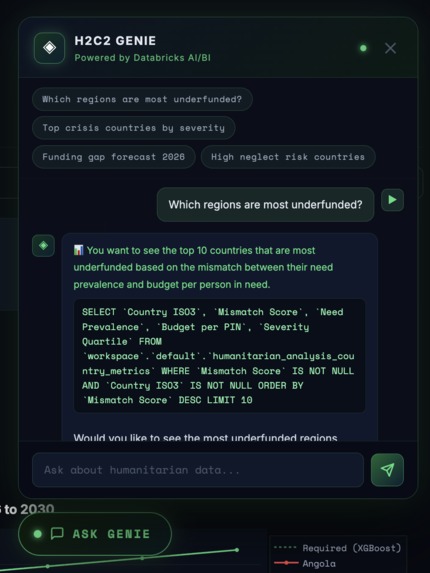
AI Genie
Inspiration
The world can always be a more positive place, and we believe in using our skills to leave an impact, however small it may seem. But in the world of humanitarian aid, we realized that the greatest enemy isn't just a lack of resources but rather a lack of time.
For those caught in a unfolding crisis, time is a luxury they simply do not have. Historically, analyzing humanitarian gaps and identifying overlooked populations took weeks of manual data aggregation and vetting. By the time the data was clear, the window for maximum impact had often closed.
We saw Databricks x UN’s Geo-Insight Challenge as the perfect opportunity to change that. We kept this question as our guiding principle for this project: What if we could turn "months of analysis" into "minutes of insight"? The power of modern Machine Learning and data platforms allows us to automate the heavy lifting of trend detection and resource benchmarking, processes that once took a lifetime can now happen in real-time. We built Insight for Impact because we believe that when lives are on the line, the speed of our technology should match the urgency of the need. This was our chance to use our abilities to ensure that no crisis remains invisible and no moment is wasted.
What it does
Insight for Impact is an AI-powered humanitarian command center featuring four core capabilities:
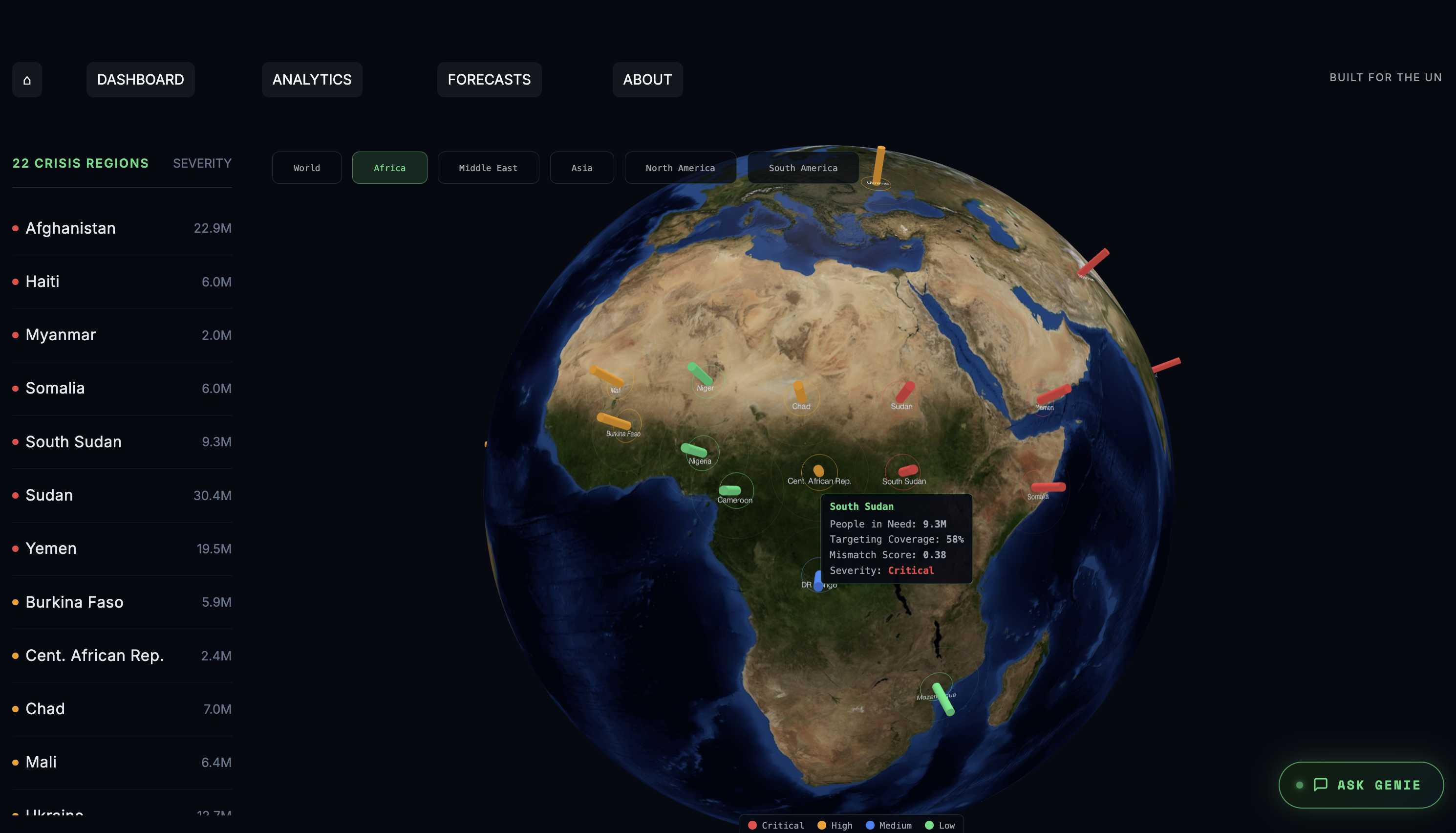
Crisis Monitoring: An interactive 3D globe visualizing real-time vulnerability hotspots and funding coverage across 20+ countries.
Funding Optimization: An analytics engine that benchmarks project efficiency (beneficiary-to-budget ratios) to identify funding mismatches.
Predictive Intelligence: ML models that forecast future resource demands based on historical patterns.
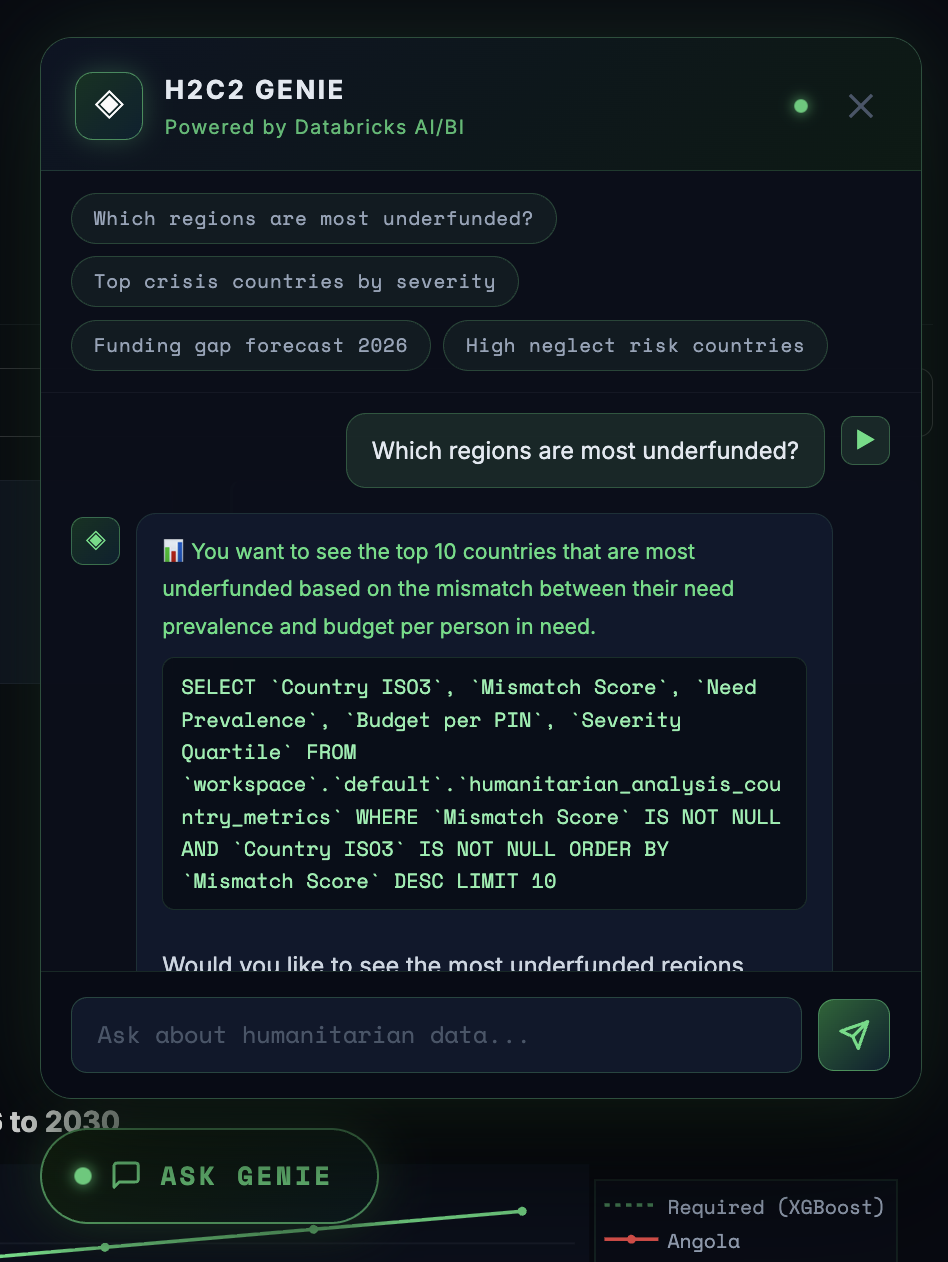
Conversational AI: Integrated Databricks Genie, allowing users to query live crisis data using natural language (e.g., "Which regions are most underfunded?") for instant, data-driven answers.
How we built it
Our architecture prioritizes real-time intelligence and a professional design:
Frontend: Powered by Streamlit and custom CSS, featuring a dark theme inspired by high-end surveillance dashboards.
Visualization: The interactive 3D globe was rendered using Globe.gl (WebGL) for smooth, data-rich interactions.
AI Integration: We leveraged Databricks Genie for natural language processing.
Data Layer: Managed with Pandas for entity tracking and project benchmarking, designed for seamless scalability to real UN Pooled Fund databases.
Challenges we ran into
Our primary hurdle (one that plagues all who work with data) involved the complex preprocessing of disparate UN datasets to ensure we could extract accurate, high-integrity insights. Navigating various data formats required a thorough cleaning phase to normalize indicators across different regions and humanitarian sectors. By systematically resolving these data inconsistencies, we were able to build a reliable foundation for our analysis and forecasting models in Databricks. This process reinforced the reality that in crisis response, the impact of AI is only as strong as the quality of the data powering it.
Accomplishments that we're proud of
We are incredibly proud of building a production-ready humanitarian command center in under 36 hours. A major highlight was attending the Databricks lecture and immediately pivoting to integrate their software into our app; learning and successfully deploying a complex new tool like Databricks Genie in such a short window was a massive technical milestone for us. We saw the Geni feature as a game-changer for non-technical humanitarian workers who need instant answers without writing code.
We are also proud of the high-fidelity design of the application. We managed to move beyond the prototype look to create a professional interface that simulates commercial software. Ultimately, we’re most proud that Insight for Impact provides a scalable solution to a massive, large-scale problem. We didn’t just build a demo, we built a bridge between high-level data and the human beings who need it most.
What we learned
Mastering the Databricks Pipeline: We learned to implement a Databricks AI/BI pipeline under pressure, gaining hands-on experience polling asynchronous endpoints and parsing complex data formats to handle real-world queries.
Integrating ML with Live Visualization: We successfully bridged high-level Machine Learning pipelines with dynamic visualizations, ensuring that sophisticated backend logic translates into actionable insights.
Solution-First Design: We embraced a philosophy of solving critical issues over being flashy, learning that the best technology often focuses on getting the right information to the right people as quickly as possible.
What's next for Insight for Impact
We believe Insight for Impact addresses a critical, real-world gap in humanitarian logistics. If fully developed, this platform could provide the UN and its partners with a transformative tool for navigating complex global crises. To transition from a hackathon prototype to a field-ready engine for change, we have identified the following key steps:
Live Data Integration: Connecting directly to UN OCHA Pooled Fund production databases to replace sample data with real-time severity scores and project budgets.
Asset & Resource Mapping: Integrating a global database of on-the-ground resources—such as medical supplies, logistics hubs, and personnel—to provide a complete picture of humanitarian capacity.
GenAI Response Planning: Using the power of GenAI to cross-reference current resources with crisis data to formulate instant response plans. This would allow coordinators to generate data-backed strategies in seconds rather than days, matching help to the areas of highest urgency.
Predictive ML Hotspots: Refining our models to forecast future needs, enabling organizations to pre-position resources before a crisis reaches a breaking point.
Field-Ready Accessibility: Developing mobile-responsive views and offline capabilities for responders in low-connectivity zones, ensuring critical insights are available exactly where they are needed most.

Log in or sign up for Devpost to join the conversation.