Inspiration
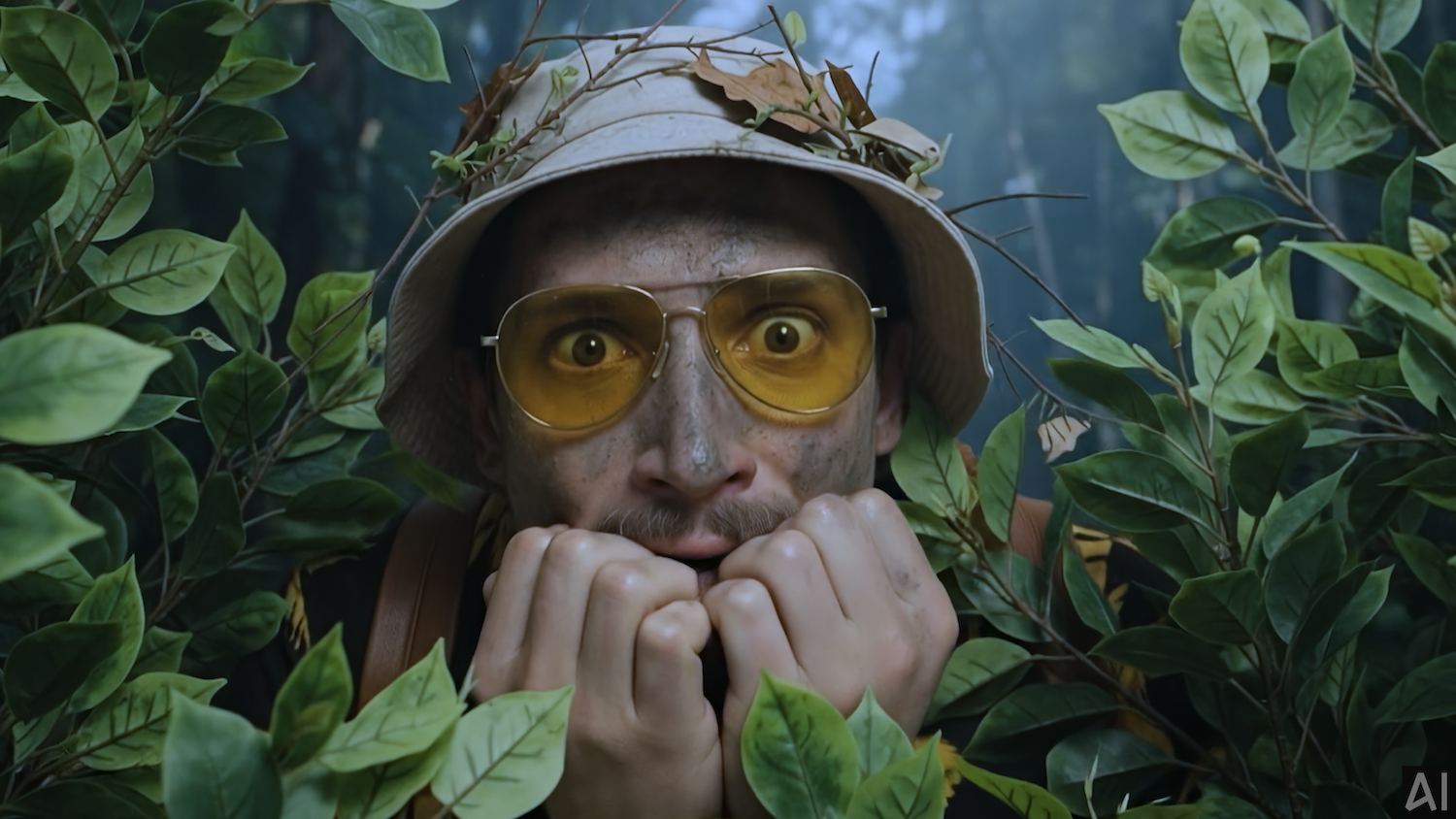
From a Festival Prompt to a Short Film This project started as my entry for the 48-hour AI film festival, "My Film 48." Let's just say things didn't go entirely to plan. The festival's prompt was this: The protagonist flies to Bali, where a silent stranger hands him an ancient map, a card with a cryptic message about a god and a temple in the local language, and a flyer for an award ceremony. The author then decides what the hero does with this loot. The clock was ticking: 96 hours total. By the second day of production, I realized I wasn't making a trailer anymore, but a full-blown short film. One of the core challenges with AI-generated content is the sheer excess of imagery; in my case, the choice was either to cut aggressively or to lean into the length. I chose length—I have a deep-seated aversion to strict time limits, formats, and all that jazz. The central theme I wanted to explore is the censorship surrounding AI artistry. It sometimes feels like an 11-year-old has more rights and freedoms today than a creator working with neural networks. I expressed this through the metaphor of the island and its volcano, whose crater is used as a dumping ground for trash—a symbol of the endless stream of AI junk produced by neuro-artists.
What it does
This film uses the immersive medium of AI-generated cinema to pose a critical question about its own existence: Can art retain its soul when it's manufactured by algorithms?
It translates the abstract, behind-the-scenes struggle of an AI artist—battling censorship, technical glitches, and the "junk" output of neural networks—into a tangible, narrative journey. The protagonist's physical disorientation in the jungle mirrors the creative and ethical disorientation in this new digital frontier.
Ultimately, the film doesn't just tell a story about AI; it is the product of that very process, serving as both a piece of AI art and a manifesto questioning its own future.
How we built it
The production was a unique blend of creative vision and technical patchworking, navigating the limitations and strengths of various AI tools.
1. The Core AI Toolbox: We used a specialized suite of models for different tasks:
- Video Generation: Veo 3, Kling 2.5, Sora 2 Pro
- Audio & Music: Suno 5
- Additional Assets: Nana banana
2. The "Downgrade to Upscale" Video Pipeline: To achieve a consistent and enhanced look, we employed an unconventional video technique:
- All footage was first downgraded to a common 720p resolution.
- It was then upscaled back to Full HD using Topaz Video AI locally, resulting in superior final quality.
3. The Prompting & Censorship Workflow: Navigating AI censorship was a central challenge. Our workflow adapted in real-time:
- Uncensored & "Grittier" Scenes: For scenes that required more edge and were blocked by GPT, we switched to Grok.
- Color Grading: This was handled at the source by embedding color instructions directly into the prompts for static image generation.
4. Assembling the Narrative Like a Puzzle: The film was literally built on creative workarounds. A key example:
- A scene involving a screaming child was blocked by both GPT (for prompting) and Veo 3 (for generation).
- The solution was a "patchwork": Sora 2 generated the child's voice, and the final animation was created in Kling.
This method of combining outputs from multiple models, each bypassing the other's limitations, became the fundamental building process for the entire story. The technical constraints directly shaped the creative outcome.
Challenges we ran into
The production was a constant battle against the very nature of current AI technology. Our main hurdles were: The Censorship Maze: This was our biggest creative bottleneck. We discovered that language models like GPT are far more restrictive than image/video models. Critical creative concepts, like a "screaming child," were routinely blocked in prompts, forcing us to find alternative models and paths, which was often a dead end.
The "Patchwork" Paradox: There is no single, unified AI filmmaking tool. We had to assemble the narrative like a puzzle, using a different model for nearly every element (Kling for animation, Sora for voice, Veo for video). This was a time-consuming process of generating, rejecting, and re-generating across multiple platforms to maintain consistency.
Inconsistent & Redundant Output: AI models tend to generate an excess of visually similar but unusable content. We faced the constant dilemma of either cutting down this abundance of "AI junk" or stretching the narrative to fit it—a difficult balance between creative intent and technical limitation.
The Protagonist's Inconsistent Look: Since the main character was based on a real person who filmed himself remotely on a phone, combined with archival photos, achieving a visually cohesive and stable character throughout the film was a significant technical and artistic challenge.
Accomplishments that we're proud of
Despite the challenges, we succeeded in creating something we believe is genuinely unique: Turning Constraints into a Creative Voice: We didn't just overcome technical limitations; we weaponized them. The film's central theme—the struggle of creation under censorship—was born directly from our battles with AI filters. Our "patchwork" method became the film's aesthetic.
Pioneering a "Multi-Model" Workflow: We successfully navigated a fragmented AI landscape, creating a cohesive narrative from the best (and most willing) parts of various models. Building a single story from Veo, Kling, Sora, Suno, and GPT/Grok is a significant technical and creative achievement in itself.
Mastering the "Downgrade & Enhance" Technique: Our unorthodox video pipeline—intentionally downgrading and then AI-upscaling via Topaz—resulted in a final visual quality that is both distinctive and superior to the raw generations.
Creating a "Living" Protagonist: We are proud of the authentic, if fragmented, main character. By leveraging remote self-filming and personal archives, we infused a "real human" into an AI-generated world, making the philosophical questions at the heart of the film feel more personal and grounded.
What we learned
What's next for God is banned
Built With
- gpt
- grok
- kling
- sora
- suno
- topaz
- veo3

Log in or sign up for Devpost to join the conversation.