
Inspiration
The inspiration for this project is that there has not been many technological advancement regarding home fire safety and prevention. For example, the sprinkler system and fire extinguishers have not taken advantage of current technology, which can make these systems more effective at fighting fire, thus saving lives.
What it does
Our project is a smart fire sprinkler, its installed on the celling or wall of your home (similar to the sprinkler system) and detects when there is a fire and sprays it until there is no fire. Of course with larger fires it is planned to be smarter, targeting key areas to limit the fires expansion. A similar version can also be installed onto a fire extinguisher to replace a human having to physically be near the fire.
How we built it
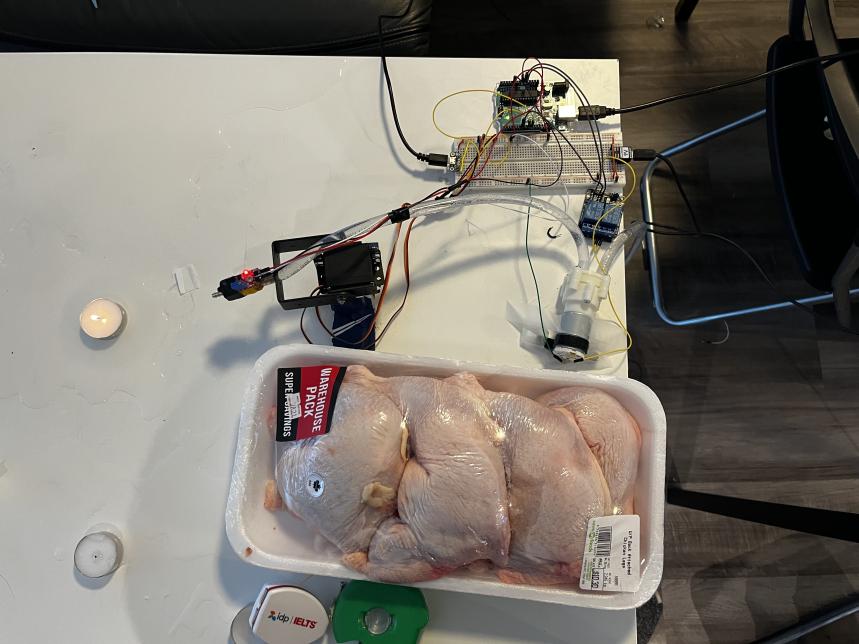
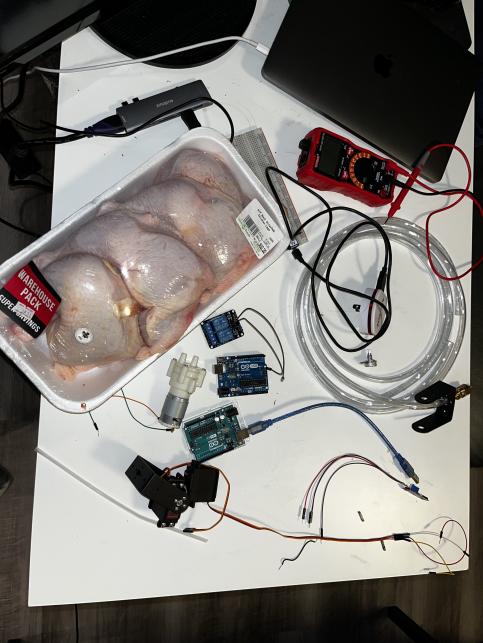
We built this system using an Arduino UNO R3 as our microcontroller of choice. An IR flame sensor is used to detect if there is water, 2 servos were used to move the sprinkler in the direction of the fire, and a pump attached to a relay is used to shoot out the water onto the fire at any location within its vicinity.
Challenges we ran into
A challenge we ran into, was hardware debugging. As the relay especially was challenging to integrate with the rest of the system, as it would work fine alone, but when connected to the whole system, errors would occur. To tackle this challenge, we had to hard code the relay to turn on or off when inside a for loop to limit it to only turning on when the servos have directed the sprinkler at the fire.
Accomplishments that we're proud of
An accomplishment that we are proud of is being able to accurately track the distance and location of the fire with a relatively high degree of accuracy. This is of course limited by the senor itself, which with trial and error , was accurate to 4 feet's.
What we learned
We learned that debugging is very crucial to understanding what is going wrong in our system. Without it, it took us very long to find a solution to why the relay was not working properly. However, after we starting debugging, it became clearer where our issues were.
What's next for Flame
Next for flame is to 3d print an external skeleton for the system to make it look presentable, The 24 hour time limited us to not use 3d printing as that would require an extensive budget of our time. Also improving the sensor limitation ( by utilizing 2 lidar scanners) so that can sense fires beyond 4 feet accurately and removing the limitation of it constantly having to move around to sense fire, adding a normal sprinkler for safety, and making a fire extinguisher version are on the list to improve our project.


Log in or sign up for Devpost to join the conversation.