-
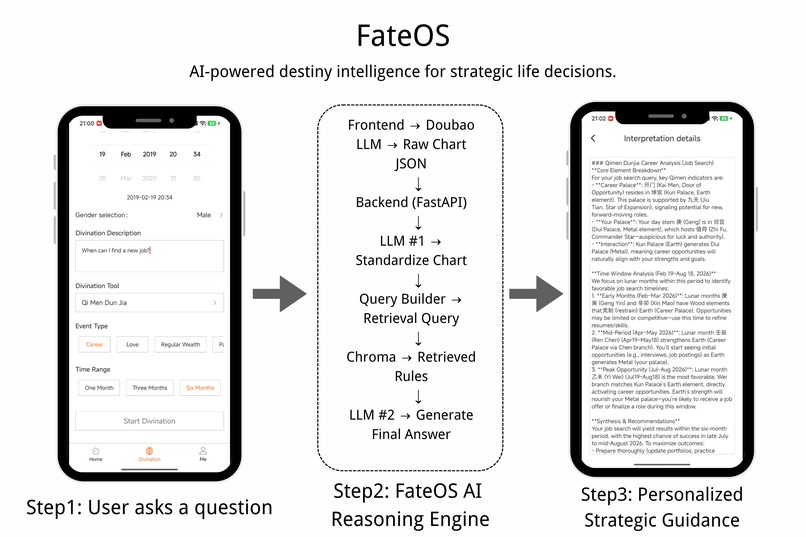
FateOS
-
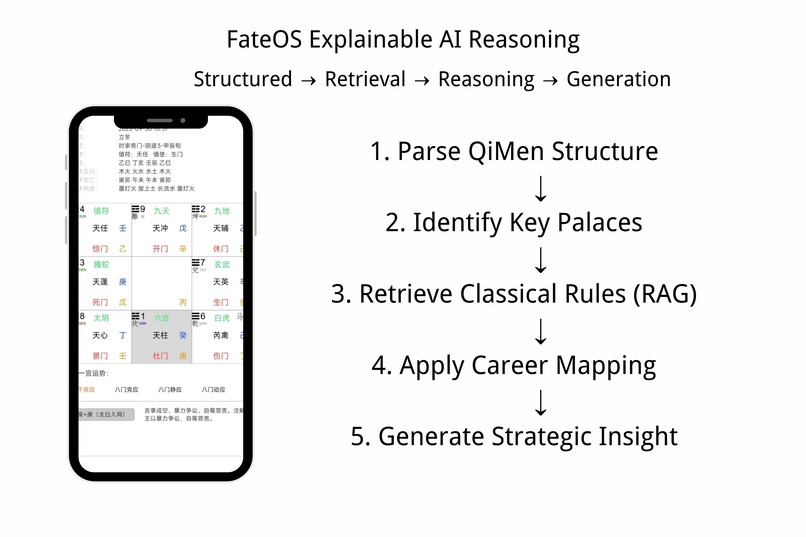
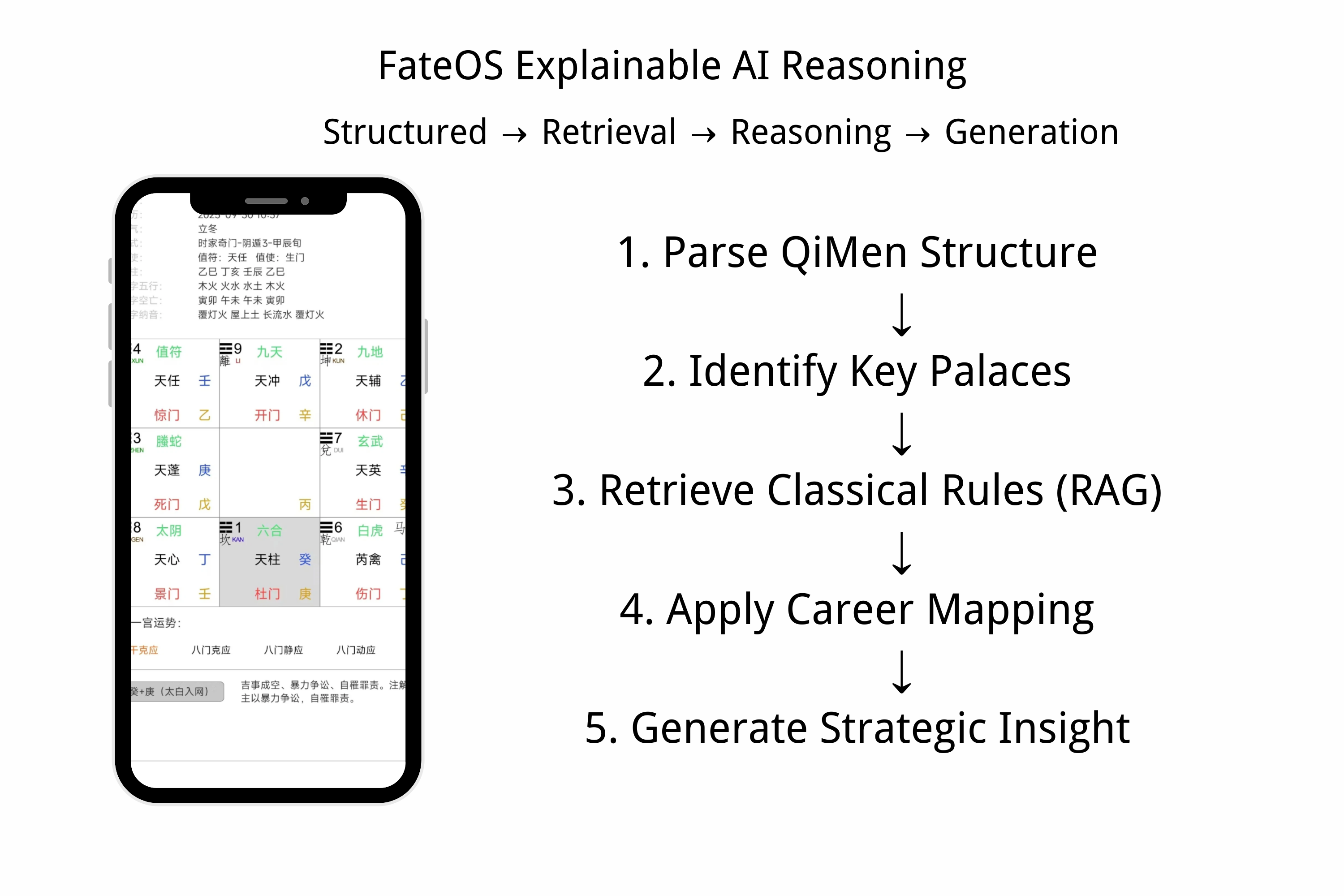
FateOS Explainable AI Reasoning
-
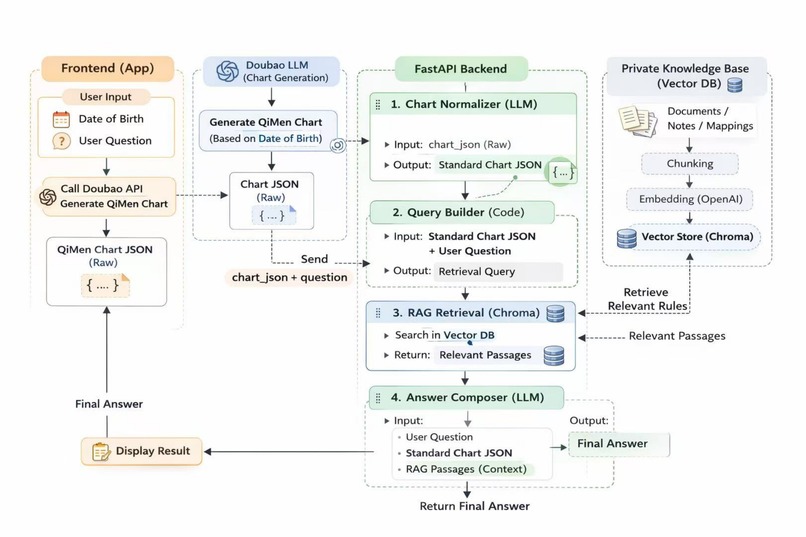
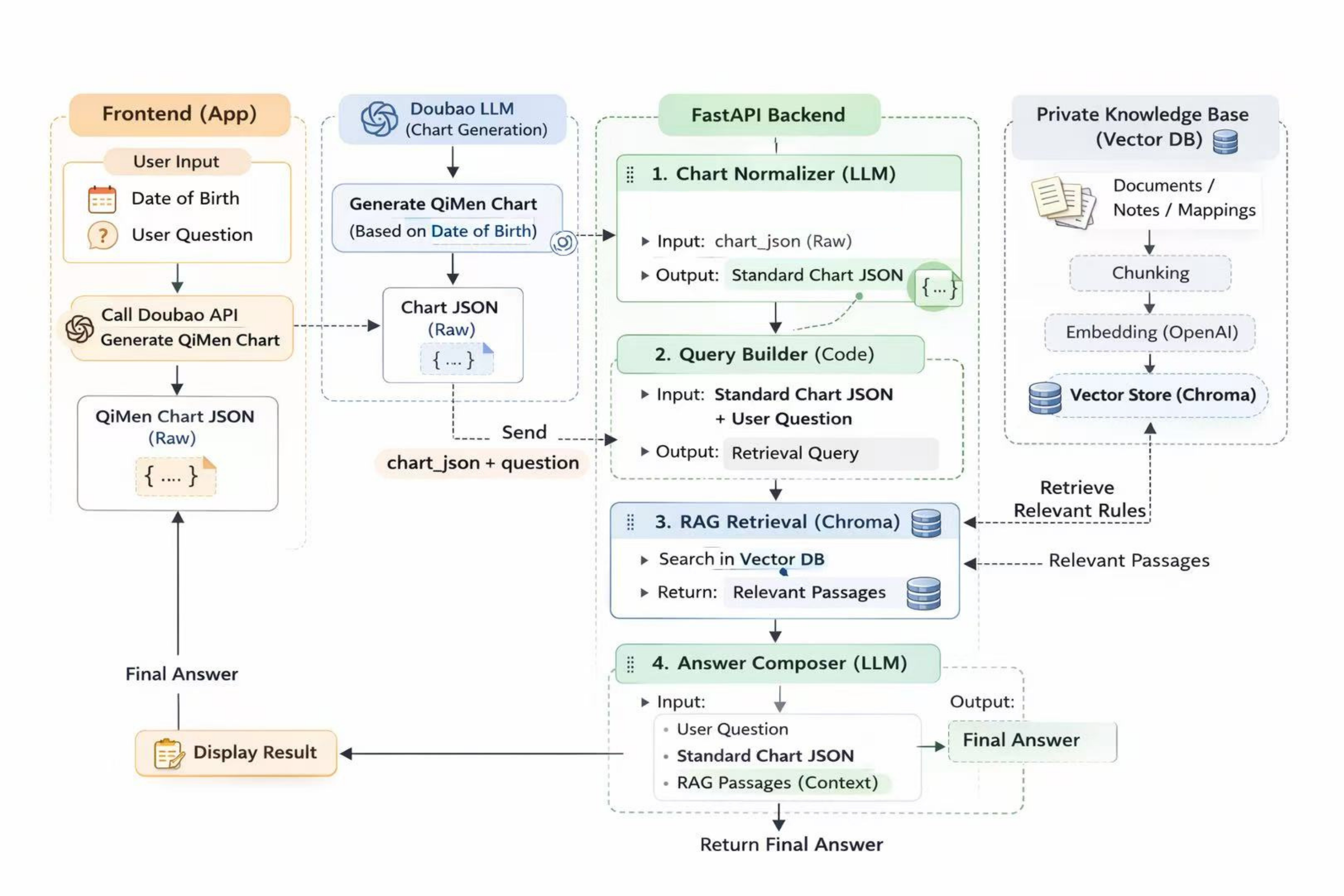
Architecture Overview
-
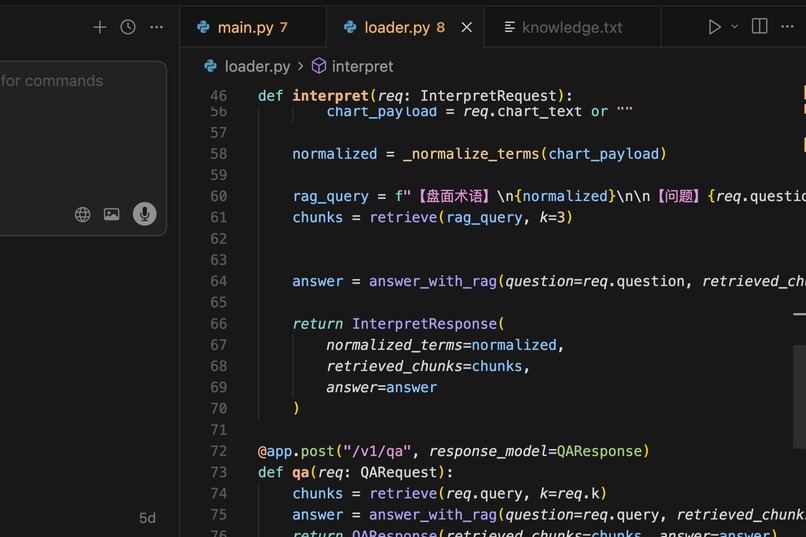
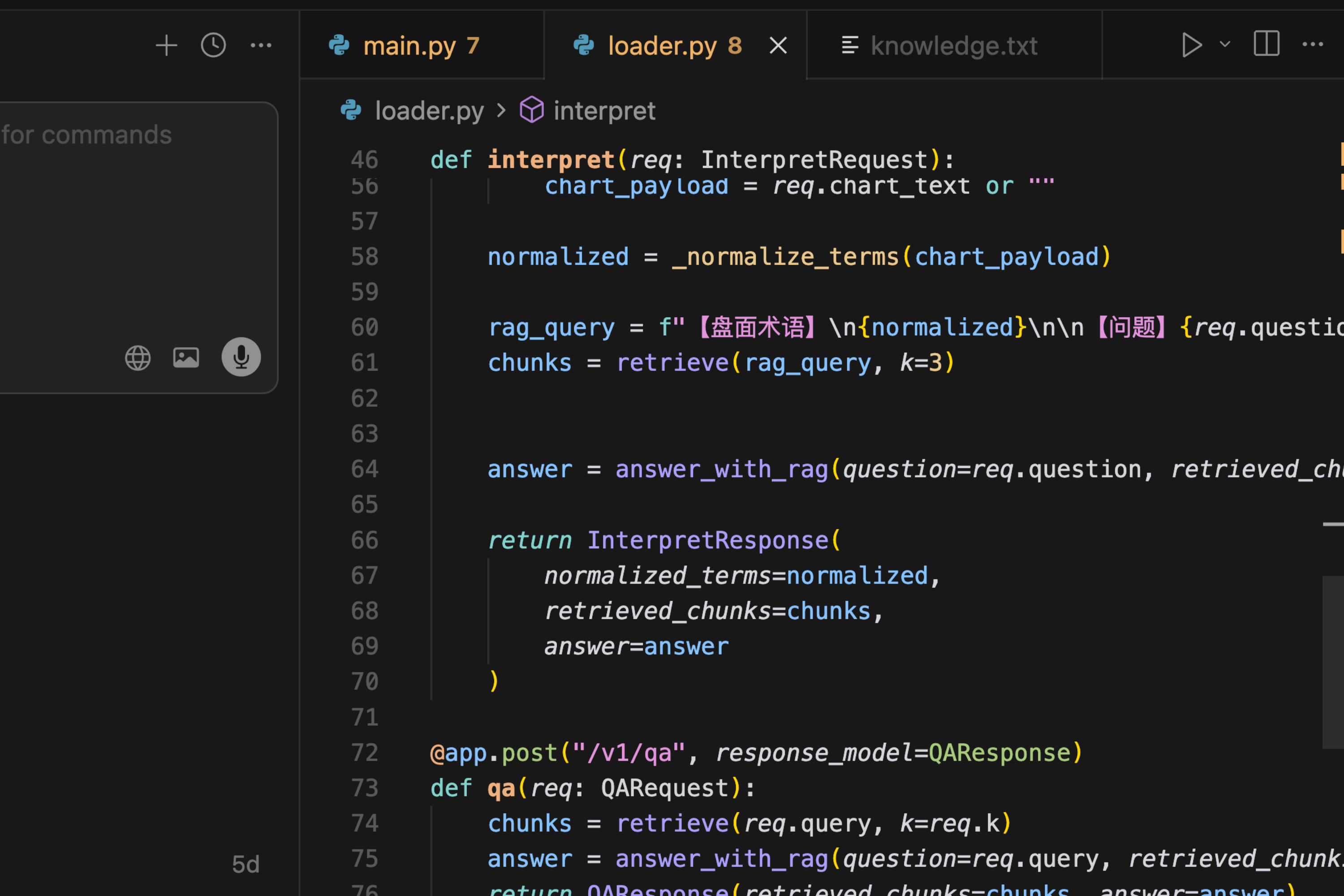
Related code
FateOS
Inspiration
Most AI applications today rely on general web knowledge or public datasets. However, many ancient Chinese metaphysical systems — such as QiMen DunJia — are deeply structured symbolic reasoning systems that require domain-specific knowledge and internal reference materials.
QiMen DunJia is one of the most sophisticated systems in traditional Chinese metaphysics. Originating over 2,000 years ago, it is a divination framework built on symbolic elements such as heavenly stems, earthly branches, stars, gates, and palaces arranged in a structured chart. Historically, it was used for strategic decision-making, military planning, and forecasting personal outcomes.
Unlike Western astrology, which primarily interprets planetary positions, QiMen DunJia operates more like a dynamic symbolic matrix — a rule-based system where each element interacts within a structured spatial configuration. Interpreting such a chart requires understanding layered symbolic relationships rather than simple keyword matching.
We asked a key question:
Can we build an AI agent that reasons over structured metaphysical charts instead of just generating text responses?
FateOS was created to bridge structured symbolic systems with modern large language models — transforming ancient divination logic into an intelligent, AI reasoning system.
What We Built
FateOS is a AI agent that:
- Accepts a user’s date of birth
- Automatically generates a corresponding QiMen DunJia chart
- Converts the chart into structured JSON
- Uses an LLM to interpret the chart
- Augments reasoning with RAG over private internal metaphysical knowledge
- Provides personalized answers for:
- Love & relationships
- Career development
- Wealth & finance
- Academic success
Unlike generic horoscope apps, FateOS operates on a full symbolic chart model and domain-specific reasoning pipeline.
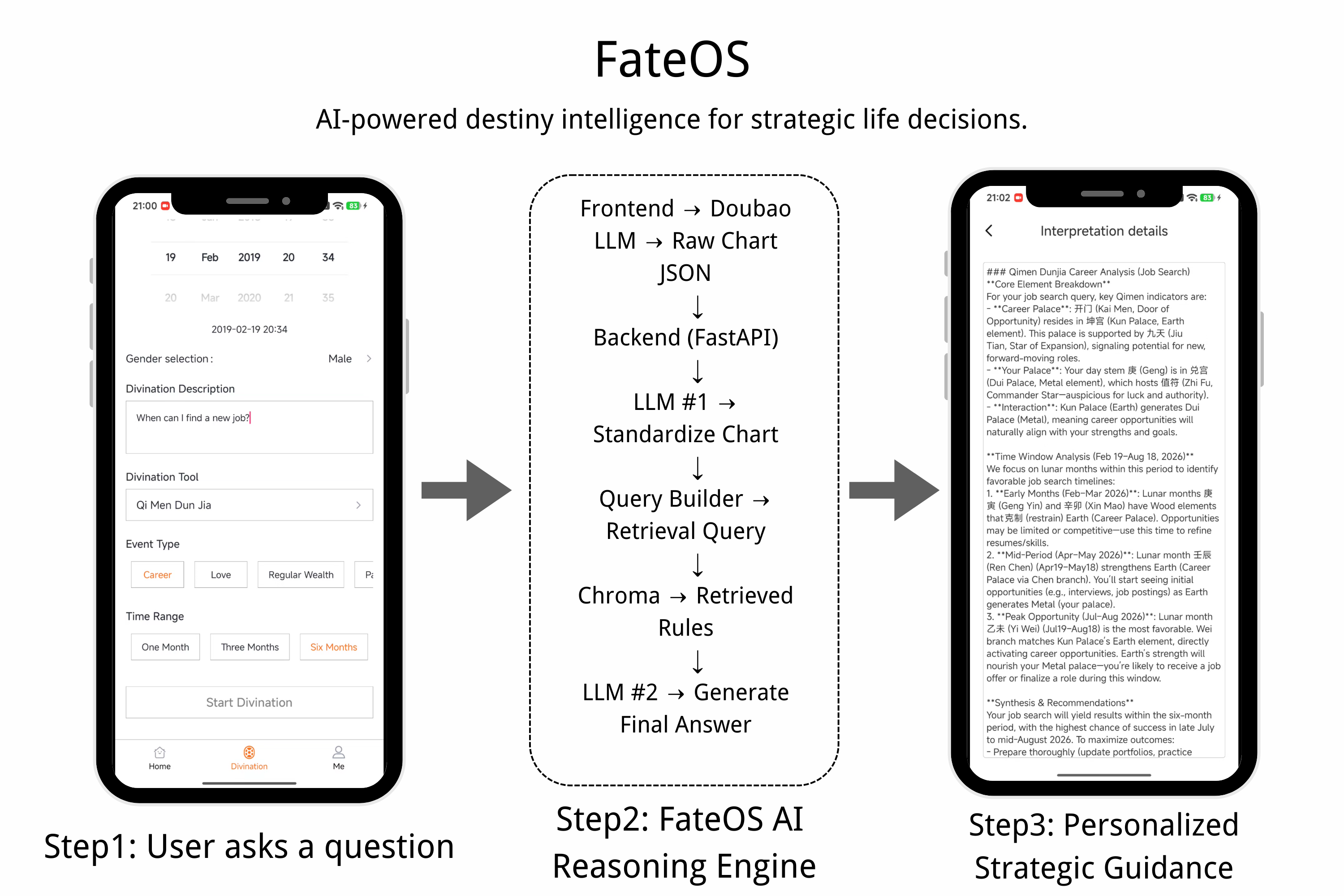
Full Data Flow
User Input
    ↓
Frontend → Doubao LLM → Raw Chart JSON
    ↓
Backend (FastAPI)
    ↓
LLM #1 → Standardize Chart
    ↓
Query Builder → Retrieval Query
    ↓
Chroma → Retrieved Rules
    ↓
LLM #2 → Generate Final Answer
    ↓
Return Response to Frontend
Architectural Pattern
FateOS follows:
Structure → Retrieval → Reasoning → Generation
Instead of:
Prompt → Free-text prediction
How It Works
1. Chart Generation Layer
- User inputs birth date (year / month / day / time)
- Backend algorithm generates the corresponding QiMen DunJia chart
- The chart is converted into a structured JSON schema representing:
- Palace positions
- Stars
- Gates
- Heavenly stems
- Earthly branches
{
  "astrolabe_data": {
    "date": "2026-02-16",
    "time": "15:46",
    "solarDate": "2026-02-16",
    "lunarDate": "2025-12-29 15:46:10",
    "chineseDate": "乙巳年 庚寅月 辛酉日 丙申时",
    "gender": "男",
    "palaces": {
      "坎": {
        "name": "坎宫",
        "heavenly_stem": "丁",
        "earthly_branch": "子",
        "star": "天任",
        "gate": "开门",
        "god": "白虎",
        "six_yi": "丁"
      },
      "坤": {
        "name": "坤宫",
        "heavenly_stem": "癸",
        "earthly_branch": "未",
        "star": "天柱",
        "gate": "景门",
        "god": "螣蛇",
        "six_yi": "癸"
      },
      "震": {
        "name": "震宫",
        "heavenly_stem": "庚",
        "earthly_branch": "卯",
        "star": "天辅",
        "gate": "生门",
        "god": "九地",
        "six_yi": "庚"
      },
      "巽": {
        "name": "巽宫",
        "heavenly_stem": "丙",
        "earthly_branch": "辰",
        "star": "天英",
        "gate": "伤门",
        "god": "九天",
        "six_yi": "丙"
      },
      "中": {
        "name": "中宫",
        "heavenly_stem": "辛",
        "earthly_branch": "",
        "star": "中宫",
        "gate": "中宫",
        "god": "中宫",
        "six_yi": "辛"
      },
      "乾": {
        "name": "乾宫",
        "heavenly_stem": "乙",
        "earthly_branch": "戌",
        "star": "天蓬",
        "gate": "惊门",
        "god": "六合",
        "six_yi": "乙"
      },
      "兑": {
        "name": "兑宫",
        "heavenly_stem": "壬",
        "earthly_branch": "酉",
        "star": "天心",
        "gate": "死门",
        "god": "太阴",
        "six_yi": "壬"
      },
      "艮": {
        "name": "艮宫",
        "heavenly_stem": "己",
        "earthly_branch": "丑",
        "star": "天冲",
        "gate": "休门",
        "god": "玄武",
        "six_yi": "己"
      },
      "离": {
        "name": "离宫",
        "heavenly_stem": "戊",
        "earthly_branch": "午",
        "star": "芮禽",
        "gate": "杜门",
        "god": "值符",
        "six_yi": "戊"
      }
    },
    "value_symbol": {
      "star": "天禽",
      "gate": "死门",
      "palace": "",
      "heavenly_stem": ""
    },
    "value_emissary": {
      "gate": "死门",
      "palace": "兑"
    },
    "pattern": {
      "name": "阳遁",
      "number": 2
    }
  }
}
This structured representation ensures symbolic consistency before LLM reasoning.
2. AI Reasoning Layer
FateOS uses a hybrid AI pipeline:
- Large Language Model (GPT-based)
- Retrieval-Augmented Generation (RAG)
- Vector search over internal metaphysical materials
- Structured symbolic prompt engineering
Key design decisions:
- The LLM does not rely only on general knowledge
- We use private internal metaphysical documentation
- Internal materials are embedded into a vector database
- Relevant domain knowledge is retrieved dynamically before interpretation
Because many classical metaphysical materials are not publicly available, this significantly improves grounding and precision.
3. Knowledge System
Our RAG layer includes:
- Classical QiMen DunJia interpretations
- Structured symbolic mappings
- Internal expert notes and private references
- Rule-based cross-validation
The system retrieves domain-relevant excerpts before generating explanations, reducing hallucination and increasing symbolic accuracy.
Technical Architecture
- FastAPI backend
- Chart generation engine
- Structured JSON symbolic layer
- LangChain-based RAG pipeline
- Vector database (Chroma)
- Cloud infrastructure hosting
We tuned:
- Embedding chunk size
- Similarity threshold
- Retrieval ranking logic
- Symbolic prompt constraints
Why It’s Different
Most astrology or fortune-telling apps simply:
- Generate generic text based on keywords
- Or directly call a large language model to produce “good sounding” predictions
- Without structured reasoning or symbolic interpretation
FateOS works differently.
Instead of asking the model to “freestyle” an answer, we:
- First generate a complete QiMen DunJia chart based on the user's birth date.
- Convert the chart into a structured JSON representation.
- Let the LLM interpret this structured symbolic system.
- Use Retrieval-Augmented Generation (RAG) to retrieve relevant internal metaphysical knowledge.
- Generate the final response grounded in both structure and knowledge.
In short:
We do not directly generate answers.
We construct a reasoning structure first, then generate.
This makes the system more consistent, more logical, and less prone to hallucination.
Agent-Based Reasoning Workflow
FateOS is designed as an AI Agent system, not a simple Q&A chatbot.
When a user asks:
“Will my career improve this year?”
The system does not immediately produce a response.
Instead, it:
- Reads the generated QiMen chart
- Identifies key palaces, stars, and gates
- Determines symbolic relationships
- Retrieves relevant internal knowledge using vector search
- Synthesizes a final interpretation
This is a multi-step reasoning pipeline rather than a single text completion.
Knowledge-Augmented Interpretation (RAG)
Many classical metaphysical texts are not publicly available online.
We digitized and structured internal reference materials and built a private knowledge base.
Our pipeline:
- Converts internal texts into embeddings
- Stores them in a vector database
- Dynamically retrieves relevant passages based on the chart structure
- Injects retrieved content into the LLM reasoning process
This reduces hallucination and improves interpretive consistency.
Simply put:
The model does not “guess.”
It looks up structured knowledge before answering.
Structured Symbolic Layer (JSON as an Intermediate Reasoning Format)
A key architectural decision was introducing a structured symbolic layer:
QiMen Chart → JSON → LLM Interpretation
This intermediate JSON layer ensures:
- The symbolic structure is preserved
- The reasoning flow is controlled
- The system can scale into multi-agent collaboration
- Future explainability features can be added
This transforms FateOS from a content generator into a symbolic reasoning agent.
Challenges
1. Teaching the LLM a Non-Language Symbol System
QiMen DunJia is not natural language — it is a symbolic framework.
We had to:
- Design structured representations
- Constrain prompts
- Carefully engineer reasoning flows
- Prevent free-form hallucination
Without structure, the model would revert to generic fortune text.
2. Reducing Hallucination in Abstract Domains
Metaphysical domains are especially prone to hallucinated interpretations.
We mitigated this by:
- Enforcing structured JSON constraints
- Using RAG with internal verified materials
- Limiting generation scope
- Filtering retrieved content by similarity thresholds
3. Balancing Accuracy and Readability
Classical metaphysical language can be obscure and difficult to understand.
We designed the system to:
- Preserve symbolic structure
- Maintain professional terminology
- Translate insights into accessible modern language
Vision
FateOS is not just a fortune-telling app.
It is an experiment in structured symbolic reasoning with AI.
We explore whether LLMs can:
- Interpret symbolic systems
- Perform multi-step structured reasoning
- Combine private knowledge with generative intelligence
- Provide explainable outputs in traditionally abstract domains
In the future, we plan to extend the system into:
- Multimodal chart visualization
- Voice-based divination interaction
- Multi-system fusion (QiMen + BaZi + ZiWei)
- Explainable reasoning path visualization
We believe AI should not only generate language.
It should reason over structured symbolic systems.
FateOS is our step toward that direction.


Log in or sign up for Devpost to join the conversation.