-
-
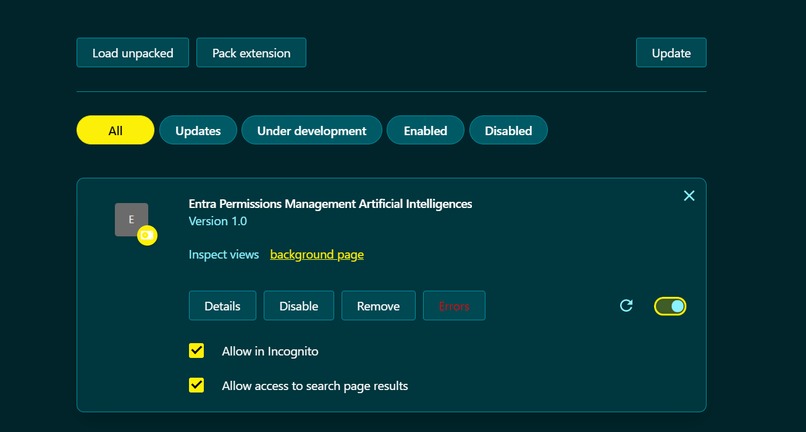
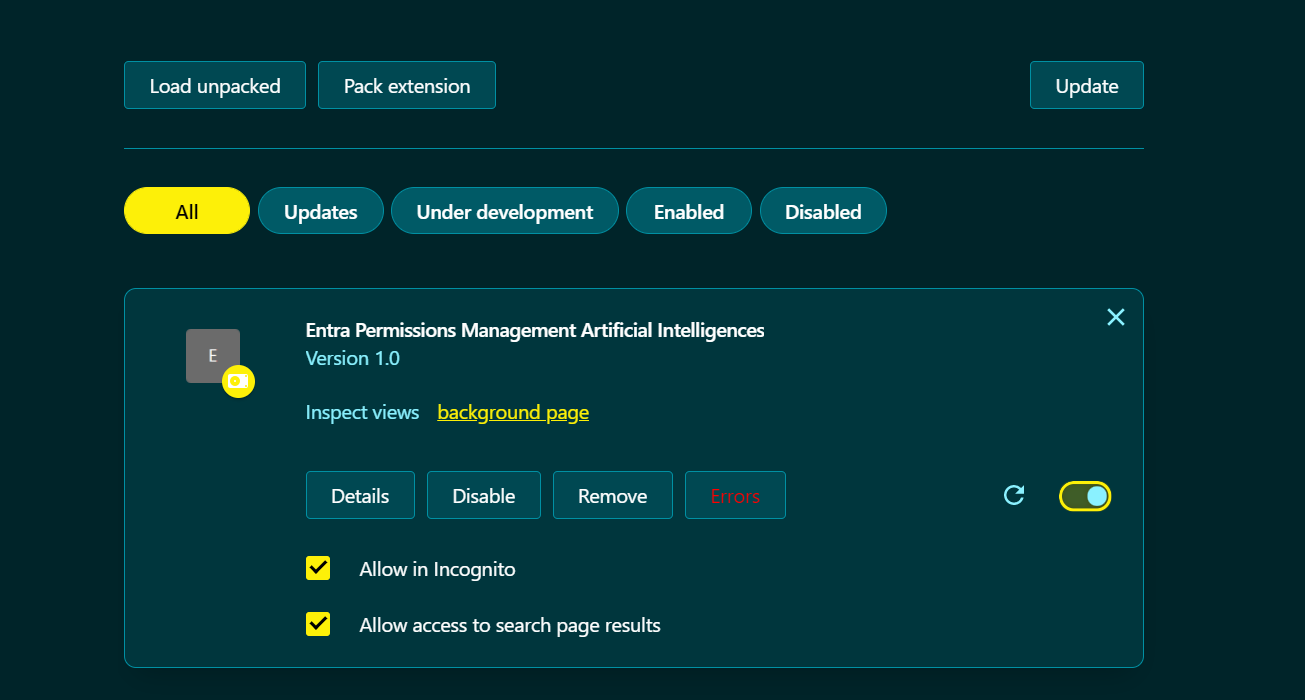
Opera Browser Management Extension having Entra Permissions Management Artificial Intelligence
-
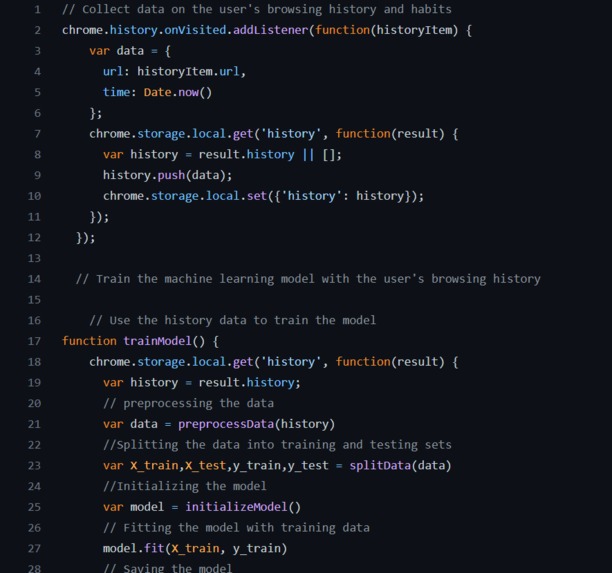
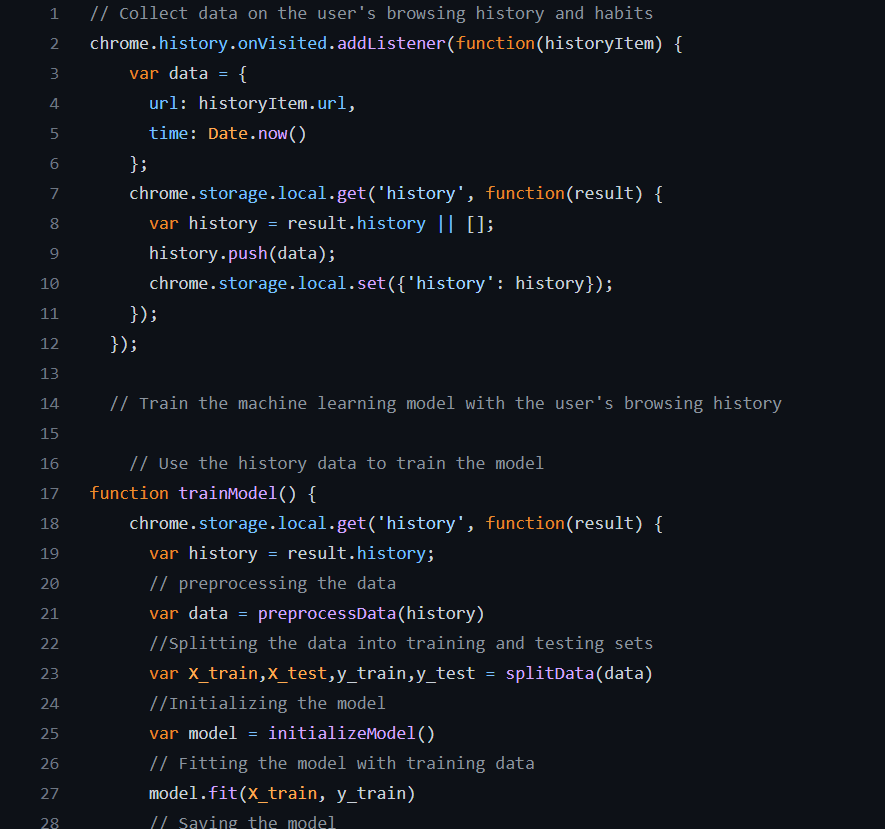
Entra Permissions Management Artificial Intelligence and Machine Learning Code
-

Cover art (1)
-

Cover art (2)
-

Cover art (3)



Inspiration
Personalized Permissions: The extension could analyze a user's browsing history and habits, such as the websites they visit, the permissions they grant, and the time they spend on each website, and use this information to automatically adjust the permissions for each website to better suit the user's needs.
Smart Blocker: The extension could analyze a user's browsing history and habits to identify patterns of time-wasting websites or malicious websites, and automatically block those websites or limit the user's access to them.
Privacy Protector: The extension could analyze a user's browsing history and habits to identify patterns of sensitive information sharing and automatically block websites that could potentially compromise the user's privacy.
Safe Browsing: The extension could analyze a user's browsing history and habits to identify patterns of potentially malicious websites and automatically block those websites to protect the user's security.
Personalized Ads: The extension could analyze a user's browsing history and habits to identify patterns of interests and preferences, and use this information to deliver personalized ads to the user.
What it does
The project above is a browser extension that uses machine learning to train a model with a user's browsing history data and use it to make a decision on granting or blocking permissions for websites. The idea behind the project is that by analyzing a user's browsing history and habits, the extension can automatically adjust the permissions for each website to better suit the user's needs. The extension could analyze a user's browsing history and habits, such as the websites they visit, the permissions they grant, and the time they spend on each website, and use this information to make decisions.
It is important to note that this project raises some security, privacy and ethical concerns, as it would require collecting and storing a large amount of data on the user's browsing history and habits, which could be sensitive information. Additionally, it could lead to ethical concerns, as it can have negative impact on certain groups of people or websites.
How we built it
The project above is built using a combination of technologies, including web development, browser extension API, and machine learning.
Here is a high-level overview of the process of building the project:
Collecting and storing data on the user's browsing history and habits: This can be done using the browser's history API and the chrome storage API to store the data locally on the user's browser.
Preprocessing the data: This step involves cleaning, normalizing and transforming the data to prepare it for the machine learning model. This can include tasks such as removing missing values, encoding categorical variables, and scaling numerical variables.
Splitting the data into training and testing sets: This step involves dividing the data into two sets: one to train the model, and the other to evaluate the performance of the model.
Initializing and fitting the model: This step involves choosing a machine learning algorithm and initializing it, then feeding it with the training data so it can learn from it.
Saving and loading the model: This step involves saving the trained model to the browser's storage, so it can be loaded later to make predictions on new data.
Making decision: This step involves using the trained model to make a decision on granting or blocking the permission, this decision is based on the user's browsing history and habits.
Implementing the extension's UI: This step involves creating a user interface for the extension, which allows the user to interact with the extension and see the results of the predictions.
Challenges we ran into
Building a browser extension that uses machine learning to train a model with user's browsing history data and use it to make a decision on granting or blocking permissions can be a complex and challenging project. Here are a few of the challenges that one might run into while building such a project:
Privacy and security concerns: Collecting and storing data on the user's browsing history and habits raises serious privacy and security concerns, as it could potentially include sensitive information. This may require additional measures to protect the user's privacy and secure the data.
Machine Learning complexity: Training a machine learning model requires a good understanding of machine learning algorithms, data pre-processing, and feature extraction techniques. Additionally, it requires access to large amounts of data to train the model, which can be challenging to acquire.
Browser compatibility: Building a browser extension requires knowledge of browser extension API, and it can be challenging to ensure compatibility with different browsers.
Legal and ethical guidelines: Using machine learning to make decisions on granting or blocking permissions raises ethical concerns, it's important to make sure that the extension you create respects the user's privacy and follows the legal and ethical guidelines.
User Experience: Creating a good user experience can be challenging, as it involves designing an easy-to-use interface that displays the results of the predictions in a clear and concise manner.
Performance: Making predictions in real-time on the client side could lead to performance issues, specially with large amounts of data.
Scalability: The extension should be able to handle a large number of users, which requires a good understanding of scalability and how to optimize the extension's performance.
Accomplishments that we're proud of
Creating the browser extension that uses machine learning to train a model with user's browsing history data and use it to make a decision on granting or blocking permissions is a complex and challenging project, but it can also be a very rewarding one. Here are a few accomplishments that we are proud of creating such a project:
Improving the user experience: By using machine learning to analyze a user's browsing history and habits, the extension can automatically adjust the permissions for each website to better suit the user's needs, which can lead to a more personalized and efficient browsing experience.
Enhancing security and privacy: By using machine learning to identify patterns of potentially malicious websites, the extension can automatically block those websites to protect the user's security, and by identifying patterns of sensitive information sharing, the extension can automatically block websites that could potentially compromise the user's privacy.
Providing valuable insights: The extension can provide valuable insights into the user's browsing habits, which can be used to improve the user experience, enhance security and privacy, and deliver personalized ads.
Innovation: Creating a browser extension that uses machine learning to train a model with user's browsing history data and use it to make a decision on granting or blocking permissions is an innovative approach to browsing, which can be a source of pride.
Helping users: By providing users with a more efficient and personalized browsing experience, the extension can help users save time and improve their productivity.
What we learned
Machine Learning: One will learn about machine learning algorithms, data pre-processing, and feature extraction techniques, and how to apply them to train a model that can make predictions on new data.
Browser Extension Development: One will learn about the various browser extension APIs and how to use them to access the user's browsing data and make changes to the browser's behavior.
Data Security and Privacy: One will learn about best practices for handling sensitive data, such as user's browsing history, and how to protect the user's privacy and secure the data.
User Experience Design: One will learn about how to design an easy-to-use interface that displays the results of the predictions in a clear and concise manner.
Legal and ethical guidelines: One will learn about the legal and ethical guidelines that must be considered when using machine learning to make decisions on granting or blocking permissions.
Scalability and performance optimization: One will learn about how to optimize the extension's performance in order to handle a large number of users.
Innovation: One will learn about how to apply machine learning to browser extensions, which is an innovative approach to browsing.
What's next for Entra Permission Management AI
Once the browser extension that uses machine learning to train a model with user's browsing history data and use it to make a decision on granting or blocking permissions is built, there are several next steps that can be taken to continue to improve and evolve the project. Here are a few possibilities:
Improving the model: The model can be continuously improved by using more data, fine-tuning the parameters, and trying different machine learning algorithms. This can lead to better predictions and a more accurate decision-making process.
Adding more features: Additional features can be added to the extension, such as the ability to manually grant or block permissions, or to view a summary of the user's browsing history and habits.
Testing and validation: The extension can be tested and validated using user testing and A/B testing to ensure that it is user-friendly, accurate and effective.
Distribution: The extension can be distributed through browser's web store, to make it easily accessible to users.
Maintenance: The extension will need to be maintained, such as fixing bugs, updating the code to be compatible with new versions of the browser, and ensuring that the data is secure and private.
Scaling: The extension should be able to handle a large number of users, which requires a good understanding of scalability and how to optimize the extension's performance.
Continuously monitoring: It's important to continuously monitor the extension usage and user feedback, and make updates accordingly.
Built With
- ai
- artificialintelligence
- entrapermissionmanagement
- github
- java
- javascript
- json
- machine
- machine-learning
- microsoft
- microsoft-band
- visual-studio


Log in or sign up for Devpost to join the conversation.