-
-
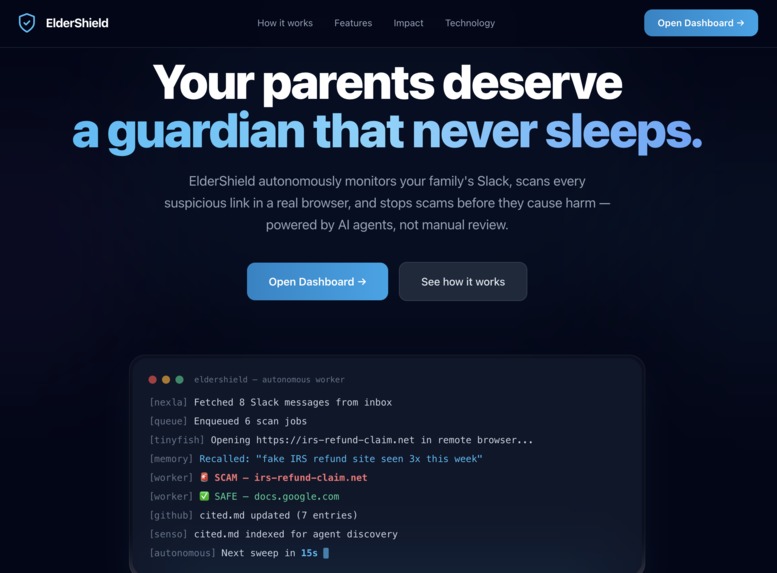
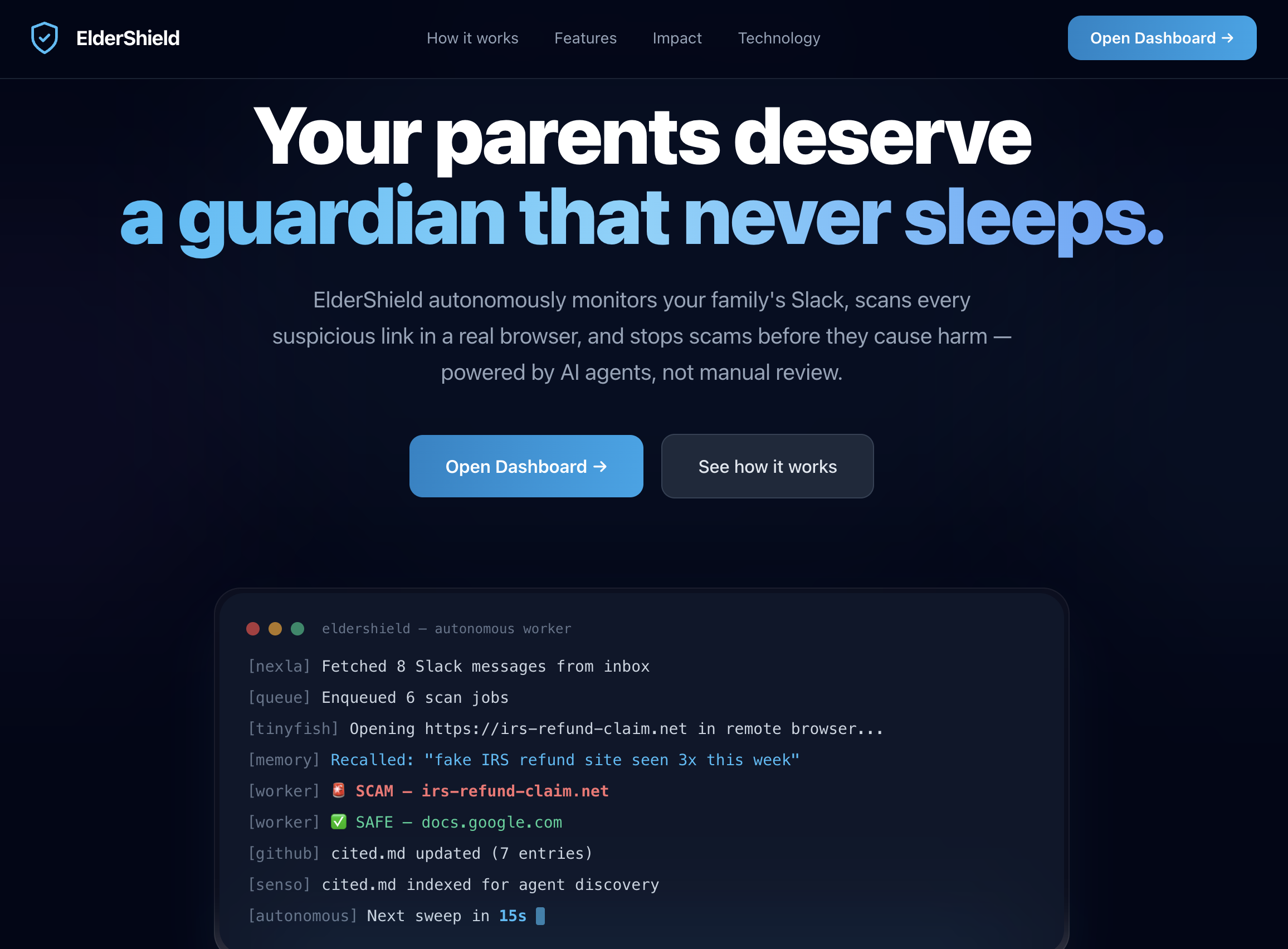
hero section
-
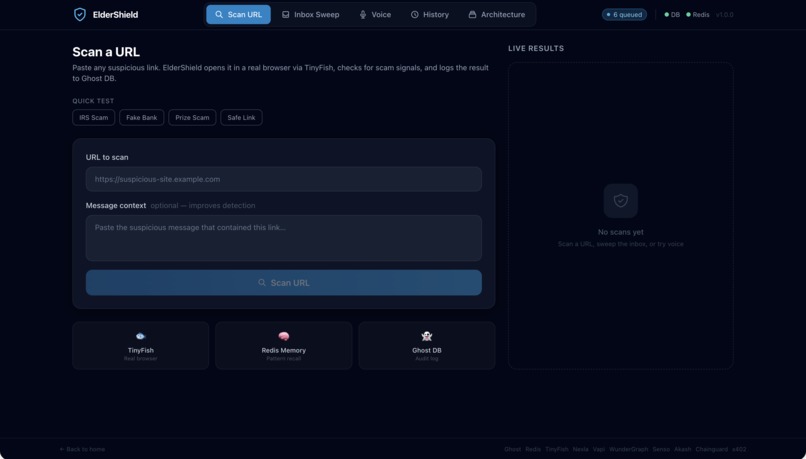
dashboard first tab
-
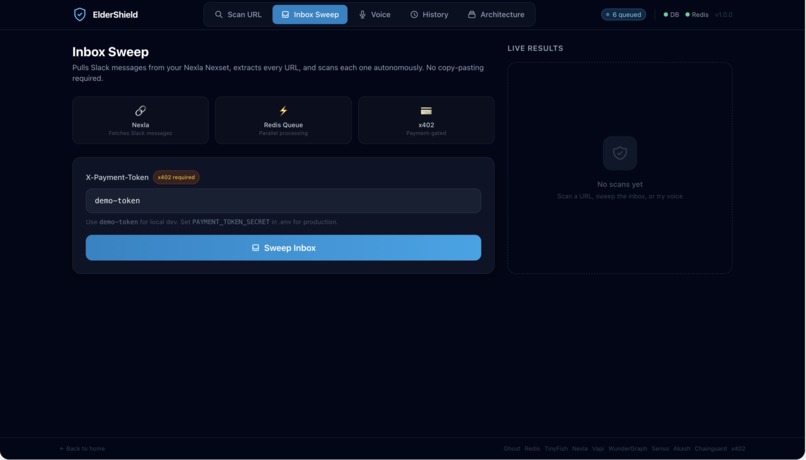
dashboard slack tab
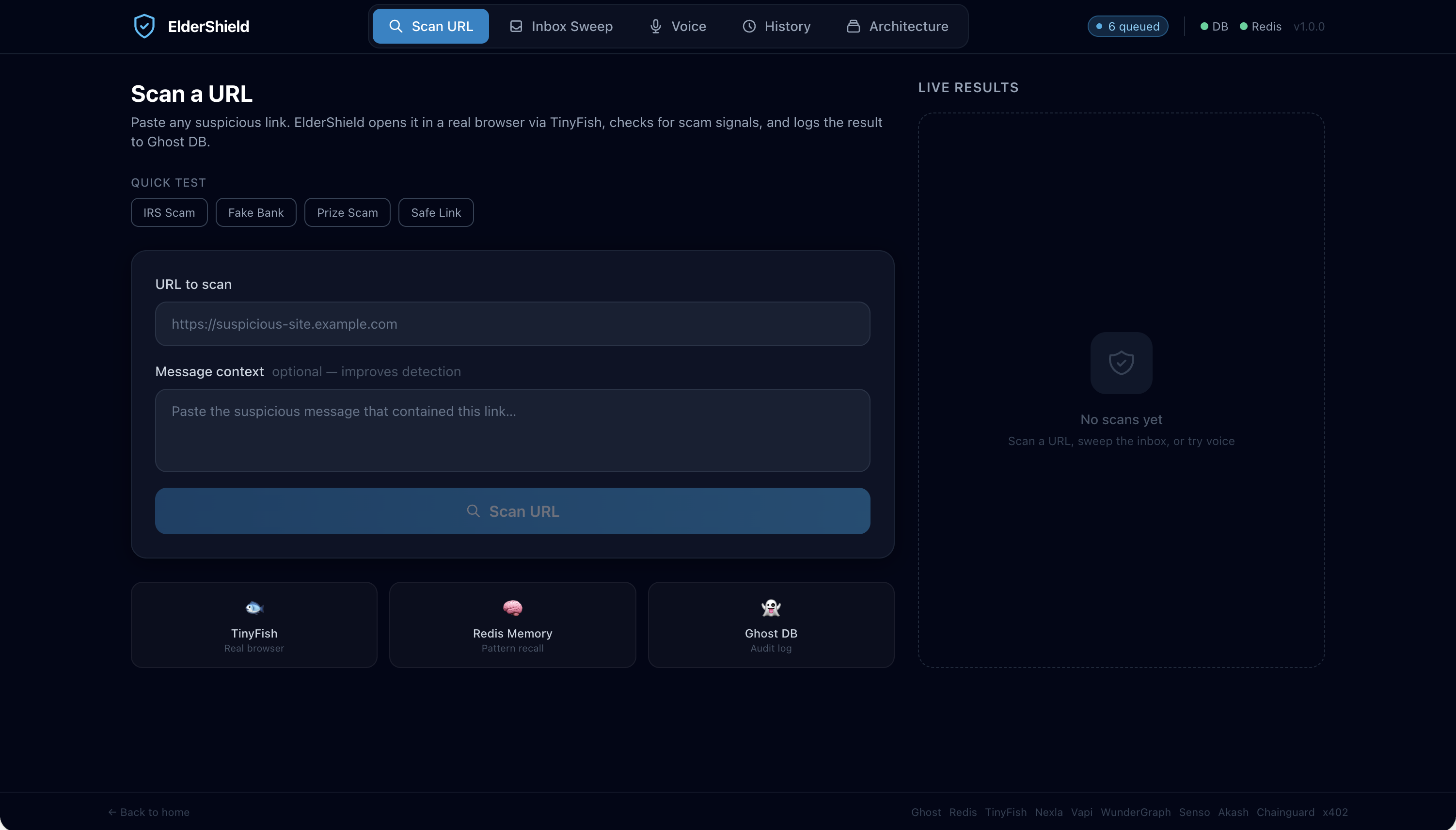
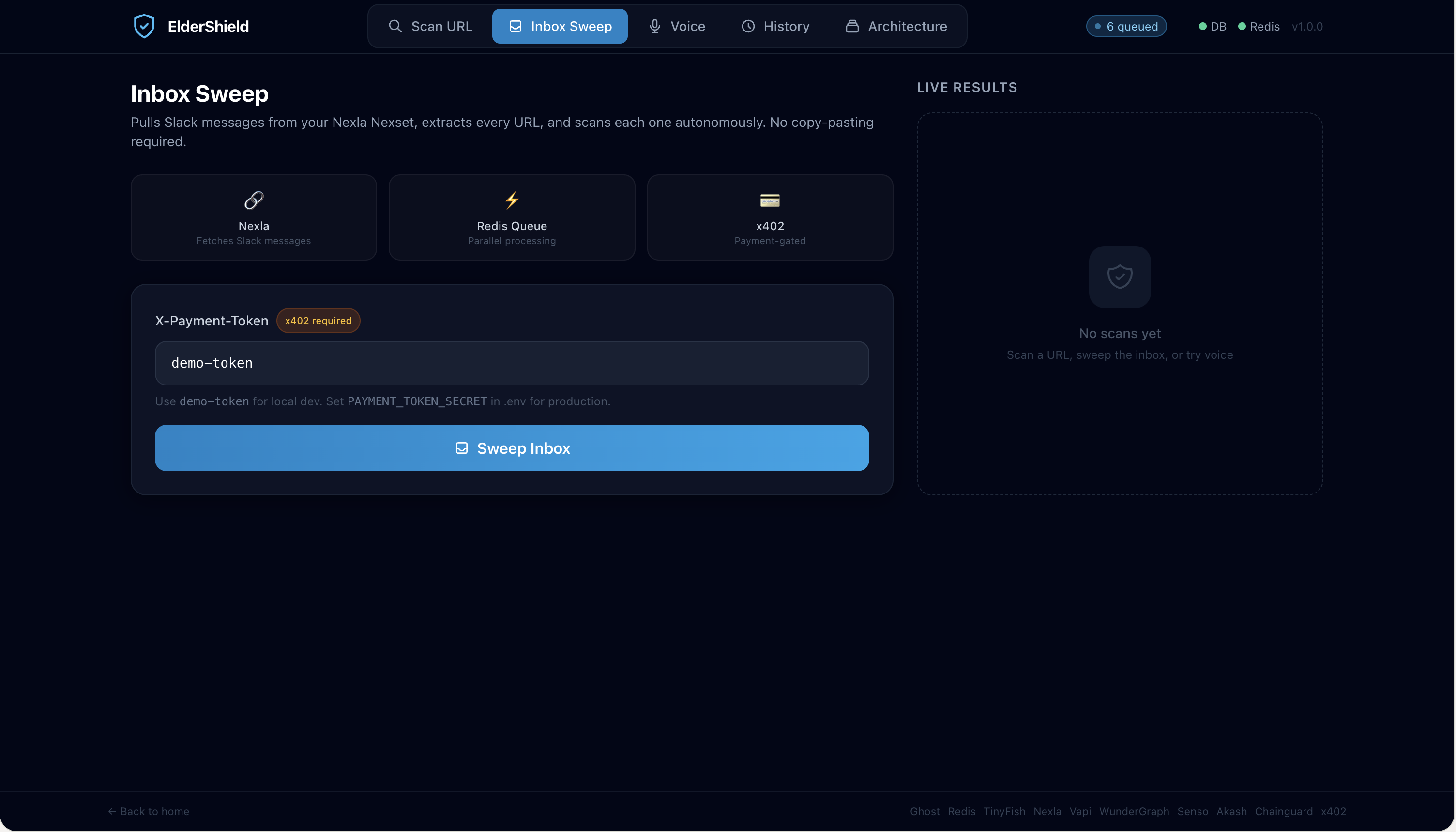
Inspiration
My grandmother lost $14,000 to a fake Medicare call last year. She's sharp, careful, and still got fooled — because the scammer sent a link that looked exactly like the real Medicare website. By the time she realized, the money was gone.
That's not a rare story. The FBI's Internet Crime Complaint Center reported $3.4 billion in elder fraud losses in 2023 alone. Older adults are targeted $3\times$ more often than younger people, and 88% of victims never report it. The tools that exist today — browser warnings, spam filters — are reactive and manual. They catch some things. They miss the sophisticated ones.
The question that drove ElderShield: what if an AI agent watched every link, in every message, before a human ever had to click?
What it does
ElderShield is a fully autonomous scam-protection agent. Once connected to a Slack workspace, it:
- Sweeps the inbox every 15 seconds via Nexla — no copy-pasting, no manual triggers
- Opens every suspicious URL in a real remote browser via TinyFish — not a URL parser, an actual browser that sees what your parent would see
- Classifies risk as
SAFE,SUSPICIOUS, orSCAMusing a memory-augmented classifier - Remembers past patterns via Redis Agent Memory — working memory per scan session, long-term semantic memory across all households
- Logs everything to Ghost (agent-native Postgres) as a durable audit trail
- Publishes results to
cited.mdvia GitHub, indexed and monetized by Senso with x402 payment rails - Responds to voice — integrated with Vapi so a family member can call and say "check this link" and get a plain-English answer
The entire pipeline runs without a human in the loop. The agent acts on real-time data, takes real action, and produces a citable, monetizable output.
How we built it
The backend is a TypeScript/Express service with a pull-based worker architecture:
Data layer: Ghost.build provides the Postgres database — households, messages, url_inspections, and risk_events tables. We used the Ghost CLI to provision it in under 60 seconds: ghost create --name eldershield --wait --json.
Queue: Redis/BullMQ handles the scan_jobs queue with exponential backoff and dead-letter. An autonomous worker loop (AUTONOMOUS_MODE=true) drains the queue every 15 seconds inside the same process — no external cron needed.
Browser analysis: Every URL goes through TinyFish's remote browser agent via a single POST to https://agent.tinyfish.ai/v1/automation/run-sse. We wrote a structured goal prompt that extracts login forms, payment forms, and suspicious signals as JSON.
Memory: Redis Agent Memory Server gives the classifier two tiers — working memory (per-scan session context, auto-summarized) and long-term memory (shared scam archetypes + per-household episodic history, semantically searchable). The recall step asks: "have we seen this domain before?" and injects the answer into the risk classifier.
Inbox ingestion: Nexla ingests Slack messages via GET /data_sets/{id}/samples. We handle Slack's <url|label> format, bare domains, and Nexla's nested rawMessage.value response shape.
Voice: Vapi calls POST /api/vapi/tool-call during live voice calls. The handler runs TinyFish synchronously and returns a spoken-friendly response in under 10 seconds.
Federation: A WunderGraph-style BFF at GET /api/wg/dashboard composes Ghost DB + Redis queue stats + GitHub cited.md into a single federated response.
Monetization: cited.md has YAML frontmatter with x402 + Stripe MPP payment config. Senso indexes it on startup and after every scan. Agents that fetch the scam intelligence pay $0.001 per request.
Deployment: A Chainguard distroless Node image (cgr.dev/chainguard/node:latest) and an akash.yml with 4 services — API, Redis Agent Memory, Redis, and a worker-cron sidecar.
The frontend is React + Vite + Tailwind with a full landing page, 5-tab dashboard, live results feed, voice recording via the Web Speech API, and an Architecture tab that shows live federated data from all sponsor tools.
Challenges we ran into
Nexla API discovery. The GenAI Tools API (api-genai.nexla.io) returned 403 for our session token. We discovered through trial and error that the standard REST API (dataops.nexla.io/nexla-api/data_sets/{id}/samples) works with session tokens and doesn't require the GenAI endpoint at all. The response shape — rawMessage.value as a nested array — wasn't documented and required defensive parsing.
TinyFish SSE parsing. The endpoint streams Server-Sent Events, but for our use case we read the full body and extracted the last valid JSON object. The tricky part was that TinyFish sometimes nests the result under output, result, or data keys depending on the run configuration. We wrote a defensive mapper that tries all three.
Ghost SSL. Ghost.build uses Timescale Cloud, which requires SSL. The connection string hostname doesn't contain localhost, so our initial SSL auto-detection logic failed. Fixed by checking for non-local hostnames explicitly.
BullMQ internal API. job.moveToActive() doesn't exist on the public Job type in BullMQ 5.x. We switched to a pull-based pattern using scanQueue.getJobs(["waiting"], 0, 0) and scanQueue.remove() instead of trying to manipulate job state directly.
Redis Agent Memory in a hackathon. The memory server requires an OpenAI key and a running Docker container. We made it non-fatal throughout — every memory operation is wrapped in try/catch so the pipeline continues even if the memory server is down. This was the right call for a demo environment.
Tailwind @apply with custom shadows. Custom boxShadow keys defined in tailwind.config.js can be used as utility classes in JSX but can't be referenced inside @apply in CSS files. Replaced with inline box-shadow values.
Accomplishments that we're proud of
- 10 sponsor tools integrated, all with real API calls — not mocks, not stubs
- Fully autonomous pipeline: Slack → Nexla → Redis → TinyFish → Redis Memory → Ghost → GitHub → Senso, running without human intervention
- The memory architecture: using Redis Agent Memory's two-tier system (working + long-term) to give the classifier genuine context — "we've seen this fake IRS domain 3 times this week" — is something most hackathon projects don't attempt
- Production-quality codebase: strict TypeScript, error handling on every external call, graceful degradation, a real Dockerfile with Chainguard, and an Akash deployment manifest
- A landing page that tells a real story: real statistics, real pain points, real people — not a generic "AI agent" pitch
The math behind the problem is stark. If $10^{10}$ dollars are lost annually to scams, and the average elder fraud victim loses approximately $\$35{,}000$, that's roughly:
$$\frac{10^{10}}{3.5 \times 10^4} \approx 285{,}000 \text{ victims per year}$$
Nearly 800 people every single day.
What we learned
Context engineering is the real moat. The heuristic classifier alone catches obvious scams. What makes ElderShield meaningfully better is the Redis memory layer — recalling that a domain appeared in a scam last week, or that this household has been targeted by fake bank logins before. That context changes a SUSPICIOUS to a SCAM. Building that memory architecture taught us more about agent design than any tutorial.
Defensive API clients are non-negotiable. Every external call — TinyFish, Nexla, GitHub, Senso, Redis Memory — can fail. Wrapping each in try/catch with non-fatal fallbacks meant the demo never crashed, even when individual services were unavailable. The pipeline degrades gracefully rather than exploding.
The Nexla data model is richer than the docs suggest. The data_sets endpoint returns far more metadata than the GenAI Tools API. Understanding the actual response shape (nested rawMessage.value arrays, Slack's <url|label> encoding) required reading the raw JSON rather than trusting the documentation.
Ghost is genuinely agent-native. The CLI provisioning experience — one command, instant Postgres, connection string in JSON — is exactly what agent infrastructure should feel like. No dashboard clicking, no waiting for email confirmation.
What's next for ElderShield
Real OAuth Slack integration. Right now the Nexla Nexset is configured manually. The next step is a one-click OAuth flow where a caregiver connects their family's Slack workspace and ElderShield starts monitoring immediately — zero configuration.
Proactive alerts. When a SCAM is detected, ElderShield should send an immediate Slack DM to the caregiver: "Your mother just received a link to irs-refund-claim.net. We've blocked it. Here's what we found."
Phone call integration. Vapi is already wired in. The next step is an outbound call flow — when a high-confidence scam is detected, ElderShield calls the household member directly and warns them before they click.
Household onboarding. A proper multi-household dashboard where caregivers can manage multiple family members, see their individual risk timelines, and configure alert thresholds.
Federated scam intelligence. The cited.md + Senso architecture already makes ElderShield's findings discoverable by other agents. The next step is consuming other agents' findings — building a shared, monetized scam intelligence network where every ElderShield instance contributes to and benefits from a collective memory.
The long-term vision: every older adult has an AI guardian that knows their habits, their trusted contacts, and their risk profile — and acts as a silent, always-on layer of protection between them and the open web.
Built With
- akash-network
- bullmq
- chainguard
- docker
- express.js
- ghost.build
- github-rest-api
- nexla
- node.js
- postgresql
- react
- redis
- redis-agent-memory-server
- senso
- speech
- stripe-mpp
- tailwind-css
- tinyfish
- typescript
- vapi
- vite
- web
- wundergraph
- x402


Log in or sign up for Devpost to join the conversation.