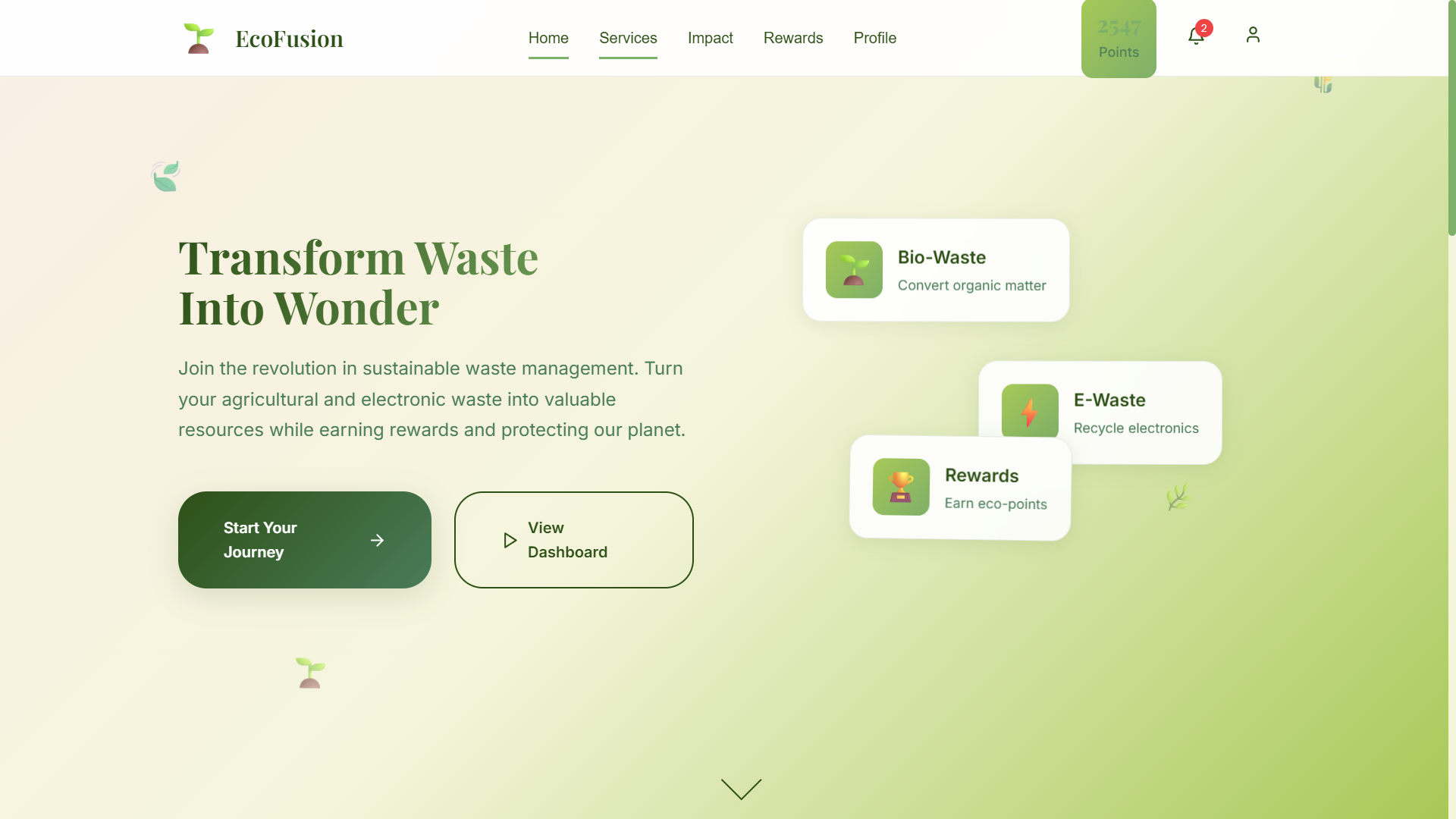
♻️ EcoFusion 2.0 – Smart Waste-to-Energy Platform
🌱 Inspiration
Our inspiration stemmed from the rising environmental crisis caused by improper disposal of electronic and agricultural waste. Most systems for waste management lack user-friendliness, incentives, or traceability. We envisioned a smart platform that not only encourages responsible disposal but also rewards it—bridging sustainability with technology.
💡 What it does
EcoFusion 2.0 is a smart waste reporting and collection platform that enables users to:
- 📍 Select their location using geolocation
- 📸 Capture photos of waste on-site using their device’s camera
- 🗂️ Categorize waste as Agricultural or Electronic
- 🚚 Book a pickup for disposal through a seamless interface
- 🎁 Earn rewards or points based on responsible waste actions
This is designed to be scalable for use by individuals, organizations, or municipalities.
🛠️ How we built it
🔧 Frontend
- React.js for building responsive components and UI
- Vite as the lightning-fast build tool
- React Context API for managing shared state
- HTML5 + CSS3 for structure and styling
- MediaDevices API for accessing the device camera
- Geolocation API for selecting current location
🖥️ Backend
- Node.js + Express.js to handle form data and endpoints
- Local backend storage for handling test payloads
🛠 Tooling
- npm for package management
- Git + GitHub for version control
🧱 Challenges we ran into
- 🔐 Accessing camera and location data while maintaining user privacy and browser compatibility
- 🌀 Managing asynchronous data like photo capture and location fetch before form submission
- ⚠️ Dealing with CORS and local development issues between Vite frontend and Express backend
- 🧠 Creating a clean state structure using Context API instead of over-engineered state tools
- 🎯 Designing a UI that feels intuitive while integrating multiple advanced APIs
🏆 Accomplishments that we're proud of
- Built a fully functional app with image, location, and category tracking
- Enabled a reward mechanism framework for incentivizing eco-friendly behavior
- Developed a clean, scalable frontend using modern React architecture
- Created a modular codebase with separation of concerns (components, pages, context)
- Laid a solid foundation for a future-ready PWA and IoT-ready waste system
📚 What we learned
- Deep dive into browser APIs like geolocation and camera access
- How to efficiently manage state sharing across multiple components
- Best practices in frontend-backend integration using Vite and Express
- Optimizing app responsiveness and user experience
- Strategies for code modularity and component reusability
🔮 What's next for EcoFusion 2.0 – Smart Waste-to-Energy Platform
- 🔌 Connect with a real-time database (Firebase / MongoDB) for waste tracking and user points
- ✅ Add authentication system for user profiles and collection agents
- 🧠 Integrate AI to classify waste using image recognition (TensorFlow.js or similar)
- 📱 Launch as a Progressive Web App (PWA) for wider mobile reach
- 🌐 Deploy on platforms like Vercel / Render with cloud-based storage
- 📊 Build an admin analytics dashboard for municipal-level waste operations
Built With
- and-modern-javascript-(es6+)-features.-for-managing-application-wide-state-in-a-clean-and-scalable-manner
- css3
- express.js
- git
- github
- html5
- javascript
- jsx
- node.js
- npm
- paired-with-vite-for-rapid-development-and-lightning-fast-build-times.-the-ui-was-developed-using-standard-html5
- react-context-api
- react.js
- the-application-integrates-the-mediadevices-api-for-real-time-camera-access-and-the-geolocation-api-to-capture-user-location-during-waste-pickup-requests.-the-development-workflow-is-powered-by-npm-for-package-management-and-git-for-version-control
- the-project-is-designed-with-scalability-in-mind?future-versions-aim-to-integrate-cloud-platforms-like-firebase-or-mongodb-for-real-time-database-support-and-user-authentication.-planned-deployment-platforms-include-vercel-or-render
- the-project-runs-on-node.js-with-a-lightweight-express.js-server-to-handle-api-routing-and-form-submissions.-to-interact-with-device-hardware
- the-react-context-api-was-used.-on-the-backend
- vite
- vitechlab
- with-the-codebase-organized-and-shared-via-github.-although-currently-running-on-local-infrastructure

Log in or sign up for Devpost to join the conversation.