Inspiration
Climate change is making extreme heat, cold, and humidity fluctuations more frequent—and older adults are among the most affected. During my work in community elder care and long-term care research, I repeatedly encountered the same questions from older adults: “Is today safe for me?”, “How should I dress?”, and “What precautions should I take?”
Most weather apps give only numbers, not guidance. I wanted to build something simple, accessible, evidence-informed, and genuinely useful for older adults in their daily lives. That is how ClimateCare—ThermoGuard for Seniors began.
What it does
ClimateCare transforms three basic weather inputs—temperature, humidity, and wind—into:
- a seven-level thermal risk classification
- personalized health and safety recommendations
- risk-triggered YouTube educational prompts (heatstroke / hypothermia prevention)
- indoor and outdoor dressing guidance tailored for older adults
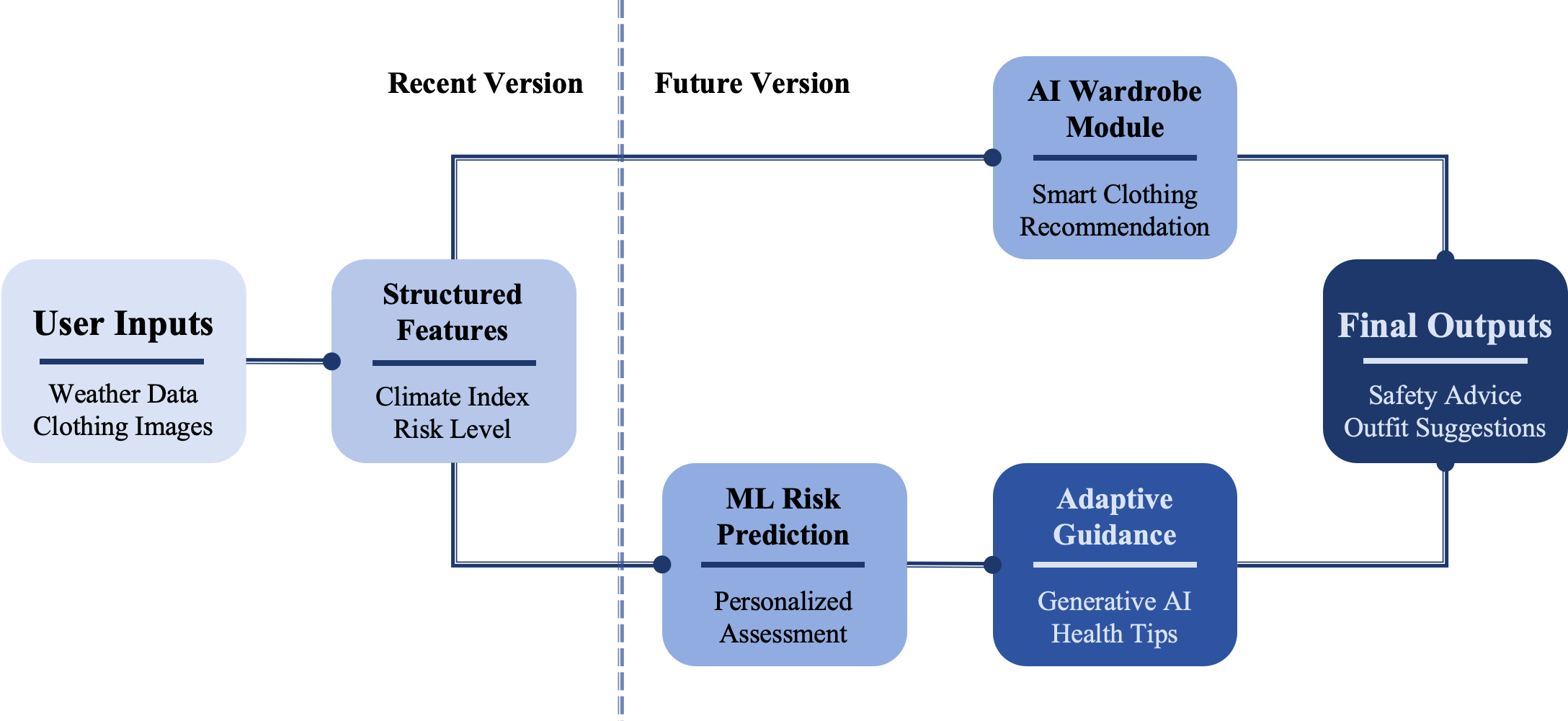
The tool is fully low-code but intentionally designed with an AI-ready data structure, enabling future machine-learning risk prediction and an AI wardrobe module that can recommend outfits based on user-uploaded clothing images.
How we built it
We used a low-code platform (Glide) to rapidly build an MVP with:
- simplified thermal formulas:
$$HI = T + 0.1\times RH$$
$$WC = T - 0.2\times Wind$$ - a 7-level thermal risk model combining heat and cold indicators
- a structured database for recommendations and dressing logic
- lightweight video prompts embedded directly into the interface
The system is organized around structured environmental features, which makes it AI-ready for future expansion. I also created a horizontal workflow and an AI roadmap flow to guide interface logic and version planning.
Challenges we ran into
- Designing recommendations that were simple enough for older adults yet still meaningful
- Creating dressing logic that works for both heat and cold risk levels
- Maintaining accessibility while keeping the architecture AI-expandable
- Building a useful MVP under tight time constraints
- Ensuring clarity with limited space in a mobile-friendly UI
Accomplishments that we’re proud of
- Building a fully functional climate-health MVP in just a few days
- Clear, science-informed thermal indicators
- A complete end-to-end flow from input → risk classification → guidance
- Incorporating health education, not just weather data
- Designing an AI upgrade roadmap, including smart outfit generation
- Staying focused on a vulnerable population that truly benefits from accessible tools
What we learned
- Low-code tools can deliver high-impact health solutions when the logic is well designed
- Weather data needs translation into actionable guidance to be meaningful
- Older adults benefit most from simple, structured, predictable advice
- Designing for accessibility improves the overall system clarity
- Building an AI-ready foundation early makes future upgrades far easier
What’s next for ClimateCare — ThermoGuard for Seniors
We plan to evolve the MVP into an AI-augmented tool with:
- ML-based personalized thermal risk prediction
- generative AI adaptive safety recommendations
- an AI wardrobe module that analyzes user-uploaded clothing to generate safe, weather-appropriate outfits
- integration with official weather alerts for automated safety notifications
- multilingual support for broader accessibility
- expanded datasets for more accurate local risk profiling
Ultimately, our goal is to build a scalable, equitable climate-health assistant that helps older adults stay safe every day.
Built With
- lowcode


Log in or sign up for Devpost to join the conversation.