Inspiration
CareSchedule was created through a discussion regarding the current problems faced in the healthcare industry. It was brought up that the COVID-19 pandemic has forcefully revealed some concerning flaws within the industry and its processes. Being a team of outside-the-box problem solvers, we noticed that a huge issue was the current unpredictability and delays in wait times and medical bills. We created CareSchedule to solve this tremendous problem and provide patients with much needed relief and insights for their future appointments. The rest is history.
What it does
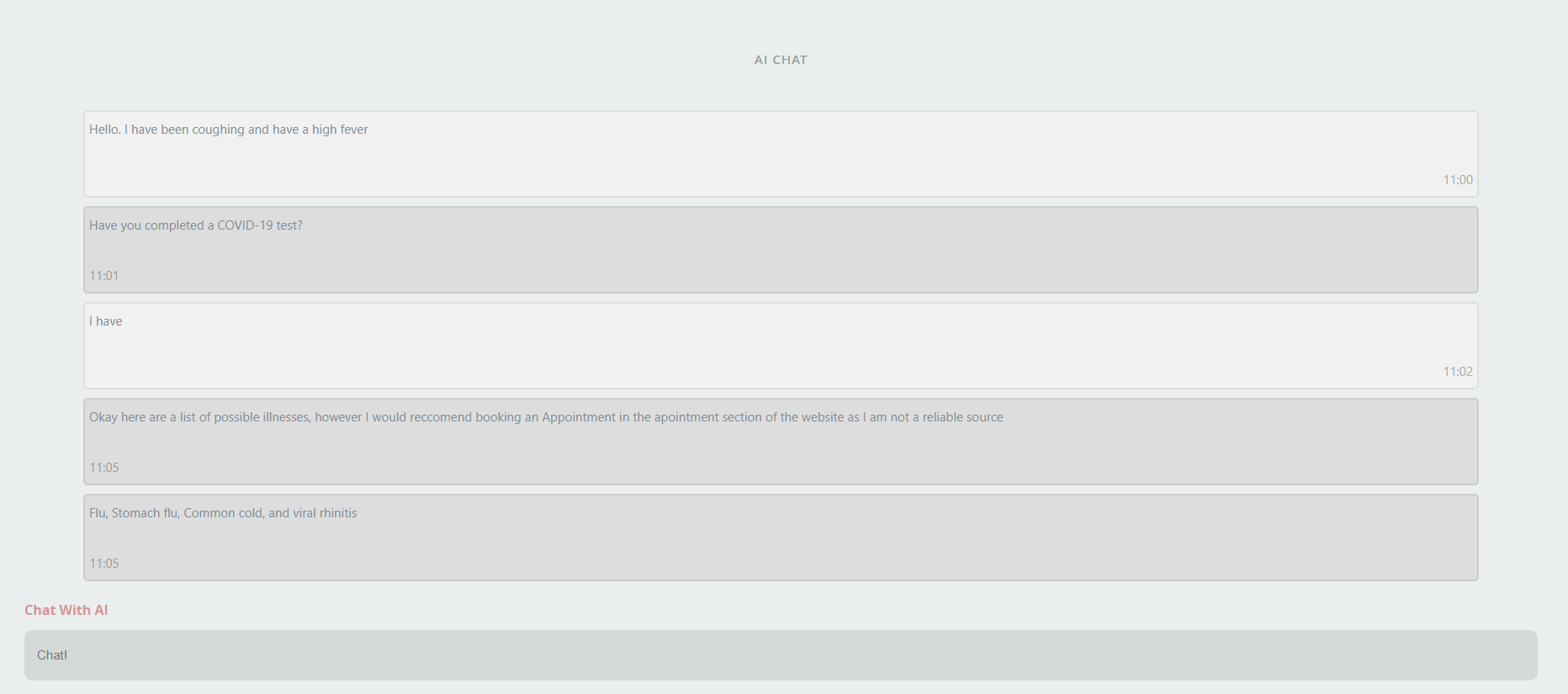
The platform allows patients to effectively schedule appointments through our advanced booking platform. expand Of course, we also want patients get some useful insights about their next appointment, which is exactly what the CarePredict and AI Chat features do. With CarePredict, a patient is able to get an estimate of their Time of Stay (TOS) and medical bill simply by inputting their age, type of admission, and severity of illness. AI Chat takes diagnosis a step further by providing a list of potential cases/illnesses a patient may have by describing their symptoms.
How we built it
The main platform was built using the React.js framework. From a UX perspective, simplicity was key for us, as we wanted to create a platform that would make the lives of users easier. Within the same page on the site, a user would be able to find the CarePredict and AI Chat features. We believe AI is the future, and we wanted CareSchedule to reflect how complex problems can be solved in innovative ways through the use of AI/ML. That being said, CarePredict was built using Python and leveraging common ML packages such as Pandas, Sci-Kit Learn, Matplotlib, and LightGBM. In order to train, optimize, and test the ML model that worked with 100,000+ data samples of patient metrics, Jupyter Notebook was utilized as well. AI Chat was built in a similar fashion, leveraging the OpenAI API to provide intelligent responses given a string of symptoms. It was developed in a Google Colab notebook, but then implemented on the platform.
Challenges we ran into
The main challenge we encountered was integrating the ML models into the platform. Our methodology was to develop the features individually and then work on putting it all together, for time optimization purposes. Ironically, we lacked time at the end in order to develop CareSchedule with 100% functionality. In order to merge the models with the frontend application, we had to create an API to communicate with the database of the application and be able to run the model with the user's input, return the TOS and cost predictions, and display the information on the website.
Accomplishments that we're proud of
Although the CarePredict feature was not fully functional on the CareSchedule website, we are extremely proud of how the features and platform came together. We were passionate about developing a solution to an imminent problem, and we did just that in a span of less than 48 hours. Additionally, we are proud of how much our technical abilities improved; most of the team did not have experience building full-stack applications, working with API's, or creating an ML model previous to BUILD'23.
What we learned
At the start of the hackathon, the team spent a lot of time evaluating ideas based on potential impact of the solution. We learned that this approach can be applied to any scenario - we are a group of Computer Engineers with little to no background in the healthcare space, however by conducting thorough research, and applying technical skills to create a service that has the potential to create change, you can build something impactful.


Log in or sign up for Devpost to join the conversation.