Inspiration
The inspiration for autoMate came from the desire to simplify how we interact with the web. The idea was to create an AI-powered assistant that could handle everyday web tasks effortlessly, from finding the latest news to writing emails. Our main goal is to help the elderly access the internet by communicating in natural language, something they are much more familiar with. By combining natural language processing (NLP) and web automation, we aimed to reduce the time spent on manual searches and repetitive actions. The vision was to build an assistant that could work seamlessly with text and voice commands, offering a hands-free and more accessible experience for all users.
What it does
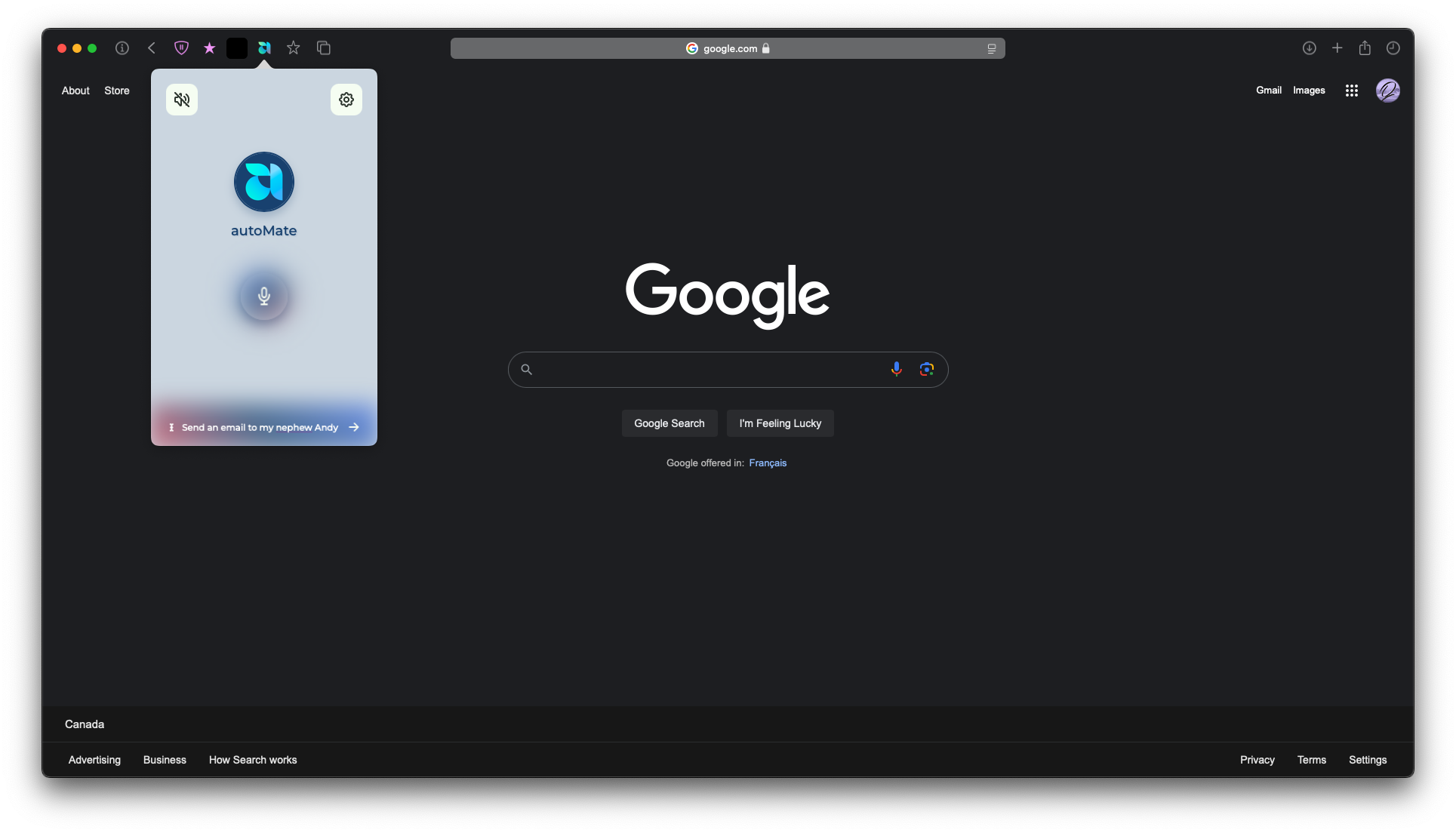
autoMate is an AI-powered web-browsing assistant that allows users to perform tasks through natural language input or voice commands. Users can ask autoMate to perform tasks like:
- Searching for information (e.g., “Find my latest emails from Johnny”).
- Automating reservations, reminders, and more.
- Providing step-by-step transparency by explaining what actions it took to fulfill the request.
With the integration of Cohort for AI generation and Groq for voice recognition, autoMate also generates content dynamically and transcribes voice commands in real-time.
How we built it
autoMate was built using a combination of web development tools and AI frameworks:
- Frontend: Developed in React with Tailwind CSS for a simple and intuitive user interface. Compatible with multiple platforms including Chrome and Safari.
- Backend: Powered by Javascript and Express.js to handle AI requests and data processing.
- NLP and AI: Cohere was added for AI-powered content generation, while Groq was used for voice recognition.
- AR/VR Integration: autoMate adds outstanding experiences utilizing cutting-edge technologies of AR/VR using platforms like Apple Vision Pro.
Challenges we ran into
Integrating real-time voice recognition using Groq posed challenges around maintaining low latency and ensuring accurate transcription. Fine-tuning the NLP models to understand various natural language inputs while also responding correctly to voice commands was another hurdle. Lastly, designing a user interface that was both simple and powerful enough to cater to diverse tasks required several iterations.
Accomplishments that we're proud of
We’re proud of successfully integrating voice recognition and AI content generation into autoMate, making it both user-friendly and highly functional. Another highlight is the step-by-step transparency feature, which ensures users know exactly what the AI is doing, building trust in automation. We also achieved significant accuracy in interpreting user intent, even from spoken commands.
What we learned
Through this project, we learned a lot about the intricacies of combining AI technologies with real-time systems like voice recognition. We gained deeper insights into optimizing AI models for both speed and accuracy, especially when handling NLP tasks in both text and speech. Additionally, working on automation workflows highlighted the need to balance between user control and efficiency.
What's next for autoMate
The future of autoMate lies in further enhancing its learning capabilities, allowing it to personalize responses based on individual user preferences. We also plan to introduce more integrations, such as shopping assistance and automated document generation. Expanding multi-lingual support for both text and voice input is another priority, making autoMate accessible to a global audience. Lastly, improving the AI’s decision-making transparency to offer even more detailed action breakdowns will continue to be a core focus.
Built With
- apis
- cloud-services
- cohere
- databases
- express.js
- frameworks
- groq
- javascript
- platforms
- react
- tailwind


Log in or sign up for Devpost to join the conversation.