-
-
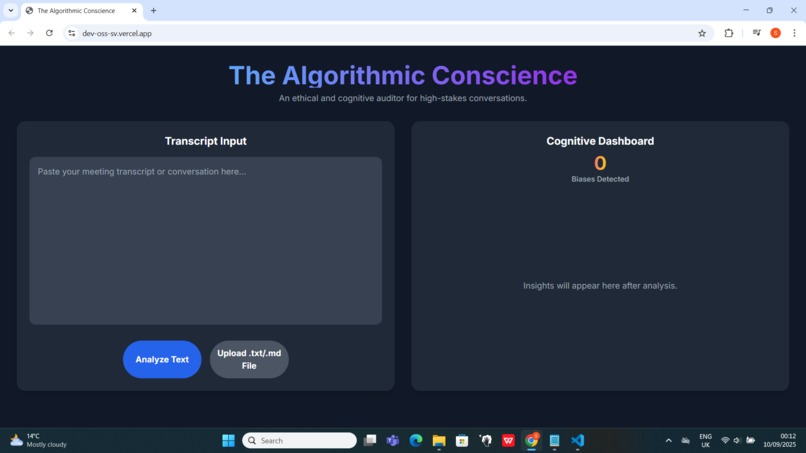
Initial Screen
-
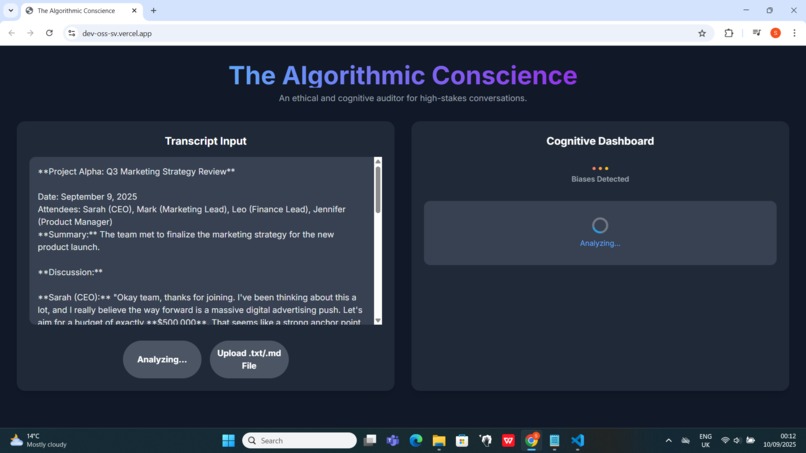
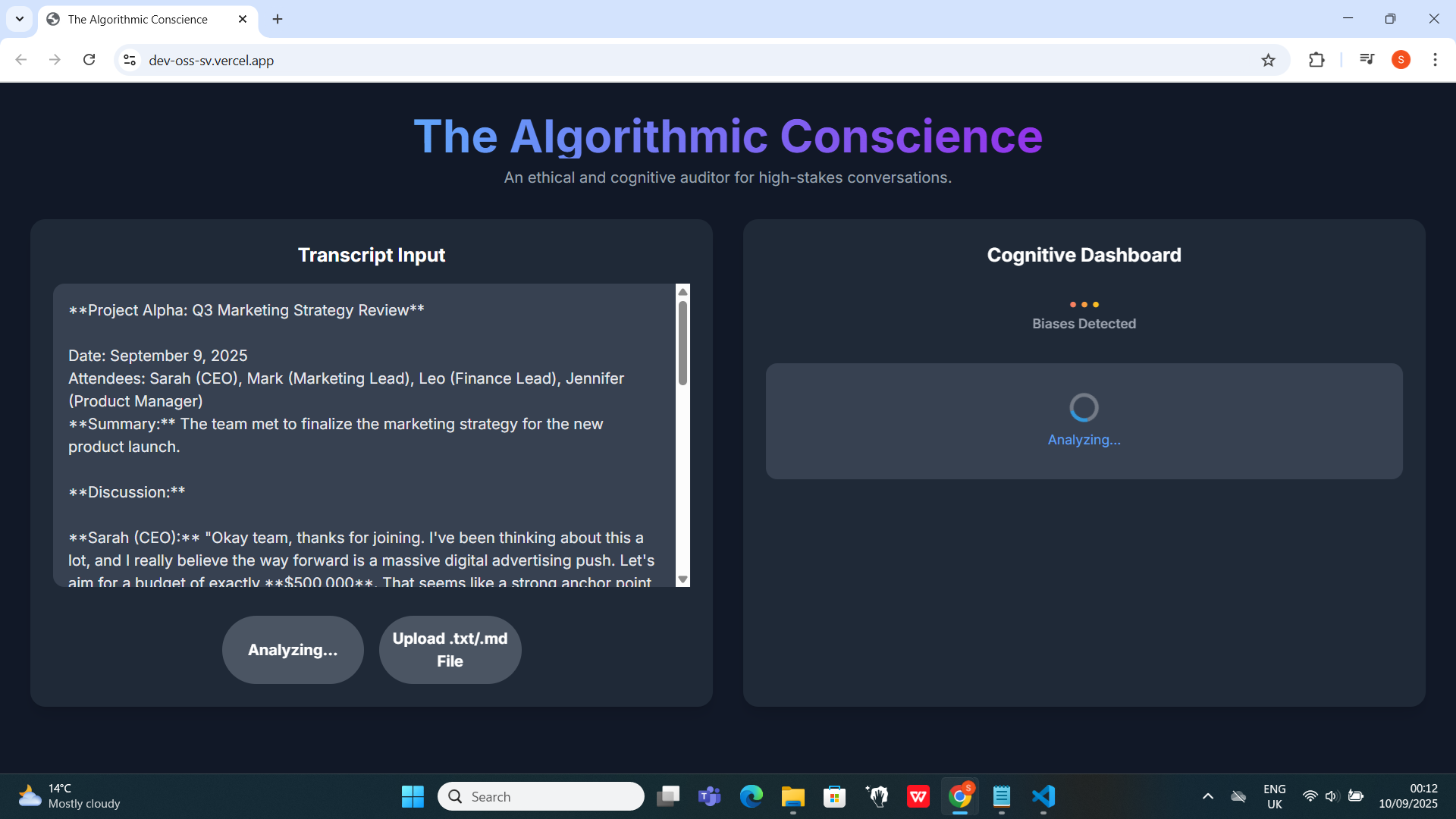
Analyzing
-
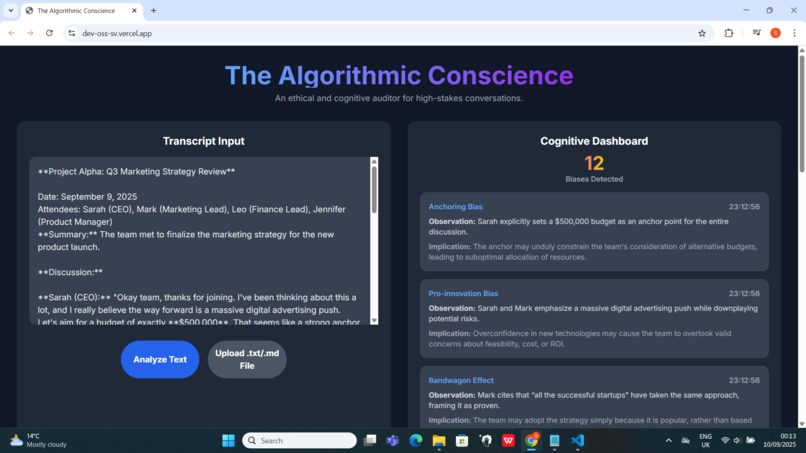
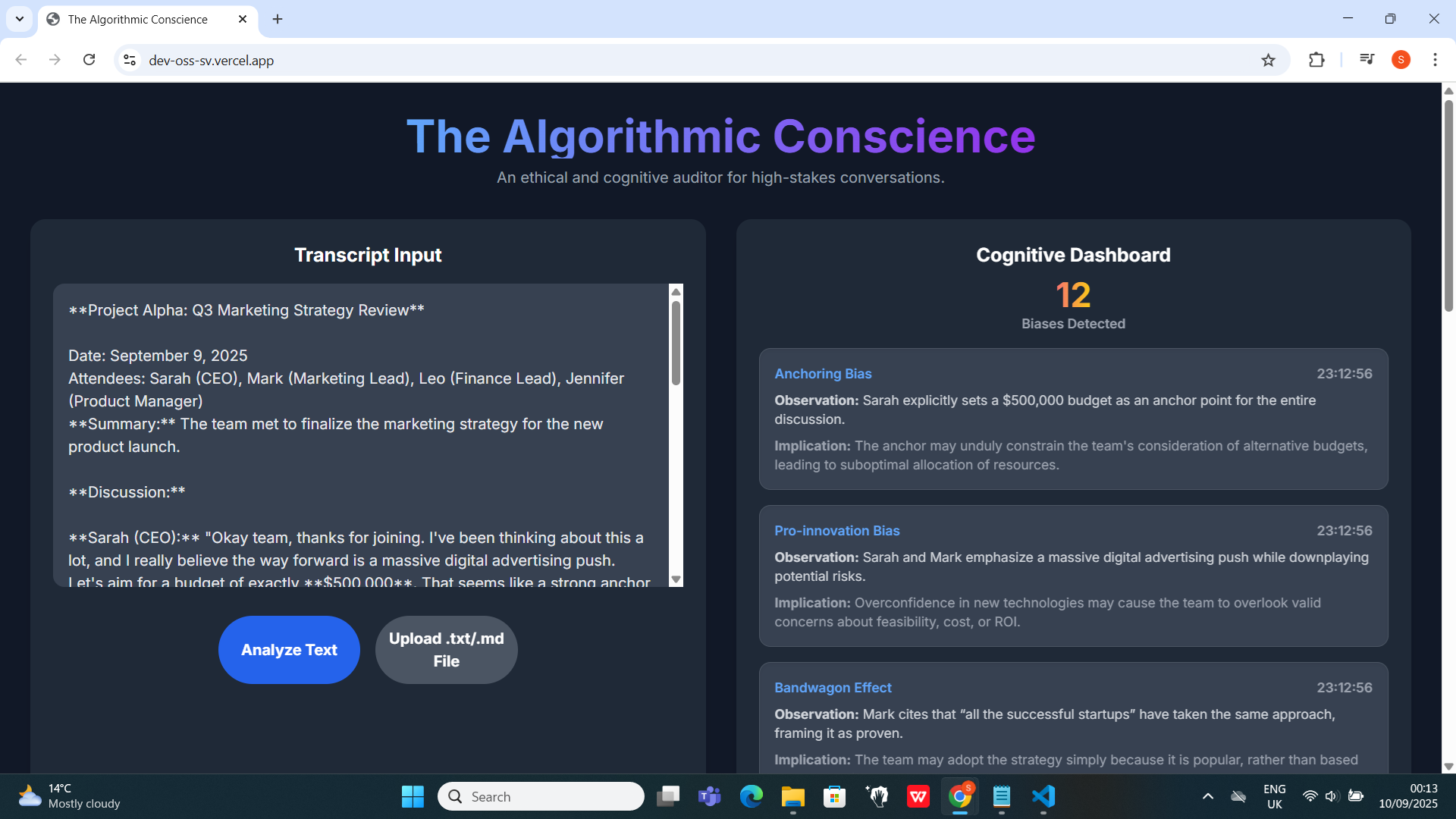
Results
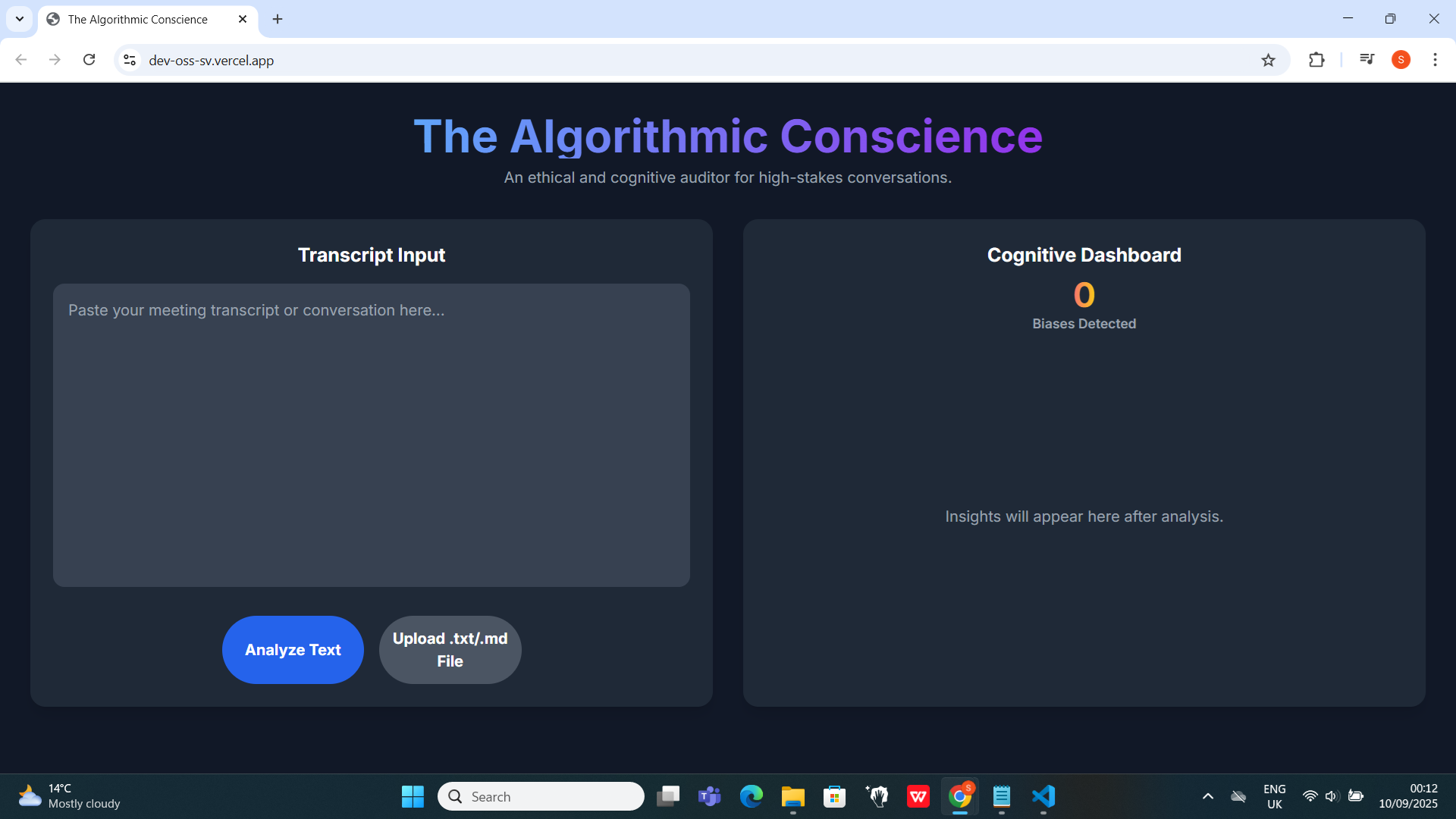
Inspiration
In high-stakes environments — boardrooms, legal negotiations, crisis response — decisions are often made under pressure, emotion, and uncertainty. I’ve seen firsthand how even brilliant teams can fall prey to groupthink, cognitive bias, and ethical blind spots. This inspired me to build The Algorithmic Conscience: a silent auditor that reflects and reveals what we might otherwise miss.
This project's impact is transformative. It turns a chaotic, emotion-driven discussion into an organized, data-supported decision-making process. By revealing our own biases and flaws, the Algorithmic Conscience empowers us to make smarter, more ethical, and ultimately better decisions in high-stakes situations. It represents a fundamental leap forward in what is possible when AI is used not as a replacement for human intellect, but as its silent partner.
What it does
The Algorithmic Conscience is a pioneering AI system designed for high-stakes professional environments like boardrooms, legal negotiations, and crisis management meetings. It acts as a silent, invisible participant that highlights systemic cognitive and ethical failures.
In a world where even a single flawed decision can have immense consequences, this project provides an essential safety net. It addresses fundamental human vulnerabilities like groupthink, logical fallacies, and emotional biases by providing a clear, unbiased, and objective view of the conversation as it unfolds.
How we built it
The Algorithmic Conscience is a single-file web application, designed for instant access and zero-friction deployment. This minimalist approach was a deliberate choice, prioritizing speed and accessibility. The project is built on the foundation of HTML, plain JavaScript, and Tailwind CSS.
The core of the application's intelligence is powered by the gpt-oss-20b model, accessed via the OpenRouter API. We used a highly specialized system prompt to transform this general-purpose language model into a focused, cognitive auditor. A custom JavaScript function handles the API call, sends the transcript, and receives the model’s JSON-formatted insights. This modular design makes the application's reasoning transparent and easy to extend.
Challenges we ran into
My primary challenge came from the real-world variability of API responses. While my initial design was built to handle a single JSON object, I quickly discovered that different API providers for gpt-oss-20b could return the same data wrapped within a JSON array. This inconsistency required me to build a more robust and flexible parsing mechanism that could automatically detect and correctly process both formats. This challenge became a key learning moment, highlighting the need for resilient code when integrating with diverse external services.
Accomplishments that we're proud of
I'm most proud of the project's core innovation: transforming a language model into a silent, ethical advisor. This moves beyond standard chat or summarization tasks and showcases the model’s true potential for complex analysis and abstract reasoning. I also successfully built a clean, single-file application with a modern, responsive user interface. This demonstrates that powerful applications don’t require complex frameworks or multi-file architectures, making my project incredibly easy to test, use, and share.
What we learned
I learned that with a finely tuned system prompt, an open model can be specialized to perform highly sophisticated, domain-specific tasks. The experience also taught me the importance of building for API resilience and accommodating unforeseen data formats. Ultimately, this project reinforced my belief that AI should serve as an extension of human intellect, providing silent support that empowers better decisions without replacing human judgment.
What's next for Algorithmic Conscience
The next phase of development focuses on enriching the Algorithmic Conscience with advanced psychological and business intelligence. By embedding principles from behavioral economics, organizational psychology, and strategic decision theory, I aim to evolve the system from a passive observer into a dynamic advisor that understands not just what is said—but why it’s said, and what’s left unsaid.
Psychological Insight Integration I plan to incorporate models of cognitive bias, emotional regulation, and interpersonal dynamics to better interpret the psychological undercurrents of high-stakes conversations. This will allow the system to flag not only logical inconsistencies but also moments of emotional escalation, manipulation, or avoidance—providing a fuller picture of the decision-making landscape.
Business Context Awareness By training the system on case studies, negotiation frameworks, and strategic planning methodologies, I’ll enable it to recognize business-specific patterns such as risk aversion, power asymmetries, and value misalignment. This will help users navigate complex scenarios like mergers, crisis response, and boardroom disputes with greater clarity and confidence.
Ethical Reasoning Expansion I’m also exploring ways to embed ethical frameworks—such as utilitarian, deontological, and virtue-based reasoning—so the system can surface not just what’s effective, but what’s right. This will be especially valuable in industries where decisions carry moral weight, such as healthcare, law, and public policy.
-Adaptive Feedback Mechanisms Future iterations will include real-time feedback loops that adapt to the personalities and communication styles of participants. This means the Algorithmic Conscience won’t just audit—it will learn and evolve with each interaction, becoming more attuned to the unique dynamics of each team or organization.
This next chapter is about moving from insight to foresight—from surfacing blind spots to actively guiding better outcomes. The goal is not to replace human judgment, but to elevate it with a deeper, more holistic understanding of the forces at play.
The Algorithmic Conscience is not just a tool—it’s a mirror, a compass, and a quiet revolution in how we think together
Built With
- css
- gpt-oss-20b
- html
- javascript
- openrouter-api
- tailwind-css

Log in or sign up for Devpost to join the conversation.