Inspiration
Auxilium means to aid and that's the basis for why we created our project.
We were brainstorming real-life issues, and within the pandemic, one of the major issues most people faced were their challenges with technology.
With online classes being our primary form of education throughout the pandemic, a lot of colleges have taken the initiative to provide their students with laptops - to help them stay engaged in their education.
However, the issue is with the allocation of these resources. A lot of these schools base their allocation on a first come first serve basis - and because of this often students who require it more, are unable to obtain/ avail this very important resource.
An example of this instance is, one of our friends recently lost their laptop, and required a laptop for the remainder of the semester, however, the wait time was predicted to be two months, whereas there are students who are receiving a secondary laptop for use, as they signed up for it first. With a limited supply and high demand, it is especially important that resources are distributed fairly.
The inspiration behind this is to promote an equal opportunity for everyone to be able to pursue their education.
What it does
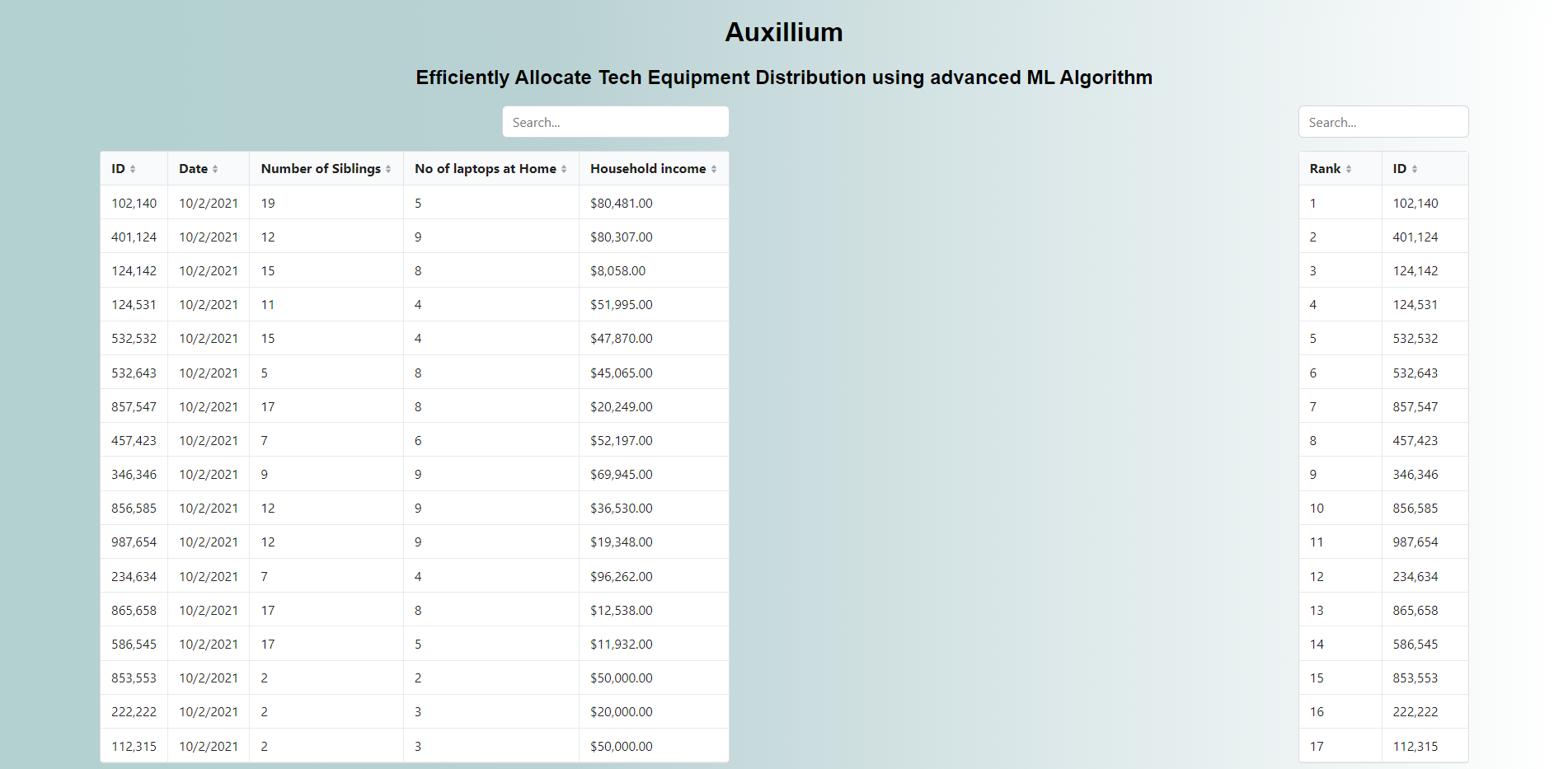
It is an algorithm that takes into account various factors such as, net household income, number of siblings in school/college within the household, and the number of available devices for use in the household, to determine a user's "need" for the laptop. And based on this, we rank them in terms of need and allocate available laptops/computers to users whose 'need' ranks are the highest.
How we built it
We implemented the ML Algorithm of Decision Trees, to help us determine need-based rankings from the attributes provided by the student/user/requestor. We developed this using Python, Scikit-Learn, Pandas, and ML.
For the database, we used AWS DynamoDb using Node.JS to store the data and pulled data using our database coded in SQL and NoSQL. Primarily because input by the user would ideally be on a server as opposed to a local file.
For the front-end, we used HTML, CSS, JavaScript, and jQuery, for information collection and appending that information to our dataset.
Challenges we ran into
There were hurdles along the way while making our vision come to life. The biggest challenge we faced was creating a final list that is to be generated using the algorithm stating the kids who needed the resources the most.
Accomplishments that we're proud of
We were able to solve a real-life problem that is present in our society, this is an issue that not only millions of others face in this world but a problem that the people on our team have faced ourselves.
Learning to implement modern technologies using AI to solve real-world problems.
What we learned
We learned that there is no limit to learning and even though most of us are seasoned programmers, there is still a lot we need to constantly learn and keep learning in order to solve the problems present in our society.
We also learned how to implement binary decision trees for intervals to classify a multi-parameter dataset. In addition to that, we also learned how to make hyper-parameter tuning for decision trees.
What's next for Auxilium
We want to implement the following steps:
-We want to be able to create a new algorithm that will let us help the students better by classifying them according to their needs i.e. a student who needs a laptop for coding would require a laptop with more specs
-We want to generalize our algorithm to read forms such as the FAFSA to make it easier for college students to make it more fair and equal on who gets what amount of aid.
- We want to partner with as many government and non-profit organizations who are involved in the education industry to help them expand their reach.


Log in or sign up for Devpost to join the conversation.