-

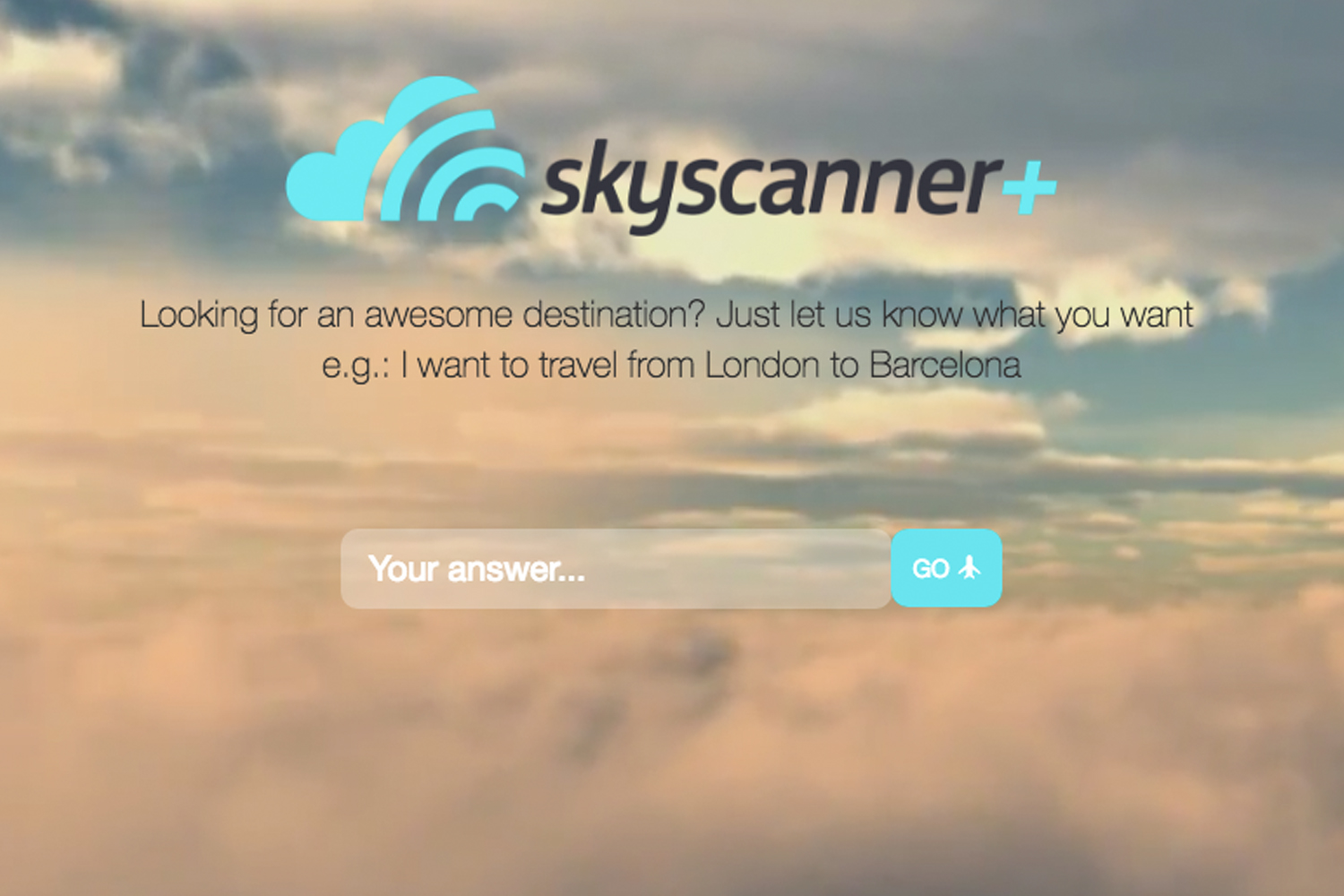
Our main website page
Inspiration
We are 4 students coming from London, who use a lot Skyscanner. Even though for us it is very simple to use and straight forward, our parents find difficult to use this awesome search engine. We tried to make the process of searching much easier, translating the natural processing language into information used by Skyscanner API to find the best 3 options. It is also a way for persons with disabilities to use Skyscanner, through our voice recognition and voice response functions.
What it does
The customer start a conversation with the bot by telling the departure city, the destination and the period of travelling. For example, if a client says "I want to travel from London to Barcelona from 6th of October to 9th of October 2016." Obviously, this example is not enough in order to complete a flight search. As a result, our bot start a conversation with the client, in order to fill all the information required, such as number of people flying and currency used. After a short interaction between the bot and the client, you can complete the booking process on Skyscanner. It is free for all Skyscanner users. Furthermore, we added a voice recognition function, in order to be more user-friendly or more suitable for persons with disabilities. In this case, the interaction between the bot and client will be made verbally.
How I built it
The front-end is constructed with Bootstrap, using html, css and js. The backend uses Rosetta API, in order to "decode" the natural language and to recognise key words, such as the outbound and inbound date and the locations. All these information are integrated with the Skyscanner API, in order to find the best 3 options available at the moment of search. We used python for this part. Furthermore, the data is transmitted cross-domain using heroku, flask and python through a XML HTTP request.
Challenges I ran into
- What to start with - initially it was quite hard to find a way to create the solution and we had to brainstorm different ways of
- Lack of information - Razvan is the only one who knew to work with heroku and servers. As a result, for the rest of us was challenging to understand the code and how to create our codes, such that everything to match. He also met lots of difficulties creating only for the second time a server. Oana and Cristian were the one in charge with the backend and with understanding the Skyscanner API and implementing the NLP software. For Ana, this was her second hackathon and considering the fact that she has an Economics background, was quite challenging to learn as much as possible in such a limited time.
- Lack of experience - we all 4 have a limited experience and was difficult to understand bits of code and how to integrate the API.
- Tiredness - well, we all traveled from London on Friday morning and woke up at 3am. As a result, it was a bit challenging for us to meet all our goals, with only some hours of sleep during those 3 nights.
- Health - we do not know how, but all 4 of us caught a cold during our stay in Barcelona.
Accomplishments that I'm proud of
Well, first of all, one hour before the deadline we had a huge list of errors and our biggest accomplishment is that our web application at least run! Second of all, learning so many things in such a limited amount of time was another accomplishment, especially because we set high goals as a team. We also had a bit of time to implement the speech recognition and voice response, which helped us focus also on the social impact of the application. As a result, we are really proud of this implementation.
What I learned
Razvan: "I learnt a lot more about servers! I spent more than 9 hours building our HTTP requests and debugging the program. Furthermore, I learnt how to work faster and more accurate. Because I was the one in charged with the Control part, I had to combine all 4 codes in the last few hours and together to debug the application - thing which, believe me, it's quite challenging and stressful." Oana & Cristian: "We worked together for the backend, using the four APIs: two from Skyscanner, Rosetta and an IP recognition API. As a result, we had to get through thousands of lines of code and to find the most efficient solutions for our problem. I do believe that the main thing we learnt from this experience was to debug quickly and to write more clearly, in order to understand what we have done and how to use our code." Ana: "Well, this was the second time I have ever coded, so, it was quite challenging for me to construct the website and to learn as much as possible from my colleagues. It is self explanatory that 90% of what I have done those 36 hours I learnt on the spot: basics of html, css, js and how to build a website from the scratch."
What's next for SkyscannerPlus.tech
Making the code more efficient and solving the server problems will be the next step. Furthermore, we are aware that we missed many types of interaction in our code and we have to develop it. We also have to learn more about speak recognition softwares and how to make a greater use of them. Taking into consideration that all 4 of us are from London and that we are really good friends, we would like to improve the application and even to make it public in the near future.
Built With
- .tech
- css3
- flask
- heroku
- html5
- java
- javascript
- python
- skyscanner
- speak-recognition


Log in or sign up for Devpost to join the conversation.