Inspiration
I guess the idea came mostly subconsciously to me; it just popped into my head when my team was discussing ideas and it seemed cool. I suppose I thought of the idea after Google Cardboard; Virtual Reality is still one of those fields where someone needs hundreds of dollars to pursue and develop in the field, but Google Cardboard lets anyone make a quick add-on to their phone for a few dollars that helps them get almost the same experience. 3D printers still cost hundreds today; maybe, if someone can build it at home on their own with very few trips to a hardware store (essentially none for sufficiently involved hobbyists), the cost of the printer can be reduced to 20 or 30 dollars. Of course, the end product won't be any Makerbot, but it could be good enough to produce basic products and perhaps bootstrap's one's way to a better printer.
The design's based on the Prusa i3 (loosely) from RepRap since it has a relatively simple design.
What it does
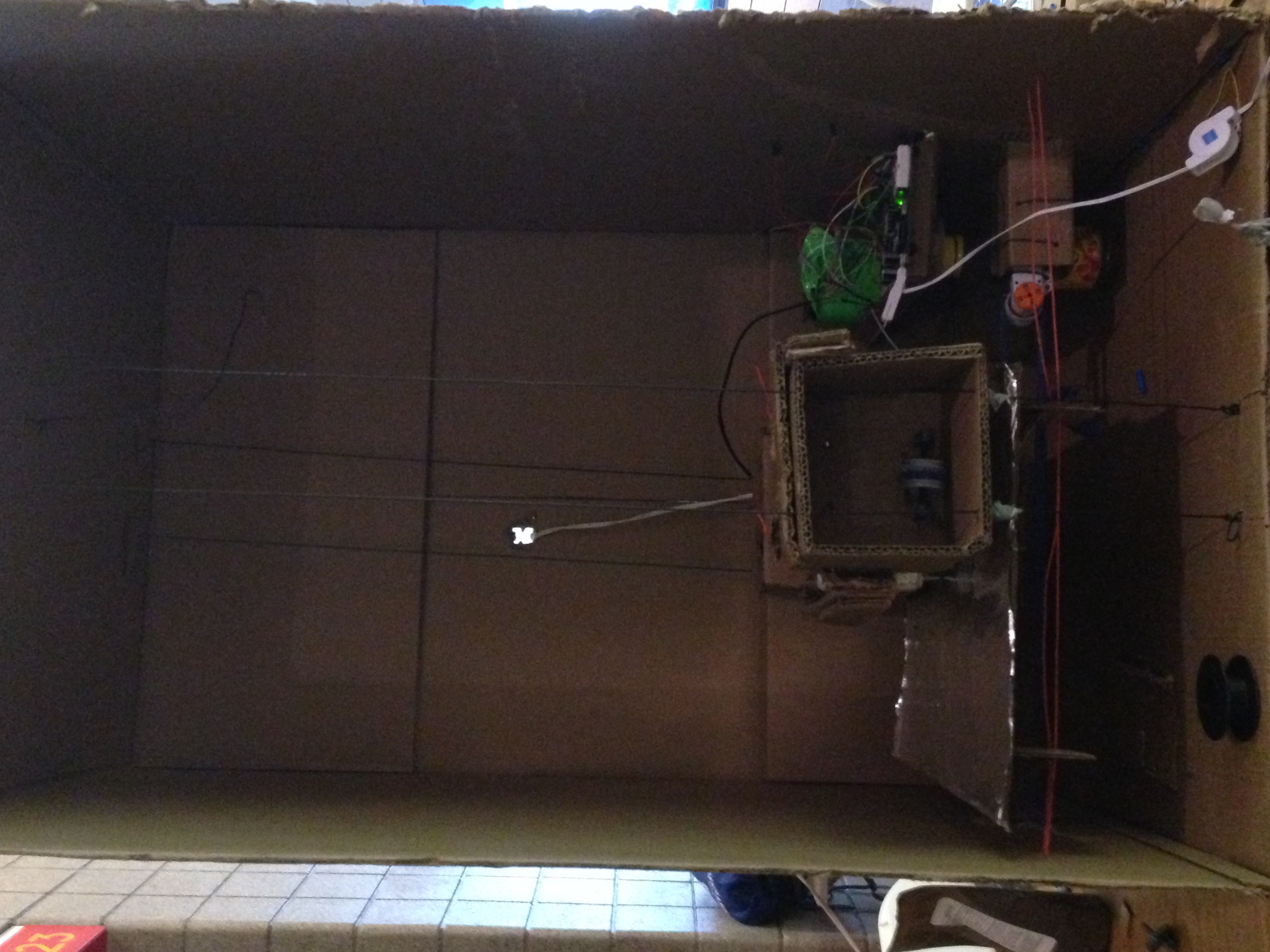
It's a really ratchet-looking 3d printer that's not very accurate--basically an attempt at a 3d printer thrown together with parts around PennApps and some things we brought along beforehand. In reality it's only 2d right now because a planned motor broke and we have no spares, but the printer's well-capable of 3d and can easily configured to do so should we have had a spare NXT motor.
How I built it
With some really shady parts--we took used cardboard boxes from sponsors and made them our base material. Hot glue was the element of choice for bonding together parts. Not sure if I should mention this, but special thanks to the sponsors that unknowingly gave us an XL shirt, which we ripped up to create our moving belts--sorry and thanks! Our project wouldn't be possible without your wonderfully stretchy shirt.
A lack of string and packaging tape at PennApps forced us to use plain old wire and gobs more hot glue in replacements. Note to PennApps: we'd like if you could include these items in the future. Motors and associated things (e.g. H-bridges) would be nice too!
Teammates brought along tools, electronics, and parts for other things, but only sparingly--we use a single microcontroller (the BASIC stamp) based on a PIC and an H-bridge, and the rest is jumper wires. We used NXT motors, but they're effectively very simple DC motors at heart and with a bit more electronics, plain old two-wire DC motors could probably be used. The BASIC stamp comes for around $50 retail, but if this kit were to be in production it would just ship with a single pre-programmed PIC, so the cost would come down quite a bit. No soldering was done; all things were put together on a breadboard.
Challenges I ran into
The extruder mechanism in most 3d printers is complicated, and due to a lack of time we were unable to develop a system that could autonomously handle extrusion with the servos available to us. So we manually feed our extruder.
During the development of a circuit that allowed the printer's motors to diverse direction, a weird set of issues and "ghost voltages" that popped up during the troubleshooting process. We were eventually given advice to switch to an H-bridge.
One motor has become mysteriously clogged, preventing its movement, so we couldn't make it a 3d printer! It's instead only able to print in 2d (but if we had a replacement, easily scalable to 3d). For now, all our prints are single or double-layer.
Accomplishments that I'm proud of
Actually finishing this thing. Goddamn. I have a Prusa I recently ordered at home that came half-assembled, and I haven't been able to assemble it in 5 days; I'm shocked we were able to throw something together functional from scratch in 36 hours.
What I learned
Yeah, aside from finishing the monster project, I'm glad we learned a lot about the interfacing of seemingly disparate technologies (e.g. BASIC stamp and NXT motors). We also became super resourceful (running all the way around PennApps several dozen times for parts) and have a greater understanding of 3d printing mechanics.
What's next for Ratchet 3D
I'd really like to see an extension of this concept as a norm for 3d printing in the future. Perhaps a plan for the construction could be open-sourced; similar to Google cardboard, it's even possible that we will be able to make printable template overlays on top of the cardboard.
Built With
- basic-stamp
- cardboard
- lego
- nxt

Log in or sign up for Devpost to join the conversation.