Inspiration
We love playing Settler's of Catan with the guys in our college dorm, but we know how frustrating it is to start a game of Catan only to find that the starting location you chose has pushed you into a corner or handicapped your resource production.
What it does
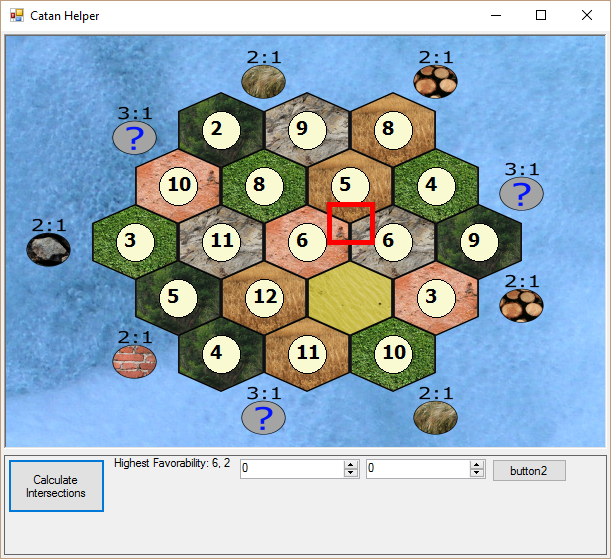
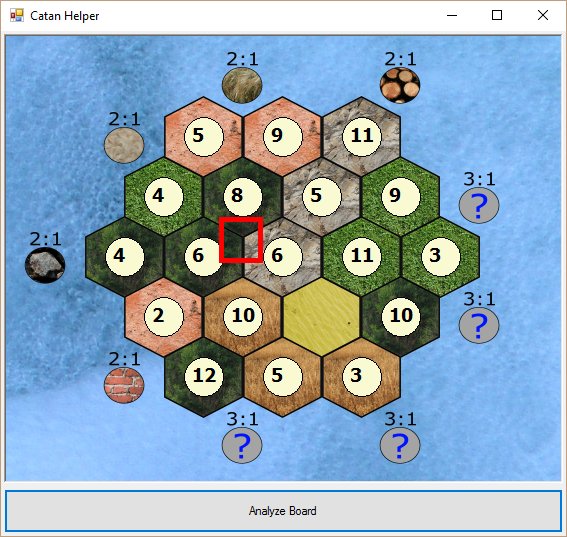
Catan Companion suggests a favorable starting location based on a given Settler's of Catan board configuration.
How we built it
We used C# and Windows Forms to construct a custom UI component that allows the user to construct any possible Settler's of Catan terrain variation.
Challenges we ran into
Representing hexagonal tiles in a two-dimensional coordinate system was tough. Calculating from code which hexagons composed each intersection was a significant obstacle. Most of our time was spent constructing the groundwork required to represent the Settler's of Catan gameboard in code. As a consequence, we had less time to refine the actual algorithm that selects strategic starting locations.
Accomplishments that we're proud of
The user interface turned out pretty well, given our limited experience. We managed to make it scalable without any major issues.
What we learned
Vance was new to C#, Windows Forms, and version control, and developing Catan Companion provided plenty of practice manipulating UI componenets, writing classes, and managing source code.
What's next for Catan Companion
We'd like to add more sophistication to the criteria used to judge potential embark locations as well as increase the number of favorable locations shown. Now that we have built the framework with which to interpret the game's components, the only limit to Catan Companion's effectiveness is our own strategic analysis of the game's interacting systems.
Built With
- c#
- visual-studio
- windows-forms


Log in or sign up for Devpost to join the conversation.