-

Main Landing Page Top
-

Main Landing Page Bottom
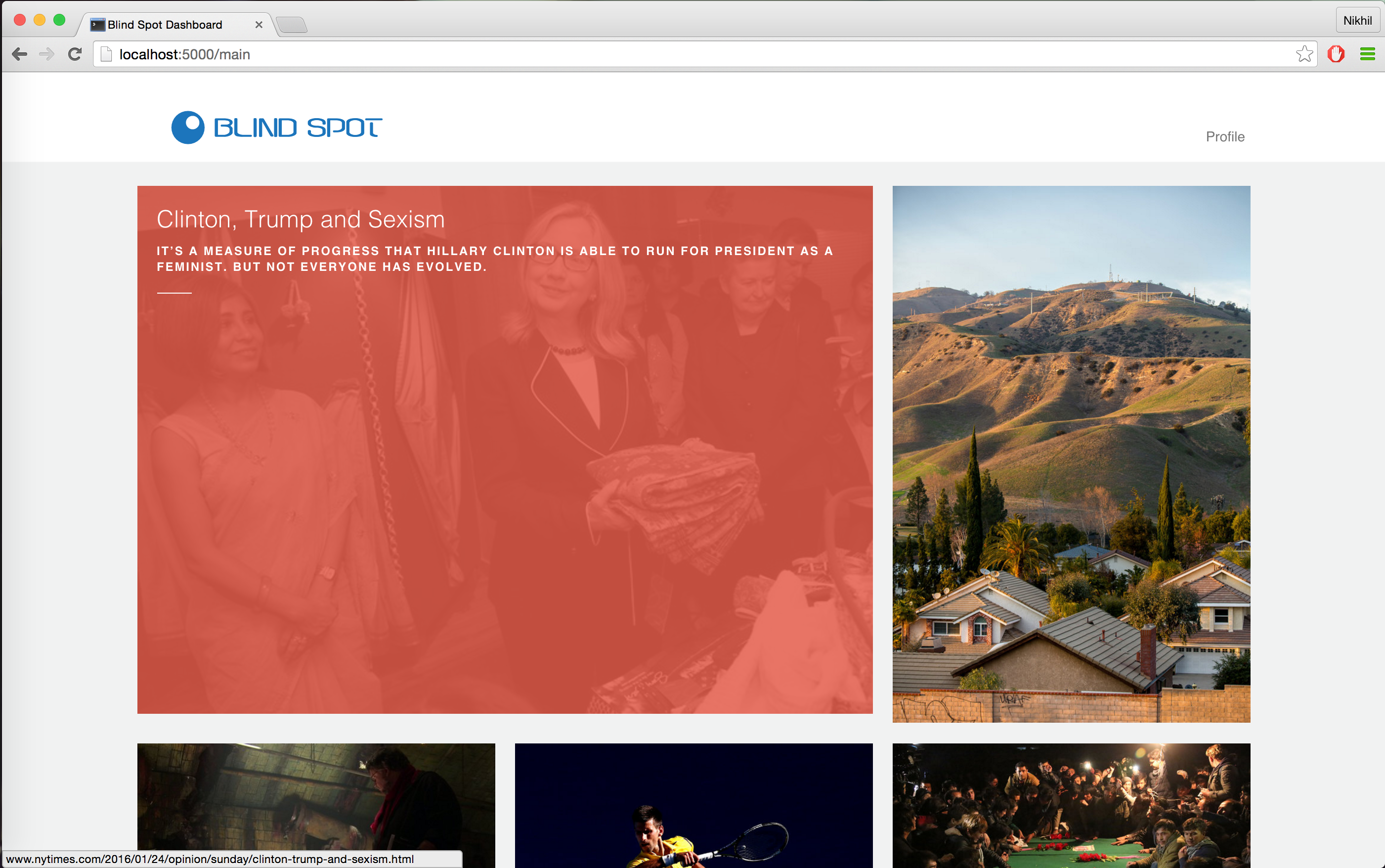
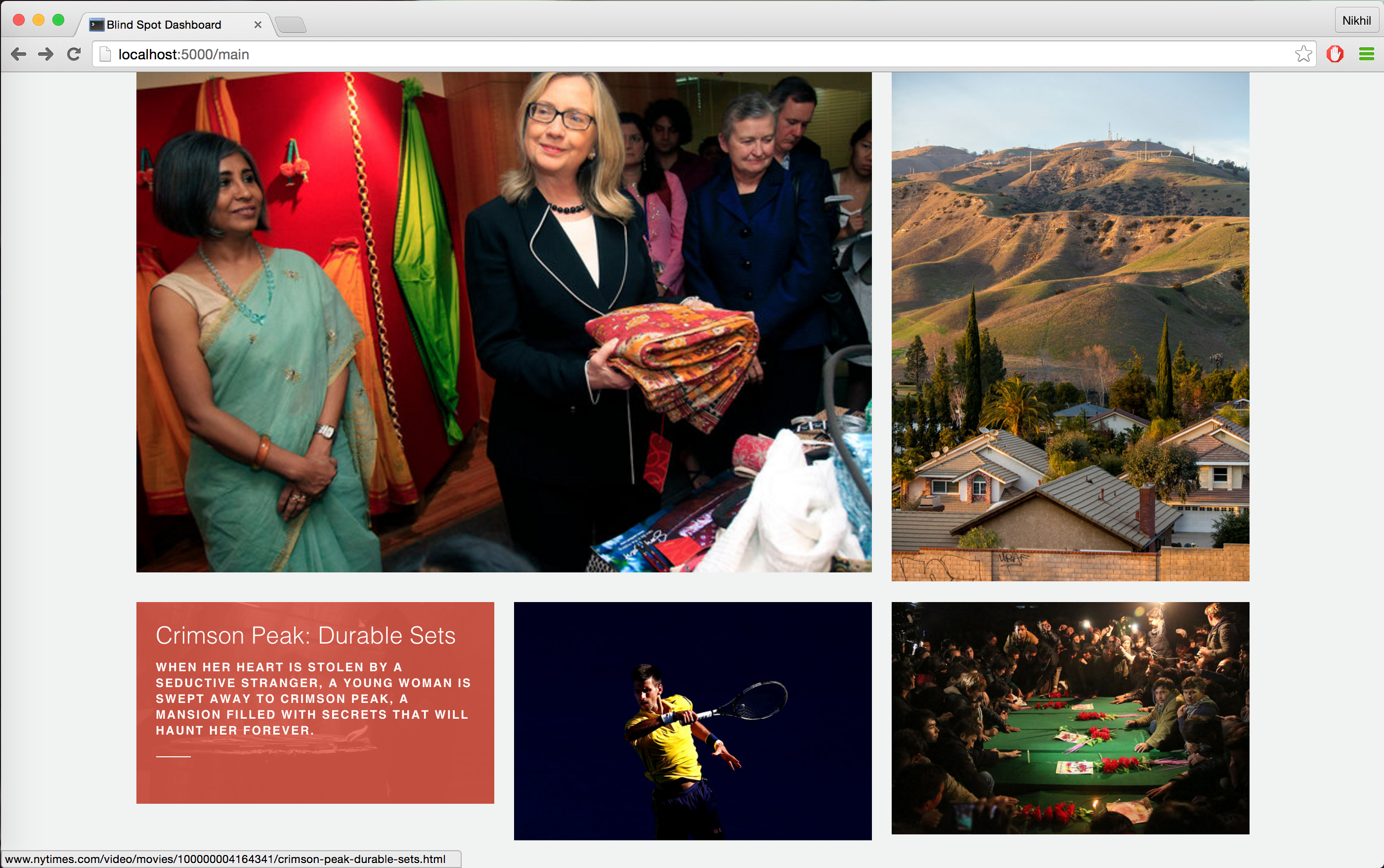
Inspiration
We are surrounded by media, yet in today's hyper-polarized world with unlimited choices, many people seem to gravitate to certain sources and topics. We believe there is great social value in expanding our perspectives and learning new things.
What it does
Blind Spot was build to leverage machine learning against confirmation bias, a common phenomenon that allows people to overlook their own blind spots. Many traditional news aggregators focus on learning user preferences and tailoring the media experience to what the user already likes. Our aggregator, in contrast, learns user preferences and then uses them to make horizon expanding suggestions. For example, imagine you are someone who is liberal leaning and interested in natural sciences. Imagine what you might choose to read on the topic of GM foods. If you already view GM technology with skepticism, would you choose to read an informative science piece on its merits? Blind Spot aims to provide pieces like this; news that is grounded in what you already have interest in, but simultaneously seeks to intersect with new domains.
How we built it
The web app works by comparing aggregated news articles of the day from The New York Times to a database of word-topic associations. Articles are classified along various topical dimensions (e.g. environmental science, performance art, national politics) within larger sections (e.g. science, art, politics). This classification is done by a machine-learning algorithm trained on a corpus of over 170,000,000 words that produces a similarity index for the article across all dimensions. The article is then tagged by its most likely subject area. A user of Blind Spot receives suggestions that are made based on a combination of their recorded preferences and the novelty of a topic.
Future development
In the future, we want to build functionality that allows user feedback to be actively and passively collected. E.g. a click is a small upvote in the user's preference database, an active like would be a larger upvote, and an active dislike would be a downvote. It is also possible to make this a more comprehensive aggregator that would pull from diverse sources, allow for the capability to pin articles to read later, and provide a visual map of the user's current media consumption.

Log in or sign up for Devpost to join the conversation.